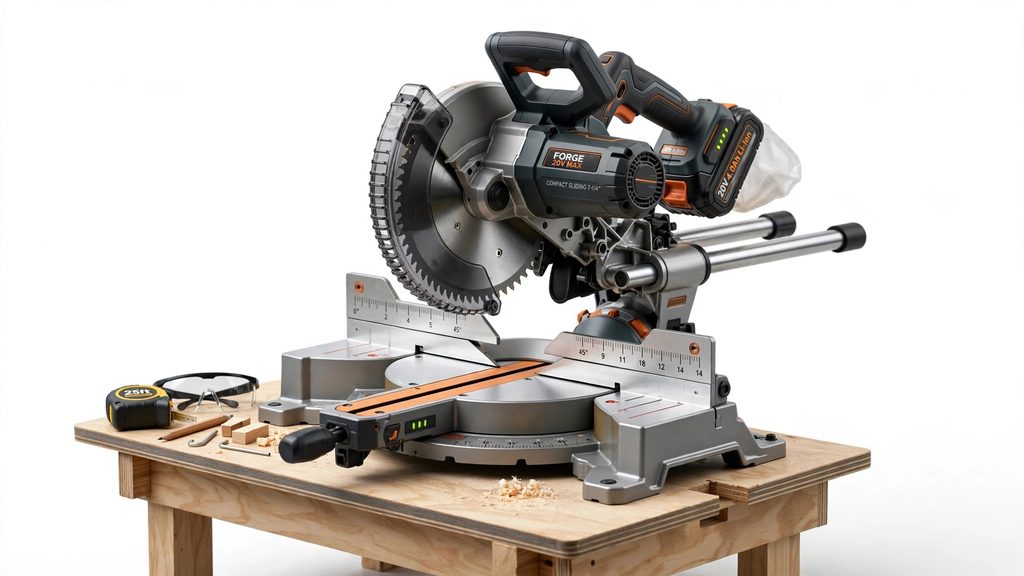
A miter saw can be one of the most useful power tools in a small garage workshop. It makes crosscuts, miter cuts, and compound cuts much faster than a circular saw, but there is one problem: traditional miter saw setups can take up a surprising amount of space.
That matters even more in a one-car garage.
When your workshop also needs to accommodate a vehicle, bicycles, storage shelves, or other tools, a large miter saw and permanent stand can quickly become an obstacle. The goal is not to buy the biggest saw available. It is to find a model that gives you enough cutting capacity without taking over the garage.
For many DIY woodworkers, trim installers, and homeowners, a 10-inch compound miter saw offers a practical middle ground.
For this type of workspace, the DEWALT DWS713 10-Inch Single-Bevel Compound Miter Saw is a particularly interesting option because it combines a 10-inch blade, 15-amp motor, relatively portable design, and useful capacity for common garage projects. DEWALT lists 14 positive miter stops, a tall sliding fence, and a built-in carrying handle among its features.
Best Compact Miter Saw for a Small Garage
DEWALT DWS713 10-Inch Single-Bevel Compound Miter Saw
Amazon Category: Tools & Home Improvement → Power Tools → Saws → Miter Saws
The DWS713 is a fixed, single-bevel compound miter saw rather than a sliding model. That distinction is important in a small garage because you are not only choosing a blade size—you are also choosing how much workspace the saw requires.
DEWALT DWS713 Specifications
| Feature | DEWALT DWS713 |
|---|---|
| Blade size | 10 inches |
| Motor | 15 amp |
| No-load speed | 5,000 RPM |
| Saw type | Single-bevel compound |
| Power | Corded |
| Bevel range | 0°–48° left, 0°–3° right |
| Miter detents | 14 positive stops |
| 90° crosscut capacity | 2×6 dimensional lumber |
| 45° crosscut capacity | 2×4 dimensional lumber |
| Fence | Tall sliding fence |
| Dust collection | Dust bag included |
| Carrying handle | Yes |
| Warranty | 3-year limited warranty |
These specifications are based primarily on DEWALT’s published product information and instruction manual.
Why a 10-Inch Miter Saw Makes Sense in a Small Garage
A 10-inch miter saw can be a practical choice when most of your projects involve ordinary lumber, trim, molding, shelving components, and smaller woodworking projects.
You do not necessarily need the cutting capacity of a 12-inch sliding miter saw just because you have a garage workshop.
The important question is what you actually plan to cut.
For example, a small workshop may regularly involve:
- 1× dimensional lumber
- 2×4 lumber
- 2×6 lumber
- Baseboards
- Window and door casing
- Trim
- Molding
- Shelving components
- Picture frames
- Small furniture parts
- Flooring materials
- DIY repair projects
The DWS713 is designed around this type of work. DEWALT specifically lists a 2×6 crosscut capacity at 90° and a 2×4 capacity at 45°.
That also tells you where its limitations begin.
If your projects regularly require cutting wide boards such as 2×10 or 2×12 lumber in a single pass, a larger sliding miter saw may make more sense.
Fixed vs. Sliding Miter Saw for a Small Garage
This is one of the most important decisions when choosing a miter saw for limited workshop space.
A fixed compound miter saw keeps the cutting head in a fixed position. A sliding compound miter saw adds rails that allow the blade assembly to move forward and backward.
The sliding design increases crosscut capacity, but it can also complicate a small workshop layout.
Fixed Miter Saw
A fixed saw can make sense when you primarily cut:
- Trim
- Baseboards
- 2×4 lumber
- 2×6 lumber
- Small furniture components
- Shelving pieces
- Molding
- Framing components
The DWS713 falls into this category.
Sliding Miter Saw
A sliding saw is more useful when you regularly need to cut wider boards.
However, the rails and additional movement can require more planning around the workbench and wall behind the saw.
That is why a larger sliding model is not automatically the better choice for a one-car garage.
Current small-shop buying guides also emphasize the importance of footprint and rear clearance rather than judging a miter saw only by its maximum cutting capacity.
How Much Space Does a Small Garage Miter Saw Need?
The physical dimensions of the saw are only part of the equation.
You also need room for:
- The operator
- Long boards
- Material support
- Miter adjustment
- Bevel adjustment
- Fence movement
- Dust collection
- Safe hand positioning
- Storage when the saw is not being used
This is where a compact workstation becomes more important than simply buying a compact saw.
A miter saw sitting on a permanent full-size stand may consume much more usable garage space than the saw itself.
For a one-car garage, consider a setup that allows the saw to be:
- Mounted on a folding stand
- Mounted to a compact workbench
- Attached to a mobile cart
- Stored against a wall when not in use
- Mounted to a removable plywood base that can be clamped to a work surface
The DWS713’s carrying handle also makes repositioning easier when you need to clear the garage. DEWALT specifically describes the design as lightweight and portable.
What Can the DEWALT DWS713 Cut?
The DWS713 is not designed to compete with large sliding saws on maximum capacity.
Instead, its strength is handling common cuts without requiring a large 12-inch sliding platform.
DEWALT rates the saw for a 2×6 crosscut at 90° and a 2×4 crosscut at 45°. Its tall sliding fence is designed to support baseboard and other taller material.
That makes it appropriate for many common garage projects.
Good Applications
The DWS713 can make sense for:
- Baseboard installation
- Door and window casing
- Trim work
- Flooring projects
- Shelving
- Small furniture
- Framing repairs
- General DIY woodworking
- Cutting dimensional lumber
- Molding projects
For a hobbyist who primarily works with standard boards and trim, that capacity may be enough.
DWS713 Miter and Bevel Adjustments
The DWS713 has a stainless-steel miter detent plate with 14 positive stops.
These stops allow you to quickly move between commonly used angles rather than manually setting every angle from scratch. DEWALT also specifies a 0°–48° bevel range to the left and 0°–3° to the right.
The saw is single-bevel, so it does not tilt equally in both directions like a dual-bevel model.
That is not necessarily a problem for a small garage.
If you mainly make ordinary crosscuts, basic miters, and occasional compound cuts, single-bevel operation may be all you need.
Single-Bevel vs. Dual-Bevel for DIY Woodworking
A dual-bevel saw is more convenient for repetitive compound cuts because you can tilt the blade in either direction without flipping the workpiece.
That can be valuable for professional trim work and complex crown molding installations.
For occasional DIY projects, however, the extra capability may not justify choosing a larger or more expensive machine.
The DWS713 is better suited to users who prioritize:
- Compact equipment
- Portability
- Straightforward operation
- Standard trim work
- General DIY projects
- Lower space requirements
If your work consists primarily of complex crown molding or repetitive compound cuts, a dual-bevel model deserves consideration instead.
Dust Collection in a Small Garage
Dust collection becomes more important as your workshop gets smaller.
A miter saw can send sawdust onto the bench, floor, nearby tools, and storage shelves. In a one-car garage, that dust can quickly spread across the entire workspace.
The DWS713 includes a dust bag, which is useful for basic cleanup. DEWALT lists the dust bag among the included accessories.
For frequent woodworking, however, connecting the saw to a suitable shop vacuum can make cleanup easier.
A compact dust-collection setup also makes sense because you do not want a large dust extractor consuming the same limited floor space you are trying to save.
Portable or Permanent Miter Saw Setup?
There is no single correct setup for a small garage.
Your choice should depend on whether the garage must remain available for parking.
Permanent Workbench Setup
A permanent setup works well if the garage is primarily a workshop.
The advantage is convenience. You can leave the saw calibrated and ready to use.
The disadvantage is that the workbench permanently occupies floor or wall space.
Folding Stand
A folding stand can be a better solution when the garage has multiple uses.
You can bring the saw into position when working and move it out of the way afterward.
Mobile Cart
A mobile cart can provide a useful compromise.
The saw stays mounted to a dedicated platform, but the entire setup can be rolled into a storage position when you need more room.
Removable Workbench Setup
Another option is to mount the saw to a sturdy plywood base.
The base can then be clamped securely to a workbench when needed and stored afterward.
DEWALT’s manual specifically describes mounting the DWS713 to plywood as one way to enhance portability.
For a one-car garage, this approach can be particularly practical.
Compact Miter Saw vs. 12-Inch Miter Saw
A 12-inch saw is not automatically better simply because it has a larger blade.
The larger saw may offer more cutting capacity, but you have to decide whether you actually need that capacity.
| Feature | 10-Inch Fixed Miter Saw | 12-Inch Sliding Miter Saw |
|---|---|---|
| Physical size | Generally smaller | Generally larger |
| Wide-board capacity | More limited | Usually greater |
| Portability | Easier | Usually more difficult |
| Storage | Easier | Requires more space |
| Trim work | Very good | Very good |
| 2×4 / 2×6 work | Well suited | More than adequate |
| Large boards | Limited | Better suited |
| Small garage | Strong fit | Depends on workspace |
| Rear clearance | Simpler setup | Can require more planning |
The key point is that the smaller saw should match your cut list.
If you rarely cut wide stock, buying a much larger saw may simply consume space that could be used for another tool or storage.
When the DWS713 May Not Be the Right Choice
The DWS713 has a sensible profile for a small garage, but it is not the right solution for every woodworker.
Consider another type of miter saw if you regularly need to:
- Crosscut very wide boards
- Cut large crown molding
- Make repeated complex compound cuts
- Process large framing material
- Cut wide boards in a single pass
- Use dual-bevel operation frequently
Its fixed single-bevel design is one of its biggest limitations compared with larger sliding and dual-bevel models.
The DWS713’s published 2×6 capacity at 90° is useful for many DIY jobs, but it should not be confused with the wider capacity offered by a sliding saw.
Who Should Buy the DEWALT DWS713?
The DWS713 makes the most sense for a garage woodworker who wants a conventional 10-inch miter saw without moving into a large sliding setup.
It is particularly suited to someone who:
- Has a one-car garage
- Needs to move the saw after use
- Works mostly with trim and dimensional lumber
- Builds small woodworking projects
- Does occasional home improvement work
- Wants a corded 10-inch saw
- Does not regularly cut very wide boards
The combination of a 10-inch blade, 15-amp motor, 5,000 RPM speed, 14 positive stops, and carrying handle gives it a useful balance for this type of workshop.
Who Should Look for a Different Miter Saw?
A different model may be more appropriate if your workshop is centered around larger woodworking projects.
For example, someone who regularly cuts wide boards may benefit more from a sliding compound miter saw.
Likewise, professional trim installers who make hundreds of compound cuts may prefer a dual-bevel model for workflow efficiency.
The important distinction is that compact does not mean universally better.
A compact saw is better when its capacity matches your projects.
Small Garage Miter Saw Buying Checklist
Before buying a miter saw for a small workshop, check these factors:
1. Blade Size
A 10-inch blade is often a useful starting point for a compact garage.
2. Cutting Capacity
Do not judge the saw only by blade diameter. Check the manufacturer’s actual capacity for the material and angles you plan to cut.
3. Fixed or Sliding
If you mostly cut trim and standard dimensional lumber, a fixed saw may be enough.
If you frequently cut wider boards, look at sliding models.
4. Bevel Direction
Single-bevel models are simpler, while dual-bevel models can be more convenient for repetitive compound work.
5. Weight
A lighter saw is easier to move when your garage serves multiple purposes.
6. Storage
Think about where the saw will go when you are not using it.
7. Workpiece Support
Long boards still need support even if the saw itself is compact.
8. Dust Collection
A dust bag is useful, but a shop vacuum can be more practical for frequent garage woodworking.
9. Electrical Requirements
The DWS713 uses a corded power source, and its manual specifies a 120-volt AC electrical connection.
10. Safety Clearance
Never sacrifice safe operating space just to make the saw fit into a smaller corner.
Safety Tips for Using a Miter Saw in a Small Garage
A small workspace requires more attention to safe positioning.
Keep the area around the saw clear and make sure long material is properly supported.
Before cutting:
- Check that the blade guard operates correctly.
- Secure the saw to a stable surface or stand.
- Clamp material when appropriate.
- Keep your hands away from the blade path.
- Never cut material freehand when it should be secured.
- Allow the blade to reach operating speed before cutting.
- Do not reach behind the blade.
- Keep the work area free from clutter.
- Wait for the blade to stop before moving the workpiece.
- Disconnect power before changing the blade or servicing the saw.
These precautions are consistent with the DWS713 instruction manual, which specifically warns against freehand operation and instructs users to wait for the blade to stop before moving the workpiece or making adjustments.
Frequently Asked Questions
Is a 10-inch miter saw good for a small garage?
Yes, a 10-inch miter saw can be a practical size for a small garage when your projects mainly involve trim, dimensional lumber, shelving, molding, and general DIY woodworking. The important factor is matching the saw’s actual cutting capacity to the material you use most often.
Is the DEWALT DWS713 good for a one-car garage?
The DWS713 can be a practical choice for a one-car garage because it is a 10-inch fixed compound saw with a carrying handle and a relatively straightforward setup. Its 2×6 capacity at 90° also covers many common DIY cuts.
Is a sliding miter saw better for a small garage?
Not necessarily. A sliding saw offers greater crosscut capacity, but it can also require more space for its sliding mechanism and larger overall setup. If you primarily cut trim and standard dimensional lumber, a fixed 10-inch saw may better match a limited workspace.
Can a 10-inch miter saw cut a 2×6?
The DEWALT DWS713 is specifically rated for a 2×6 dimensional-lumber crosscut at 90°. DEWALT also lists a 2×4 capacity at 45°.
Is single bevel enough for DIY projects?
For many DIY projects, yes. A single-bevel saw can handle standard crosscuts, miter cuts, and compound cuts. Dual bevel becomes more useful when you frequently make compound cuts in both directions or work extensively with molding.
How do I save space with a miter saw?
Use a folding stand, mobile cart, compact workbench, or removable mounting platform. The goal is to keep the saw stable while working but make it possible to reclaim the floor or bench space afterward.
Final Verdict
The DEWALT DWS713 10-inch single-bevel compound miter saw is a sensible match for a small garage when the priority is balancing cutting capability with portability and workspace efficiency.
Its 15-amp motor, 5,000 RPM speed, 14 positive miter stops, tall fence, 10-inch blade, and built-in carrying handle give it the basic capabilities needed for a wide range of DIY woodworking and home improvement projects.
Its biggest limitation is also important to understand: this is a fixed, single-bevel saw with more limited cutting capacity than a larger sliding model.
For someone working in a one-car garage, that trade-off can be worthwhile.
Instead of filling the workshop with the largest miter saw available, choose the saw based on the material you actually cut, the amount of storage space you have, and whether you need to move the equipment when the garage has to serve another purpose.
For many small-shop projects, a compact 10-inch saw can provide enough capability without allowing the miter saw to dominate the entire workspace.