
As an Amazon Associate I earn from qualifying purchases.
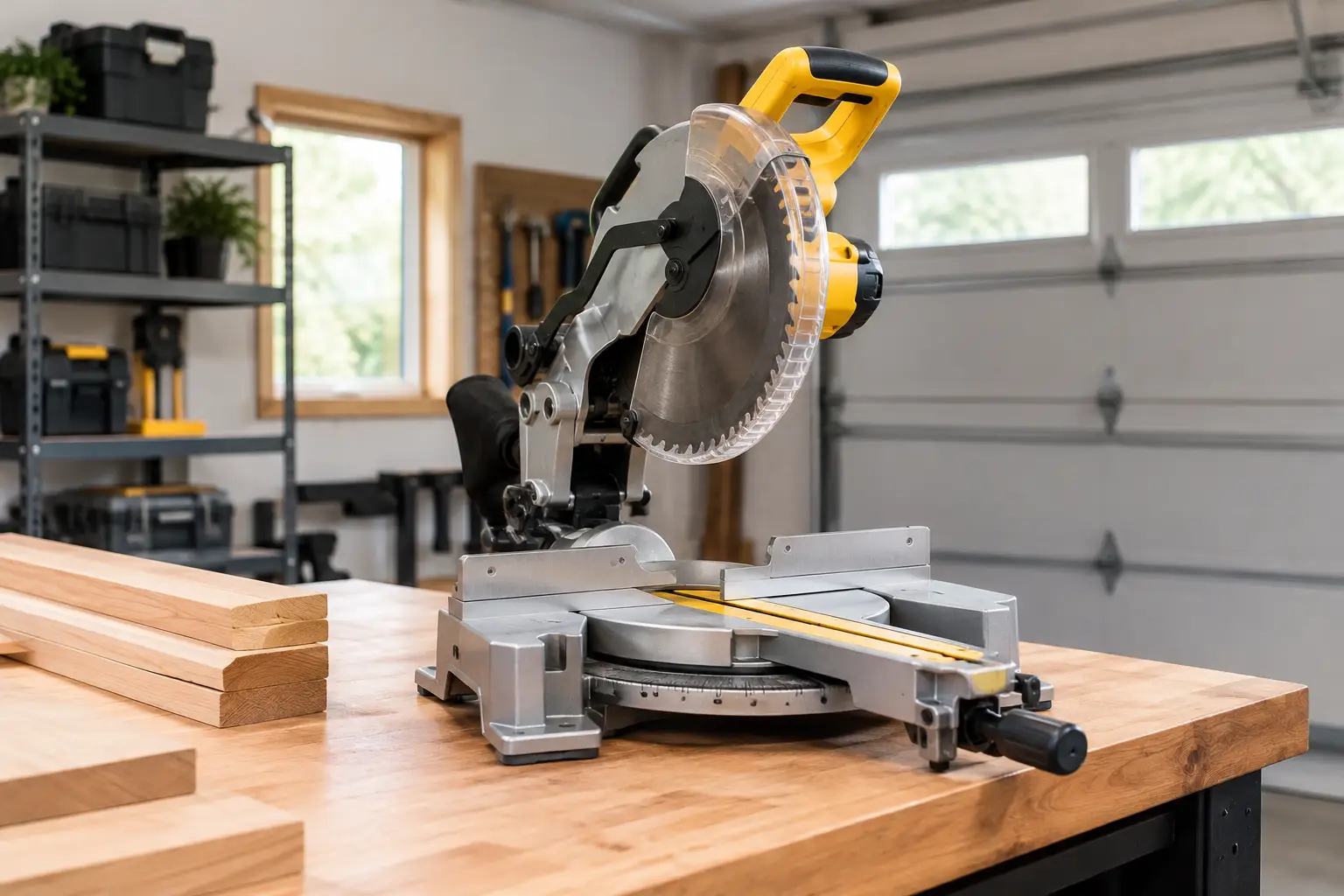
Choosing a miter saw for a one-car garage is less about buying the biggest saw you can afford and more about finding one that fits the way you actually work.
A miter saw may have a relatively small footprint, but the material you cut can extend several feet on either side of the blade. Add a stand, dust collection, offcut support, storage space, and room to move safely, and a saw that looked compact in the store can quickly become one of the largest obstacles in a small workshop.
For most one-car garage woodworkers, the sweet spot is a 10-inch miter saw, but that does not automatically mean a 10-inch sliding model is the right choice. If you mostly cut narrow trim and small boards, a non-sliding saw can save considerable space. If you regularly cut wide boards, a 10-inch slider gives you much more capacity without the size and weight of many 12-inch models.
The best miter saw for a small garage is the one that handles your normal projects, fits your available workspace, and can be stored without making the rest of the garage difficult to use.
Start With Workflow, Not Blade Size
Most hobby woodworkers first compare 10-inch and 12-inch blades. That matters, but it is not the first question in a one-car shop. Begin by deciding where the saw will operate and where it will live when it is not in use.
A miter saw needs clearance on both sides for material support. If you regularly cut 8-foot trim, framing lumber, or hardwood boards, the saw station needs a straight feed path that extends well beyond the saw table. A portable stand solves part of the problem, but not the clearance problem. You still need a safe place for the board, the cutoff, and your hands.
For many garages, a rolling saw cart or folding stand is the practical answer. Store the saw against a wall, then roll it into an open center aisle or driveway when cutting long stock. That approach is less convenient than a permanent built-in station, but it preserves valuable wall space for a workbench, lumber rack, or vehicle parking.
A permanent miter saw station makes sense only when the garage is primarily a workshop and you have at least one uninterrupted wall. If the garage must still hold a car, a fixed station often becomes an obstacle before it becomes a productivity upgrade.
What Size Miter Saw Fits a Small Garage?
A 10-inch sliding compound miter saw is the best starting point for most one-car garage shops. It offers useful crosscut capacity, handles common framing and trim work, and typically weighs less than a comparable 12-inch slider. Blade costs are also lower, and a good 10-inch blade is widely available in general-purpose, finish, and plywood-cutting tooth counts.
A 12-inch saw earns its larger footprint when you routinely cut thick timbers, tall baseboard standing against the fence, or wide material that exceeds a 10-inch saw’s capacity. The trade-off is real: these saws are heavier, their rails often demand more rear clearance, and the blade can consume more material on fine cuts due to its wider kerf.
Non-sliding compound saws deserve more attention in compact shops than they usually get. They have a smaller operating envelope because there are no sliding rails extending behind the machine. They are also often lighter and less expensive. Their limitation is crosscut width. If your work is mostly narrow trim, small furniture components, and construction lumber, a fixed-head saw may be the space-efficient choice.
| Saw type | Best fit in a one-car garage | Main compromise | |—|—|—| | 10-inch non-sliding compound | Trim, framing, narrow boards, frequent storage | Limited width capacity | | 10-inch sliding compound | General woodworking, wider boards, versatile use | Larger operating footprint | | 12-inch sliding compound | Thick stock and large trim | Weight, cost, and more space demand | | Compact rail-forward slider | Wall-adjacent setups | Often higher cost and less capacity than large sliders |
A rail-forward or articulating-arm slider can be especially useful if the saw must sit close to a wall. Traditional rail sliders need clearance behind the saw head as it travels. A forward-rail design reduces that rear-space requirement, though it does not eliminate the need for long infeed and outfeed support.
→ Compare Compact Miter Saws on Amazon
Measure the Operating Envelope Before You Buy
Manufacturer dimensions describe the tool at rest. They do not tell you how much room it consumes during an actual cut. Before buying, mark out the saw’s operating space with painter’s tape on the garage floor.
Include the width of the stand or cart, the saw head at full rear travel, and a minimum of 3 feet behind the operator. Then account for your most common board lengths. An 8-foot board needs about 4 feet of support on each side when centered on the blade, although you can shift the workpiece as needed for shorter cuts.
Also look upward. Open garage doors, door tracks, shelving, and low-mounted lights can interfere with long boards that are tilted or carried into position. This is a common problem in one-car garages because the door hardware occupies the same overhead zone you may want for lumber storage.
If the only workable cutting location is directly in front of the garage door, treat that as a valid plan. Cutting with the door open provides better natural ventilation and gives long stock a place to extend. Just keep the saw out of rain, avoid running cords across the driveway, and secure the stand on a level surface.
Dust Collection Is a Bigger Deal in a Closed Garage
Miter saw dust collection is notoriously imperfect. Even saws with large rear shrouds tend to throw fine dust past the port, particularly during wide sliding cuts. A published dust-port diameter does not guarantee clean operation.
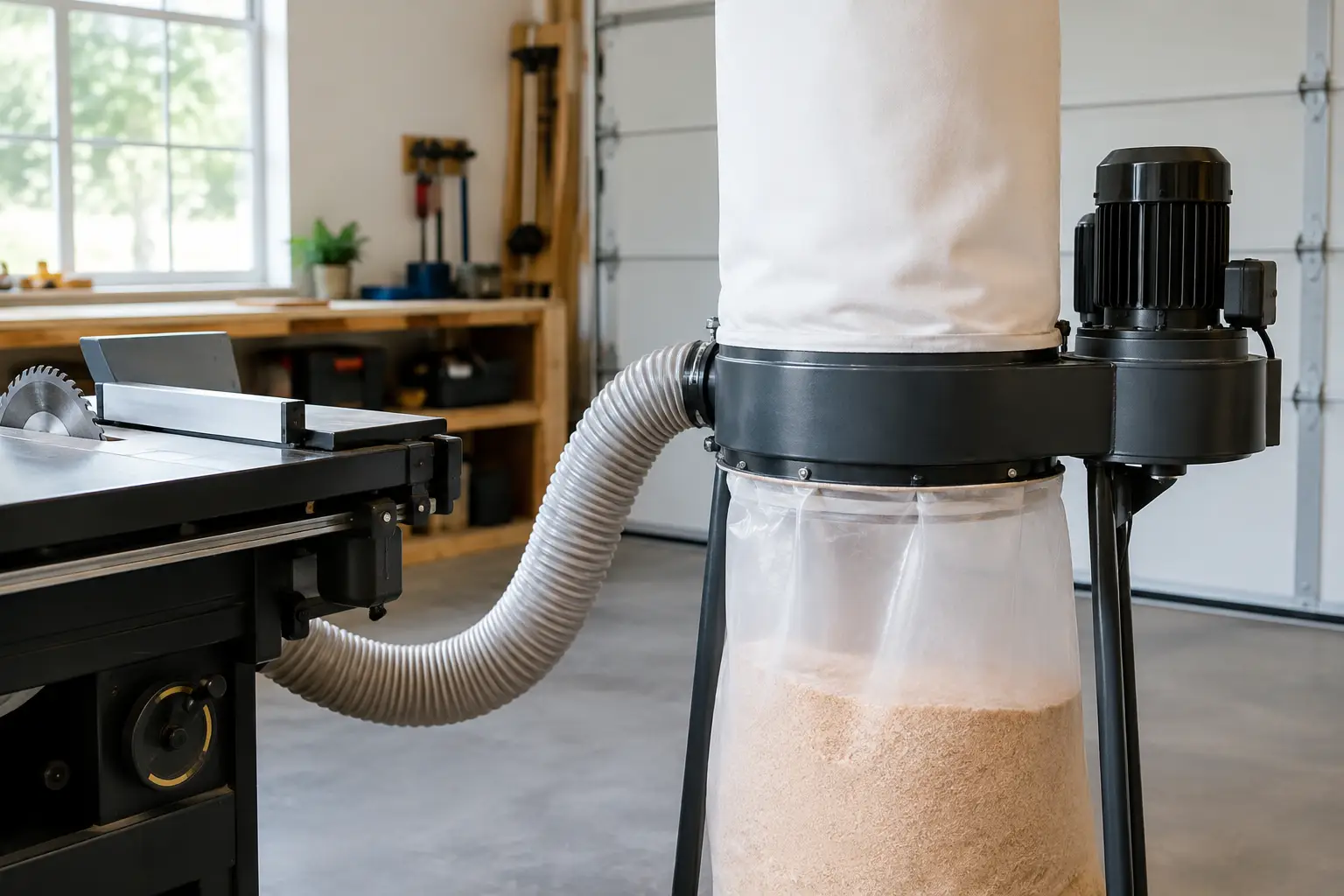
Most miter saws use a port around 1-1/4 to 2-1/2 inches. That usually matches a shop vacuum better than a full-size dust collector. A high-quality shop vacuum with a clean filter, a properly fitted hose, and a dust hood behind the saw can capture a meaningful amount of dust. The hose should be as short and straight as practical. Every extra length, sharp bend, reducer, and loose adapter reduces the airflow reaching the saw.
For a small garage, source capture is more useful than trying to pull all the airborne dust back across the shop. Put the collection hose at the saw, use a rear hood if space permits, and clean up the remaining dust with a vacuum after the cutting session. A ceiling-mounted air cleaner can help with fine suspended dust, but it is not a replacement for a dust mask or source collection.
Avoid placing the saw tight against drywall or a finished wall without protection. The saw’s rear discharge area will coat that wall quickly, and a collection hood needs some room to work. A removable backer panel or a shallow curtain-style hood can keep cleanup manageable without turning the station into a permanent structure.
→ Explore Shop Vacs for Small Garage Workshops
Match the Stand to the Way You Actually Work
A folding stand is a good fit for an occasional user who needs to reclaim floor space. Look for one with material supports that adjust easily, locking wheels, and a stable stance. The saw and stand should not rock when you pull a board through a sliding cut.
For frequent use, a rolling cabinet-style cart is often better. It gives the saw a dedicated home, adds storage for blades and accessories, and can be positioned close to a wall when parked. Build or buy it only after measuring the saw with its handle, dust hose, and power cord in place. A cart that looks narrow on paper can become bulky once those details are added.
Do not confuse portability with light weight. A 60-pound saw on a 50-pound stand is technically portable, but it is not pleasant to carry or repeatedly lift over thresholds. Wheels matter more than advertised portability for most garage setups.
Electrical and Safety Details That Prevent Frustration
Most homeowner miter saws run on a standard 120-volt, 15-amp circuit. The challenge comes when a shop vacuum starts on the same circuit. The combined startup load can trip a breaker, especially in an older garage with other lights, outlets, or appliances sharing the line.
If possible, run the saw and vacuum on separate circuits. If that is not available, start the vacuum first and use a short, heavy-duty extension cord rated for the tool load. Avoid light household cords, which can cause voltage drop and reduce motor performance.
Keep the saw station clear of stored gasoline, paint, solvents, and lawn equipment. Wood dust is combustible, and a miter saw produces sparks at the brushes and switch even though it is not normally a major ignition source. Good housekeeping also keeps offcuts from becoming trip hazards around a moving blade.
Before each session, verify that the lower guard returns freely, the fence is square, and the board is supported at the same height as the saw table. Never reach behind the blade for a cutoff until the blade has stopped completely. Small pieces can be pulled into the blade or launched unexpectedly, especially when cutting narrow stock.
The Practical Recommendation
For most one-car garage woodworkers, choose a 10-inch sliding compound saw on a rolling cart or a quality folding stand. Prioritize a compact rail design if the saw must park near a wall. Pair it with material supports, a shop vacuum, and a dust hood sized to the space behind the saw.
Step up to a 12-inch slider only when your work regularly demands its capacity. Choose a non-slider when narrower cuts are the norm and storage space is the harder limit. The best miter saw setup is not the one that fills the garage with capability. It is the one you can roll out, cut safely with, clean up quickly, and put away before it starts dictating every other decision in the shop.
Frequently Asked Questions
Is a 10-inch miter saw enough for a one-car garage?
For many homeowners and hobby woodworkers, yes. A 10-inch saw can handle a wide range of trim, framing, furniture, and general woodworking tasks. The important factor is the exact cutting capacity of the model. Check its published capacity against the widest and thickest material you regularly plan to cut.
Is a sliding miter saw worth it for a small garage?
It can be, especially if you regularly cut material wider than a non-sliding saw can handle. A sliding model provides additional crosscut capacity, but it can also require more space and weigh more. If your projects mainly involve narrow trim, a non-sliding saw may be the more practical choice.
Should I buy a 10-inch or 12-inch miter saw?
Choose the 10-inch model if its capacity covers your projects and you value easier storage and handling. Consider a 12-inch saw when you regularly work with larger stock or trim that exceeds the practical capacity of a 10-inch machine. The larger saw is not automatically better for a small garage.
How much space do I need around a miter saw?
There is no single universal footprint because saw designs and workpieces vary. You need enough space for the saw’s full movement, the operator, material support, dust collection, and the longest boards you cut. Measure the complete setup rather than relying only on the dimensions listed for the saw itself.
Can I put a miter saw against a garage wall?
Some compact saw designs are better suited to wall-adjacent installations than traditional rear-rail sliders. However, you still need adequate clearance for the saw head, workpiece, fence, dust collection, and operator. Always check the manufacturer’s required clearance and operating instructions before installing the saw close to a wall.
What is better for a small garage: a miter saw stand or a workbench?
A folding stand is usually more flexible when floor space is limited because it can be stored when not needed. A workbench or permanent station is better when the saw is used frequently and the garage is primarily a workshop. A rolling cart provides a useful middle ground for many one-car garages.
The Bottom Line
Choosing a miter saw for a one-car garage is really a space-management decision as much as a tool decision.
For many woodworkers, a 10-inch miter saw provides enough capacity without becoming unnecessarily difficult to move and store. A 10-inch sliding compound model is a strong all-around option when you need additional crosscut capacity, while a 10-inch non-sliding saw can be the smarter choice when narrow trim and limited storage are the priorities.
Move up to a 12-inch miter saw when your projects consistently demand its additional capacity.
Before buying, measure the entire operating area, check rear clearance, plan for material support, and decide how the saw will be stored when you are finished cutting.
In a one-car garage, the best miter saw is not necessarily the largest or most powerful model. It is the one that gives you enough cutting capacity while still allowing the rest of the garage to function.
A saw you can quickly roll into position, use safely, connect to dust collection, clean up, and put away is far more useful than a larger machine that permanently consumes the space you need for everything else.

Leave a Reply