As an Amazon Associate I earn from qualifying purchases.
A dust collector that looks compact on a product page can become one of the biggest obstacles in a one-car garage. The cart needs parking space, the hose needs room to reach the machine, and the collection bag needs enough clearance to remove when it is full.
The best portable dust collector for a small garage is not necessarily the one with the highest advertised CFM. It is the one that provides enough airflow for your largest dust-producing machine, works effectively through a practical hose setup, fits the available space, and can be moved out of the way when the garage needs to become a parking area again.
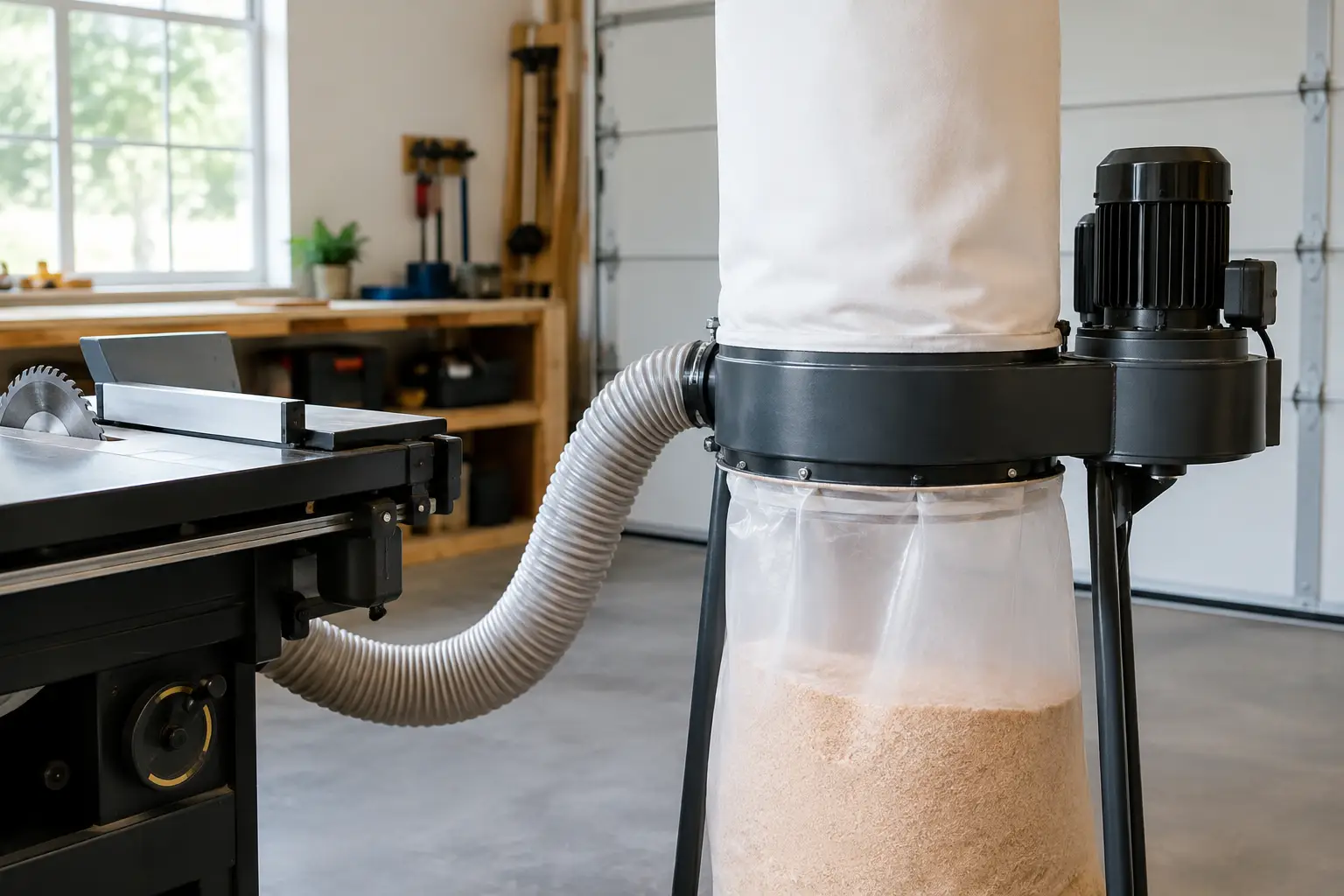
For most small garage workshops, a 1 HP to 1-1/2 HP mobile dust collector is a practical starting point for stationary woodworking machines. A 4-inch hose and a short, direct connection can make a major difference in real-world performance.
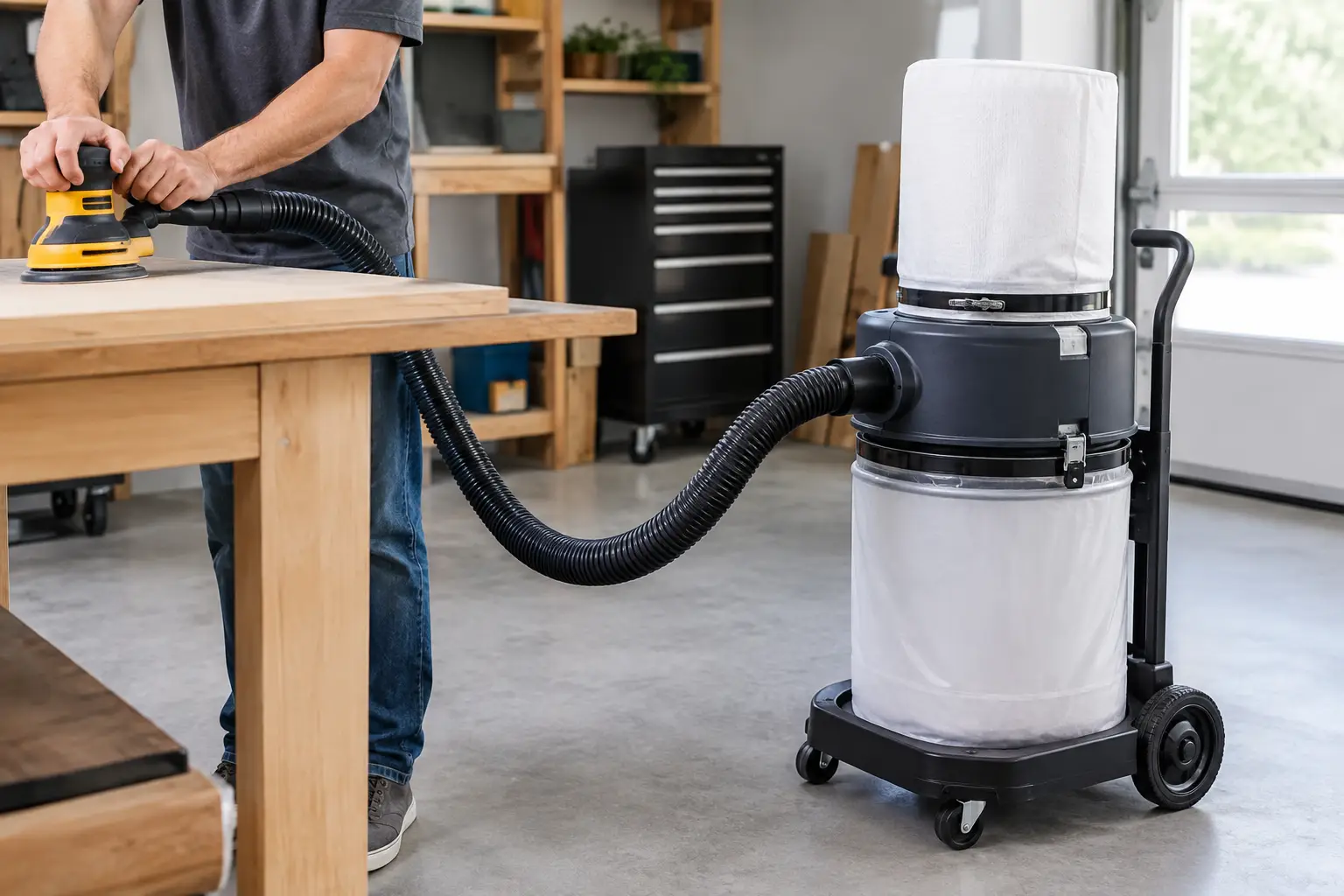
However, not every woodworking tool needs the same type of dust collection. A planer or jointer produces large quantities of chips and generally benefits from a dedicated dust collector. A random-orbit sander or track saw produces much finer dust through a smaller port and is often better served by a quality shop vacuum or HEPA dust extractor.
The right choice starts with the machines in your garage, not with the biggest number printed on the dust collector box.
→ Compare portable woodworking dust collectors on Amazon to find a model that fits your garage, dust port, and available space.
What Makes the Best Portable Dust Collector for a Small Garage?
The first question is simple: What tool are you trying to collect dust from?
A benchtop planer can produce a surprising amount of wood chips in a short period of time. A jointer and table saw also benefit from substantial airflow through a 4-inch dust port. On the other hand, a random-orbit sander creates much finer dust and normally uses a smaller connection.
That difference is important because dust collectors and shop vacuums are designed around different airflow characteristics.
A dust collector generally moves a larger volume of air through a larger hose. A shop vacuum or dust extractor generally produces stronger suction through a smaller hose. Neither is automatically better for every woodworking machine.
CFM is important, but it is not the whole story
Manufacturers commonly advertise the maximum airflow of a dust collector in CFM, or cubic feet per minute. That number is useful for comparing machines, but it should not be treated as the exact airflow you will receive at the tool.
Airflow changes when you add:
- Flexible hose
- Elbows and sharp bends
- Reducers
- Blast gates
- Machine dust ports
- Filters
- Collection bags
- Cyclone separators
The longer and more restrictive the path, the more airflow you can lose.
That is why a collector with a lower advertised CFM can sometimes perform better in a small garage than a larger collector connected through a long, restrictive hose system.
Static pressure is another important specification. It describes how well the collector can maintain airflow against resistance in the system. When comparing dust collectors, looking at airflow and static pressure together gives you a better idea of how the machine may perform once connected to actual woodworking equipment.
For a small garage, the goal is not to build the largest dust collection system possible. The goal is to build an efficient one.
How Much Dust Collector Do You Need for a Small Garage?
The size of your dust collector should be based primarily on your largest stationary woodworking machine.
| Garage workshop setup | Recommended approach | Why |
|---|---|---|
| Sanders and handheld routers | Shop vacuum or dust extractor | Small ports and fine dust favor higher suction |
| Benchtop planer | Compact 1 HP collector or suitable high-performance vacuum system | Produces a large volume of chips |
| Jobsite table saw | Compact mobile collector | Works well when the hose run is short |
| Router table | 1 HP collector with a 4-inch connection | Benefits from higher air volume |
| Full-size table saw | 1 HP to 1-1/2 HP collector | Requires good source capture and airflow |
| Jointer | 1 HP to 1-1/2 HP collector | Produces substantial chips |
| Planer and jointer | 1-1/2 HP class is more appropriate | Gives additional airflow headroom |
| Mixed small garage | Dust collector plus shop vacuum | Each system handles a different type of dust |
You should also remember that most small garage workshops operate one major machine at a time. You generally do not need a large central system designed to maintain full airflow through several open blast gates simultaneously.
That makes a mobile collector particularly attractive.
Instead of permanently installing a large duct network, you can roll the collector to the machine you are using, connect a relatively short hose, and then move the collector back against a wall when the project is finished.
For a one-car garage, that flexibility can be more valuable than additional horsepower.
Best Portable Dust Collector Size for a One-Car Garage
1 HP: Compact and practical
A compact 1 HP dust collector can make sense when floor space is extremely limited and your woodworking machines are relatively small.
It is particularly useful for:
- Benchtop planers
- Small table saws
- Router tables
- Small jointers
- Occasional woodworking
The main limitation is airflow reserve.
If you connect a long hose, several fittings, a separator and a restrictive machine port, a compact collector has less capacity to overcome those losses.
A 1 HP collector is therefore most effective when you keep the system simple and the hose short.
1-1/2 HP: More breathing room
A 1-1/2 HP mobile collector is a better fit when your garage contains larger stationary woodworking machines.
It makes more sense for:
- Full-size table saws
- Planers
- Jointers
- Router tables
- Multiple stationary machines used one at a time
The trade-off is size.
A larger collector can take considerably more floor and vertical space, so measure the complete machine rather than looking only at the footprint of its base.
That includes the height of the upper filter or bag and the clearance required to remove the lower collection bag.
This is particularly important in garages with low ceilings, overhead storage, garage-door tracks or shelving.
Shop Fox W1685: A Larger Portable Option
The Shop Fox W1685 illustrates why a 1-1/2 HP collector can make sense in a small workshop when larger stationary machines are involved.
The W1685 is specified with a 1-1/2 HP motor, 1280 CFM airflow, 10.1 inches of static pressure, a 40-gallon collection capacity and a 2.5-micron upper bag. It uses a 6-inch intake with a removable Y fitting that provides two 4-inch connections.
That gives it considerably more capacity than a small compact collector.
But there is an important catch for a garage workshop: size.
The W1685 is approximately 78 inches tall and weighs about 94 pounds.
That makes it a very different proposition from a lightweight portable unit.
It can work well when you have a dedicated wall-side parking location and need the additional airflow, but it may be unnecessarily large for a garage dominated by benchtop tools.
Its 16-amp electrical requirement also deserves attention when planning where it will operate.
For a small garage, always consider the available circuit before choosing a larger dust collector.
WEN DC3401: A Compact Option for Tight Garages
If floor space is the biggest limitation, the WEN DC3401 takes a very different approach.
The DC3401 is rated at 660 CFM, uses a 5.7-amp motor, has a 12-gallon collection bag and weighs only 17 pounds. WEN lists dimensions of approximately 34.25 × 13 × 14.2 inches. It also has lockable swivel casters and an optional wall-mount configuration.
That combination makes it particularly interesting for a small garage.
The unit has a 4-inch dust port and a 5-micron collection bag.
Its compact dimensions make it much easier to move between machines or store against a wall when the garage needs to be cleared.
The limitation is airflow capacity compared with larger 1-1/2 HP collectors.
The DC3401 makes more sense for a compact workshop where you operate one machine at a time and keep hose runs short. It is not the collector I would choose simply because the number “660 CFM” appears on the specification sheet; the entire system still needs to be matched to the machine and hose arrangement.
That distinction is important when comparing portable dust collectors.
→ Compare compact dust collectors on Amazon to check dimensions, mounting options, collection bags, and portability for a small garage workshop.
Dust Collector vs. Shop Vac: Which One Is Better?
This is one of the most common mistakes when building a small garage workshop.
A shop vacuum is not simply a smaller dust collector.
A shop vacuum is generally designed to produce strong suction through a smaller hose. That makes it useful for:
- Random-orbit sanders
- Track saws
- Circular saws
- Handheld routers
- Small power tools
A dedicated dust collector moves much more air through a larger hose and is better suited to machines that produce large quantities of chips.
That includes:
- Planers
- Jointers
- Table saws
- Router tables
- Larger stationary woodworking machines
If your garage contains only a sander, circular saw and small router, buying a large dust collector may not make sense.
If you regularly use a planer or jointer, a shop vacuum may become overwhelmed by the volume of chips.
For many small workshops, the most practical arrangement is actually both: a dust collector for stationary machines and a shop vacuum or dust extractor for handheld tools.
What About a HEPA Dust Extractor?
A HEPA dust extractor can be particularly useful when fine dust is the primary concern.
It is well suited to:
- Random-orbit sanders
- Track saws
- Handheld routers
- Fine woodworking
- Tools with 1-1/4-inch or 1-1/2-inch ports
Its smaller hose and strong suction are designed around the requirements of these tools.
However, a dust extractor is not a replacement for a high-volume collector when you are producing large quantities of planer shavings or jointer chips.
The container can fill quickly, and the filter can load with dust much faster when the system is used outside its intended application.
For that reason, the best small-garage dust collection setup often uses different equipment for different jobs.
Why Filtration Matters in a Small Garage
Airflow gets most of the attention when people shop for a dust collector, but filtration matters just as much.
A collector can remove chips from the machine while still allowing finer particles to escape if the filtration system is inadequate or poorly maintained.
This becomes especially important in a garage because the same space may also contain:
- Vehicles
- Storage shelves
- Household items
- Lawn equipment
- Other tools
- Clothing or cardboard storage
Fine dust can settle on everything.
A filter or bag with a smaller micron rating can capture smaller particles, but the number should not be treated as the only measure of dust-control performance.
Source capture is still critical.
A properly connected dust hood, short hose, good seals and clean filter can have a major effect on actual performance.
If your collector supports a better cartridge or canister filter, upgrading the filtration system can be worthwhile for frequent woodworking.
Just remember that a larger filter can also increase the overall height of the machine, which matters in a garage.
Should You Use a Cyclone Separator?
A cyclone separator can be an excellent addition when your main machines produce a lot of chips.
The separator sits between the woodworking machine and the dust collector and removes much of the heavier material before it reaches the collector’s filter.
This can help:
- Reduce how quickly the collection bag fills
- Keep the filter cleaner
- Maintain airflow for longer
- Make chip disposal easier
- Reduce the amount of material reaching the main filter
Planers are an especially good example.
A thickness planer can generate a large volume of chips very quickly, so separating those chips before they reach the filter can make the system easier to manage.
But there is a downside for a small garage: a separator takes space.
You now have another container, another connection and more hose.
If your entire workshop is built around a very small footprint, adding a cyclone simply because it is popular may make the system less convenient.
The best setup is the one that improves dust collection without turning your garage into a maze of hoses and containers.
Keep the Hose Short and Large
One of the easiest ways to improve a portable dust collector is to improve the hose layout.
A 4-inch collector connected to a machine with a short, reasonably straight 4-inch hose will generally have an easier job than the same collector connected through a long series of restrictions.
Whenever possible:
- Keep the hose short
- Use the largest practical diameter
- Avoid unnecessary bends
- Avoid unnecessary reducers
- Keep unused ports closed
- Use smooth, properly fitted connections
- Keep the filter clean
Do not assume that adding a larger collector automatically solves a restrictive hose system.
A badly designed connection can waste the airflow you paid for.
This is also why a mobile dust collector is so useful in a one-car garage.
Instead of putting the collector 15 or 20 feet away and routing a hose around the entire workshop, you can often move the collector closer to the active machine.
That reduces hose length and keeps the system simpler.
Do You Need a 4-Inch Dust Hose?
For a dedicated dust collector connected to a stationary woodworking machine, a 4-inch hose is often the practical starting point.
It provides substantially more cross-sectional area than a 2-1/2-inch hose.
That does not mean every tool should automatically be converted to 4 inches.
Many handheld tools are designed around smaller ports, and those tools are better matched with a shop vacuum or dust extractor.
The important point is to avoid using a long, undersized hose between a high-volume dust collector and a machine designed for a larger connection.
If the machine has a 4-inch port, use it when practical.
If the machine has a smaller port by design, choose the collection system around that tool rather than forcing an inappropriate connection.
Storage Is Part of Dust Collector Performance
In a one-car garage, storage is not an afterthought.
It affects whether you will actually use the dust collector.
If connecting the collector requires moving three machines, removing storage bins and uncoiling 20 feet of hose, you are more likely to skip dust collection for a quick cut.
A portable collector should have a clear parking location.
Before buying one, measure:
- The collector’s footprint
- Its total height
- Bag or bin removal clearance
- Hose storage space
- Wall or shelving clearance
- Garage-door clearance
- Vehicle parking clearance
Do not measure only the wheelbase.
A collector with a small base can still become difficult to store if the upper filter or bag reaches into an overhead shelf.
Electrical Requirements Matter Too
A portable dust collector still needs to work with the electrical system in your garage.
Check the manufacturer’s voltage and amperage specifications before choosing a location.
For example, the WEN DC3401 is specified at 120V and 5.7A, while the Shop Fox W1685 is specified at 110V and 16A.
Those are very different electrical demands.
Avoid assuming that every 1 HP or 1-1/2 HP dust collector can simply be plugged into any convenient outlet without considering what else is running on the circuit.
If the collector shares a circuit with other high-draw equipment, you should account for the total electrical load and follow the manufacturer’s electrical requirements.
When in doubt, have the garage circuit evaluated by a qualified electrician.
Dust Collection Safety in a Garage
Wood dust is more than a cleaning problem.
OSHA has documented fire and explosion hazards associated with improperly installed woodworking dust-collection systems and emphasizes following applicable requirements, manufacturer instructions and appropriate dust-control practices.
For a home garage, the exact requirements depend on the equipment, installation and local rules, so a portable hobby collector should not be treated like an industrial dust-collection installation.
At a minimum:
- Follow the manufacturer’s installation instructions
- Keep the collector and hoses in good condition
- Empty collection bags before they become excessively full
- Keep dust away from ignition sources
- Do not modify the collector’s safety components
- Keep electrical connections in good condition
- Use appropriate respiratory protection when necessary
- Check local requirements if installing a permanent system
A dust collector also should not be confused with an ambient air cleaner.
The collector’s primary job is to capture dust at the source. An ambient air cleaner can be used as a second layer to remove airborne particles that escape the tool’s dust hood.
Good source capture should come first.
Best Portable Dust Collector Setup for a Small Garage
For most one-car woodworking garages, the setup can be kept surprisingly simple.
A practical system looks like this:
Stationary machine → short 4-inch hose → dust collector
For a planer that produces a large amount of chips, you can use:
Planer → 4-inch hose → cyclone separator → dust collector
For sanding:
Sander → small hose → shop vacuum or dust extractor
This approach avoids trying to make one machine perform every type of dust-collection job.
It also keeps the garage more flexible.
What I Would Look for Before Buying
When comparing portable dust collectors for a small garage, I would check these specifications in this order:
1. Tool compatibility
Make sure the collector is appropriate for your largest dust-producing machine.
2. Hose diameter
A 4-inch connection is useful for stationary woodworking machines.
3. Airflow
Use the manufacturer’s CFM rating as a comparison point, not as a guarantee of airflow at the tool.
4. Static pressure
This becomes more important as hose length and system resistance increase.
5. Filtration
Look at the actual filter or bag specification rather than assuming every collector handles fine dust equally.
6. Footprint
Measure the complete machine.
7. Height
This is easy to overlook in a garage with overhead storage.
8. Collection capacity
A larger bag means less frequent emptying, but it can also increase the collector’s physical size.
9. Electrical requirements
Check voltage and amperage before deciding where the machine will operate.
10. Mobility
Locking casters and a practical handle can make a major difference in a small workshop.
Which Type Is Right for Your Garage?
Choose a compact 1 HP mobile dust collector if your workshop is dominated by benchtop machines and you have limited storage space.
Choose a 1-1/2 HP mobile collector if you regularly use a table saw, planer or jointer and have enough space for a larger machine.
Choose a wall-mounted collector when floor space is the biggest problem and your tools are positioned close enough to keep hose runs short.
Choose a shop vacuum or dust extractor when sanding and handheld tools make up most of your woodworking.
Choose a collector plus cyclone separator when your planer or other chip-producing machines generate enough material to fill the collection bag quickly.
And if your workshop produces both heavy chips and fine sanding dust, using two different collection systems can be more practical than trying to force one machine to handle everything.
→ Compare available dust collectors on Amazon before buying. Check the manufacturer’s airflow specifications, hose compatibility, filter type, dimensions, and electrical requirements for your setup.
Final Thoughts
The best portable dust collector for a small garage is the one that fits the way your workshop actually operates.
For a one-car garage, a compact collector that rolls directly to the machine can be more useful than a much larger system that requires permanent floor space. A short 4-inch hose, good source capture and clean filtration can also make a significant difference in real-world performance.
A 1 HP collector can be a practical choice for compact machines and occasional woodworking. A 1-1/2 HP collector provides more airflow headroom for larger stationary machines such as table saws, planers and jointers.
The important thing is to avoid buying based on horsepower or CFM alone.
Think about the machine, hose diameter, hose length, static pressure, filtration, electrical requirements and storage space as one complete system.
If you are designing a small-garage dust collection system, start with the machine that produces the most chips and work backward from there.
And if your workspace is specifically a one-car garage, this guide to the best dust collector for a small one-car garage can help you think through the space and layout limitations before choosing the equipment.
The best dust collection system is ultimately the one you can connect quickly, use consistently and store without sacrificing the limited space your garage has to offer.

Leave a Reply