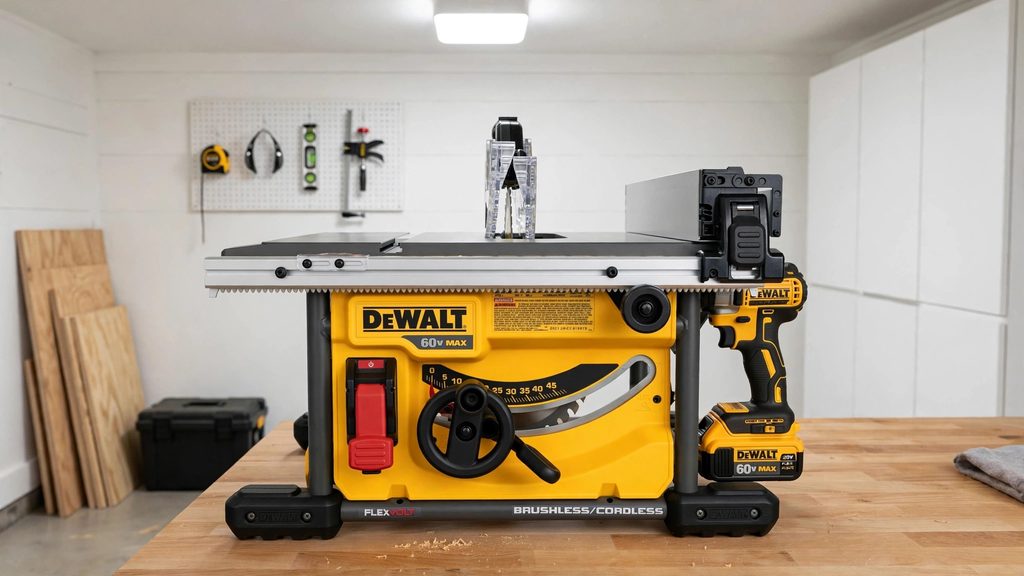
A small garage workshop can be surprisingly capable, but space and electrical access can limit which tools make sense. If you are working in a one-car garage with standard household outlets and no dedicated 240V circuit, a cordless table saw can be an attractive way to add serious cutting capability without permanently wiring your workshop around one machine.
But there is an important distinction to make first: you do not need 220V simply to use a table saw. Many portable and jobsite table saws run from standard 120V household power. The main advantage of a battery table saw is not that it avoids 220V. It is that it eliminates the power cord, making the saw easier to move, store, and use in a garage that has to serve more than one purpose.
For a one-car workshop, that flexibility can be extremely valuable.
The Milwaukee M18 FUEL 8-1/4-Inch Table Saw with ONE-KEY, model 2736-21HD, is a particularly interesting option because it combines a compact jobsite design with the cutting capacity needed for plywood, dimensional lumber, shelving, cabinets, workbenches, and many other DIY projects.
Best Battery Table Saw for a Small Garage: Milwaukee M18 FUEL 2736-21HD
The Milwaukee M18 FUEL 8-1/4-Inch Table Saw 2736-21HD is designed around portability without giving up the cutting performance expected from a full-size jobsite saw.
Milwaukee lists the saw as delivering the power of a 15-amp corded saw, with a 24-1/2-inch rip capacity and up to 600 linear feet of cutting per charge under the manufacturer’s stated conditions. The kit includes an M18 REDLITHIUM HIGH OUTPUT HD12.0 battery and rapid charger.
Milwaukee M18 FUEL 2736-21HD Specifications
| Feature | Specification |
|---|---|
| Model | 2736-21HD |
| Power source | Milwaukee M18 battery |
| Blade diameter | 8-1/4 inches |
| Maximum rip capacity | 24-1/2 inches |
| Maximum cut depth at 90° | 2-1/2 inches |
| Maximum cut depth at 45° | 1-3/4 inches |
| Motor | POWERSTATE brushless |
| Bevel capacity | Up to 47° |
| Battery included | M18 REDLITHIUM HIGH OUTPUT HD12.0 |
| Charger included | M18/M12 Rapid Charger |
| ONE-KEY | Yes |
The 8-1/4-inch blade is one of the reasons this saw works well in a compact workshop. It is smaller than the 10-inch blade found on many traditional table saws, but it still provides enough capacity for a large percentage of typical DIY woodworking tasks. Independent testing has also found the saw capable of handling plywood and dimensional lumber while maintaining performance comparable to corded jobsite models.
Why a Cordless Table Saw Works Well in a One-Car Garage
A one-car garage has a unique problem: it is usually both a workshop and a storage or parking area.
You may need enough room for a vehicle, lawn equipment, bicycles, shelves, a workbench, and other household items. A large stationary table saw can quickly become an obstacle.
A cordless table saw gives you another option.
Instead of building the entire workshop around a permanently positioned saw, you can bring the machine out when you need it and store it against a wall or in another convenient location afterward.
There is also no extension cord running across the floor while you work.
That can make a noticeable difference in a small workspace.
The cordless design is particularly useful if your garage has only standard 120V outlets and you do not want to install a dedicated circuit. However, remember that a 120V corded table saw can also work from a standard household outlet. The battery advantage is primarily mobility and convenience, not simply electrical compatibility.
What to Look for in a Battery Table Saw for a Small Garage
The smallest table saw is not automatically the best choice. You need to consider the entire workflow around the machine.
1. Blade Size
An 8-1/4-inch blade is a practical compromise for a compact workshop.
It keeps the saw relatively portable while providing a maximum cutting depth of about 2-1/2 inches at 90°. That is enough for many common woodworking jobs.
The trade-off is that you do not get the same cutting depth as a larger 10-inch saw.
If you frequently cut thick hardwood, large posts, or other oversized material, a full-size saw may be more appropriate.
For plywood, shelving, cabinets, trim-related work, workbenches, and typical DIY projects, the smaller blade can be more than adequate.
2. Rip Capacity
Rip capacity becomes especially important when working with sheet goods.
The Milwaukee provides up to 24-1/2 inches of rip capacity, which gives you considerably more flexibility than a very small compact saw. Milwaukee specifically positions the saw for ripping larger sheet materials.
For a garage workshop, this matters because you want one machine that can handle a wide variety of jobs rather than purchasing several specialized cutting tools.
3. Overall Footprint
Don’t measure only the saw itself.
A table saw requires working space around it.
You need room to feed material into the blade, guide the workpiece past the blade, and safely control the material as it exits.
This becomes particularly important with a 4×8 sheet of plywood.
Before purchasing any table saw for a one-car garage, measure the available floor area and think about where the material will enter and exit the machine.
A compact saw can still become difficult to use if it is positioned against a wall with no room behind it.
4. Weight and Portability
A cordless table saw is not a handheld tool.
The Milwaukee is still a substantial machine, but independent testing places the tool’s weight at roughly 41.6 pounds, making it considerably easier to move than a large stationary woodworking machine.
That makes a difference when you need to change the garage from workshop mode back to parking or storage mode.
5. Battery Platform
If you already own Milwaukee M18 tools, the 2736-21HD becomes easier to justify because you are already invested in the battery ecosystem.
If you are starting from scratch, however, the battery platform is part of the total cost.
The kit includes a high-output HD12.0 battery, which is useful for a high-demand tool such as a table saw. Milwaukee’s advertised runtime of up to 600 linear feet should be treated as a manufacturer performance claim rather than a guaranteed amount for every project. Actual runtime depends on material, thickness, blade condition, cutting technique, and other factors.
Can a Battery Table Saw Handle Plywood?
Yes.
A cordless table saw such as the Milwaukee 2736-21HD is designed to handle common jobsite and woodworking materials, including plywood and dimensional lumber.
The important point is to understand the saw’s limits.
An 8-1/4-inch table saw is not intended to provide the same cutting capacity as a large 10-inch cabinet saw.
For a small garage workshop, though, the ability to cut plywood for shelving, cabinets, storage projects, workbenches, and furniture can cover a surprisingly large portion of typical DIY work.
Independent testing of the Milwaukee has included plywood, OSB, untreated pine, and pressure-treated pine, with the tester reporting smooth cutting and substantial power for a cordless machine.
Milwaukee’s Rack-and-Pinion Fence
A good fence is critical on a table saw.
If the fence is difficult to adjust or does not remain parallel to the blade, making accurate cuts becomes frustrating and potentially unsafe.
The Milwaukee uses a rack-and-pinion fence adjustment system designed for relatively quick and precise positioning. Independent testing specifically noted the smooth adjustment of the fence.
For a small garage, this is useful because you may frequently switch between different cutting widths instead of leaving the saw permanently configured for one task.
Dust Collection in a Small Garage
Dust management becomes more important as the workshop gets smaller.
In a large dedicated shop, you may have a permanent dust collection system. In a one-car garage, many DIY woodworkers rely on a shop vacuum or compact dust collector.
The Milwaukee’s dust collection design has received positive comments in independent testing, including a dust port and internal design intended to direct more sawdust toward the collection system.
Connect the saw to an appropriate dust extractor or shop vacuum whenever possible.
Good dust collection does not eliminate the need for appropriate respiratory protection or cleanup, but it can substantially reduce the amount of airborne and loose sawdust in the garage.
Battery vs. 120V Corded Table Saw
One of the biggest misconceptions about this type of purchase is assuming that a cordless saw is necessary because the garage does not have 220V.
It isn’t.
Many jobsite table saws operate from standard 120V power.
The real comparison looks more like this:
| Feature | Battery Table Saw | 120V Corded Table Saw |
|---|---|---|
| Requires 220/240V | No | Usually no |
| Power cord | No | Yes |
| Portability | Excellent | Good |
| Continuous runtime | Battery dependent | Yes |
| Easy to store | Excellent | Good |
| Battery platform required | Yes | No |
| Best for | Mobile workshops | Areas with convenient outlets |
| Main advantage | Cordless mobility | Unlimited runtime |
If your garage already has a convenient 120V outlet and the saw will remain in one location, a corded model may make more financial sense.
If you constantly move tools, share the garage with a vehicle, or need to put the saw away after every project, cordless operation becomes much more valuable.
Milwaukee vs. Other Cordless Table Saws
Milwaukee is not the only manufacturer making cordless table saws.
DeWalt’s FlexVolt table saw is another well-known option in this category. The DeWalt DCS7485 also uses an 8-1/4-inch blade and offers approximately 24 inches of rip capacity, while its design incorporates features such as onboard storage and a rack-and-pinion fence.
FLEX also offers cordless table saws, including an 8-1/4-inch model and a larger 10-inch option. Independent testing has highlighted the combination of cordless and corded operation available on certain FLEX models.
This means the best choice for your garage may depend partly on which battery platform you already use.
If you already own several M18 tools, the Milwaukee is easier to integrate into your workshop. If your garage already uses DeWalt FlexVolt or another battery system, staying within that ecosystem can make more sense.
What Can You Build With a Cordless Table Saw?
A compact cordless table saw can handle a wide range of projects.
Common uses include:
- Garage shelving
- Workbenches
- Storage cabinets
- Small furniture
- Plywood cabinets
- Utility shelves
- Workshop organizers
- Cutting dimensional lumber
- Plywood strips
- Cabinet components
- DIY storage systems
- General woodworking projects
For a homeowner or hobby woodworker, that covers many of the projects that justify having a table saw in the first place.
When an 8-1/4-Inch Table Saw May Not Be Enough
The Milwaukee’s compact blade size is also its main limitation.
The maximum cutting depth is 2-1/2 inches at 90° and 1-3/4 inches at 45°.
That is useful for common materials, but a larger 10-inch table saw offers greater cutting depth.
You may want a larger saw if your projects regularly involve:
- Thick hardwood
- Large structural lumber
- Deep cross sections
- Heavy professional production
- Large-volume repetitive cutting
- Specialized woodworking requiring greater blade capacity
For occasional garage woodworking, however, the smaller format can be a reasonable trade-off for portability.
Safety Considerations for a Small Garage
A table saw should never be chosen based on size alone.
The available working space around the machine is part of the safety equation.
Keep the blade guard and riving knife installed when appropriate for the cut. Use the supplied anti-kickback components as intended, and use a push stick when your hands would otherwise get too close to the blade.
The Milwaukee kit includes a blade guard, riving knife, anti-kickback pawls, miter gauge, blade wrench, and other accessories.
Keep the floor around the saw clear of scrap wood, cords, boxes, and other trip hazards.
Most importantly, make sure there is enough space to safely support the material before, during, and after the cut.
A table saw should not be operated with a vehicle, wall, shelving unit, or other obstruction immediately behind the material path.
Who Should Buy the Milwaukee M18 FUEL Table Saw?
The Milwaukee 2736-21HD makes the most sense for a garage woodworker who values portability and already uses, or plans to use, the M18 battery platform.
It is particularly suited to someone who:
- Has a one-car garage
- Wants a cordless table saw
- Has standard 120V electrical service
- Does not want to install a dedicated circuit
- Needs to move the saw frequently
- Works on DIY woodworking projects
- Cuts plywood and dimensional lumber
- Needs to store the saw after use
- Wants a relatively compact jobsite design
It is less compelling if you are building a dedicated woodworking shop where the saw can remain permanently positioned and continuous corded operation is more important than portability.
Frequently Asked Questions
Do I need 220V for a table saw?
Not necessarily. Many portable and jobsite table saws operate from standard 120V household power. A battery model eliminates the need for a power cord altogether, but the absence of 220V by itself does not require you to buy a cordless saw.
Is a cordless table saw powerful enough for woodworking?
Yes, for many DIY and general woodworking applications. Modern cordless table saws can handle plywood and dimensional lumber effectively. The main limitations are battery runtime and, depending on the model, cutting depth compared with larger 10-inch saws.
Is an 8-1/4-inch table saw enough for a small garage?
For many homeowners and DIY woodworkers, yes. An 8-1/4-inch saw provides a useful balance between cutting capacity and portability. It is particularly practical for plywood, shelving, cabinets, workbenches, and general garage projects.
Can I use a cordless table saw without a battery charger nearby?
Yes. Once the battery is charged, the saw can operate without being connected to an electrical outlet. However, having a spare compatible battery can be useful if you regularly work on larger projects.
Is a battery table saw better than a corded saw for a garage?
That depends on how you use the garage. A cordless saw offers easier movement and storage, while a 120V corded saw provides continuous runtime. For a garage that must frequently change from workshop space to parking or storage space, cordless operation can be particularly convenient.
Final Verdict
The Milwaukee M18 FUEL 8-1/4-Inch Table Saw 2736-21HD is a strong fit for a small garage workshop when portability is a major priority.
Its 24-1/2-inch rip capacity, 2-1/2-inch maximum cutting depth at 90°, brushless motor, M18 battery platform, rack-and-pinion fence, and compact jobsite-oriented design give it enough capability for a wide range of DIY woodworking projects. Milwaukee also rates it for up to 600 linear feet of cutting per charge with the included high-output battery.
The most important thing to understand is that you don’t need a battery table saw simply because your garage lacks 220V. A 120V corded saw may work perfectly well.
The stronger reason to choose cordless is flexibility.
In a one-car garage, the ability to cut without a cord, move the saw when necessary, and store it when the project is finished can be worth more than the extra cost of entering a battery platform.
For a compact workshop where every square foot matters, that can make a cordless table saw a practical centerpiece rather than another permanent obstacle.