
As an Amazon Associate I earn from qualifying purchases.
A full-size cabinet saw can be tempting when you start building furniture or upgrading a home workshop. The problem shows up when you try to fit one into a one-car garage. Suddenly, the machine occupies valuable floor space, the vehicle has nowhere to go, and moving sheet goods around becomes harder than the actual woodworking.
For many home woodworkers, jobsite saws for small garage workshops offer a more practical solution. These portable table saws provide enough cutting capacity for many furniture, shelving, cabinet, and DIY projects without requiring a permanent installation.
But choosing the right one involves more than looking at motor power or maximum rip capacity. A compact saw with a good fence may be more useful than a larger model with a bulky stand. Likewise, a machine that folds easily but takes too long to set up may become frustrating if you use it several times a week.
The best jobsite table saw for a small garage is the one that fits your actual projects, can be positioned safely, and can be stored without taking over the workshop.
Why Jobsite Saws Make Sense in a Small Garage
Jobsite table saws were originally designed for portability and use on construction sites. Most corded models combine a compact tabletop, a direct-drive motor, an adjustable rip fence, and a lightweight frame or folding stand.
That design makes them attractive for home workshops where floor space is limited.
Instead of keeping a large stationary machine in the middle of the garage, you can store a portable saw against a wall, roll it into a working position, and put it away when the cutting is finished.
This arrangement is especially useful when the garage serves more than one purpose. You might need the same floor space for a vehicle, bicycles, storage cabinets, a workbench, or other power tools.
A jobsite saw can handle many common workshop tasks, including:
- Ripping hardwood boards to width.
- Cutting plywood and other sheet materials into manageable pieces.
- Making shelving and cabinet components.
- Preparing stock for furniture projects.
- Cutting material for workbenches and garage storage.
- Producing repeatable straight cuts for smaller woodworking projects.
There are limitations, however.
Portable saws generally have less tabletop support and mass than contractor and cabinet saws. Their universal motors are also relatively loud, and their dust collection systems are usually less effective than those found on enclosed stationary machines.
That does not make them unsuitable for serious woodworking. It means the rest of your workshop setup becomes more important.
Corded vs. Cordless Jobsite Table Saws
Most traditional jobsite table saws use a 120-volt corded motor, commonly rated at 15 amps. This makes them convenient for garages with a suitable electrical circuit.
However, cordless models are also available. They can be useful when you need to work away from an outlet or move the saw between locations.
For a permanent home garage workshop, a corded model is often the simpler choice. You do not have to manage battery charging or purchase additional batteries to maintain working time.
Before buying, check the manufacturer’s electrical requirements. A 15-amp saw should be connected to an appropriate circuit, and an overloaded circuit or undersized extension cord can cause performance problems. Avoid sharing the circuit with other high-draw equipment when the manufacturer recommends a dedicated supply.
| Jobsite Saw | Best For | Amazon USA |
|---|---|---|
|
DEWALT DWE7485 8-1/4-Inch Compact Table Saw |
Small garages where portability and storage are priorities. | Check Price on Amazon |
|
SKIL TS6307-00 10-Inch Table Saw |
Woodworkers who want a full-size blade and folding stand. | Check Price on Amazon |
|
DEWALT DWE7491RS 10-Inch Table Saw with Rolling Stand |
Workshops that need greater rip capacity and mobility. | Check Price on Amazon |
How to Choose a Jobsite Saw for a Small Workshop
Manufacturer specifications can make different table saws look almost identical. Many corded models advertise a 15-amp motor, but their cutting capacity, tabletop dimensions, fence systems, and storage arrangements can be very different.
For a small garage, I would evaluate these features before focusing on the advertised horsepower or maximum cutting capacity.
8-1/4-Inch vs. 10-Inch Jobsite Saws
One of the first decisions is blade size.
Compact 8-1/4-inch saws are attractive because they generally have a smaller cutting platform and are easier to move and store. They can handle many everyday woodworking jobs, including ripping boards, cutting plywood components, and preparing smaller furniture parts.
A 10-inch jobsite saw offers greater cutting depth and usually provides more flexibility when working with thicker stock.
Here is the practical difference:
| Feature | 8-1/4-Inch Saw | 10-Inch Saw | |—|—|—| | Blade diameter | 8-1/4 inches | 10 inches | | Maximum cutting depth | Generally lower | Generally higher | | Storage | Often more compact | Usually requires more space | | Thick material | More limited | Better suited | | Everyday woodworking | Yes | Yes | | Large project flexibility | More limited | Generally better |
For example, DEWALT’s DWE7485 has a published maximum cutting depth of 2-9/16 inches at 90 degrees and a 24.5-inch rip capacity. Its larger DWE7491RS has a 10-inch blade, a maximum 90-degree cutting depth of 3-1/8 inches, and a 32-1/2-inch rip capacity.
Those differences matter more than simply comparing the motor ratings.
If you mostly work with standard boards, plywood components, and smaller furniture parts, an 8-1/4-inch saw may be sufficient.
If your projects regularly involve thicker hardwood, larger shelving, or wider panels, a 10-inch model gives you more flexibility.
Rip Capacity: How Much Do You Really Need?
Rip capacity describes the maximum distance between the saw blade and the rip fence, usually measured on the right side of the blade.
It is an important specification because it determines how wide a board or panel can be ripped in a single setup.
A compact jobsite saw with approximately 24 inches of rip capacity may be enough for many home woodworking projects. Models with 30 inches or more offer additional flexibility for wider shelving and sheet materials.
However, there is an important distinction between having enough rip capacity and being able to handle a full sheet of plywood safely.
A standard 4-by-8-foot sheet is large, flexible, and difficult to control by yourself. Even a saw with 32 inches of rip capacity does not automatically provide enough support for a full sheet.
For a small garage, I would consider using a track saw or circular saw to break down full sheets before bringing the smaller pieces to the table saw for final sizing.
This approach reduces the amount of material you need to maneuver around the machine and makes it easier to work in a limited space.
The Stand Can Make or Break Your Setup
A jobsite saw is only as practical as the stand supporting it.
A lightweight benchtop model may be easy to carry, but you still need a stable surface at the correct working height. A folding stand can solve that problem without permanently occupying valuable floor space.
Wheeled stands are another option. They are particularly useful when you regularly move the saw between a storage position and a cutting area.
Before purchasing, think about how often you will move the machine.
- Benchtop saw: Best when you already have a suitable workbench or mobile cart.
- Folding stand: Useful when the saw needs to be assembled and stored regularly.
- Rolling stand: Better when you want to move the complete machine without carrying it.
- Gravity-rise stand: Convenient for frequent setup and breakdown, although the complete assembly can be relatively bulky.
If you need help choosing a suitable base, see our guide to compact table saw stands.
Also measure the complete storage package, not just the saw itself. Fence rails, handles, wheels, and accessories can add considerable width.
If you plan to store the saw vertically, verify that the manufacturer permits that storage position and that the folded machine remains stable. Make sure it will not interfere with garage-door tracks, shelves, or vehicle access.
Fence Quality Is More Important Than You Might Think
The rip fence is one of the most important components of a jobsite table saw.
It determines how consistently you can produce straight, repeatable cuts. A fence that moves out of alignment or fails to lock securely can turn a simple ripping operation into a frustrating process.
Many popular portable saws use rack-and-pinion fence systems. These allow the operator to adjust the fence using a control mechanism that moves it along the rails.
The advantage is convenience. Instead of manually adjusting both ends of a fence, the mechanism helps keep the front and rear positions synchronized.
Other fence designs can also work well, provided they lock securely and remain parallel to the blade.
When evaluating a saw, check the following:
- Does the fence lock securely at both ends?
- Does it remain parallel to the blade throughout its travel?
- Is there noticeable movement after locking?
- Are the measurement markings easy to read?
- Can the fence be adjusted without excessive effort?
- Does the rail system extend too far into your available storage area?
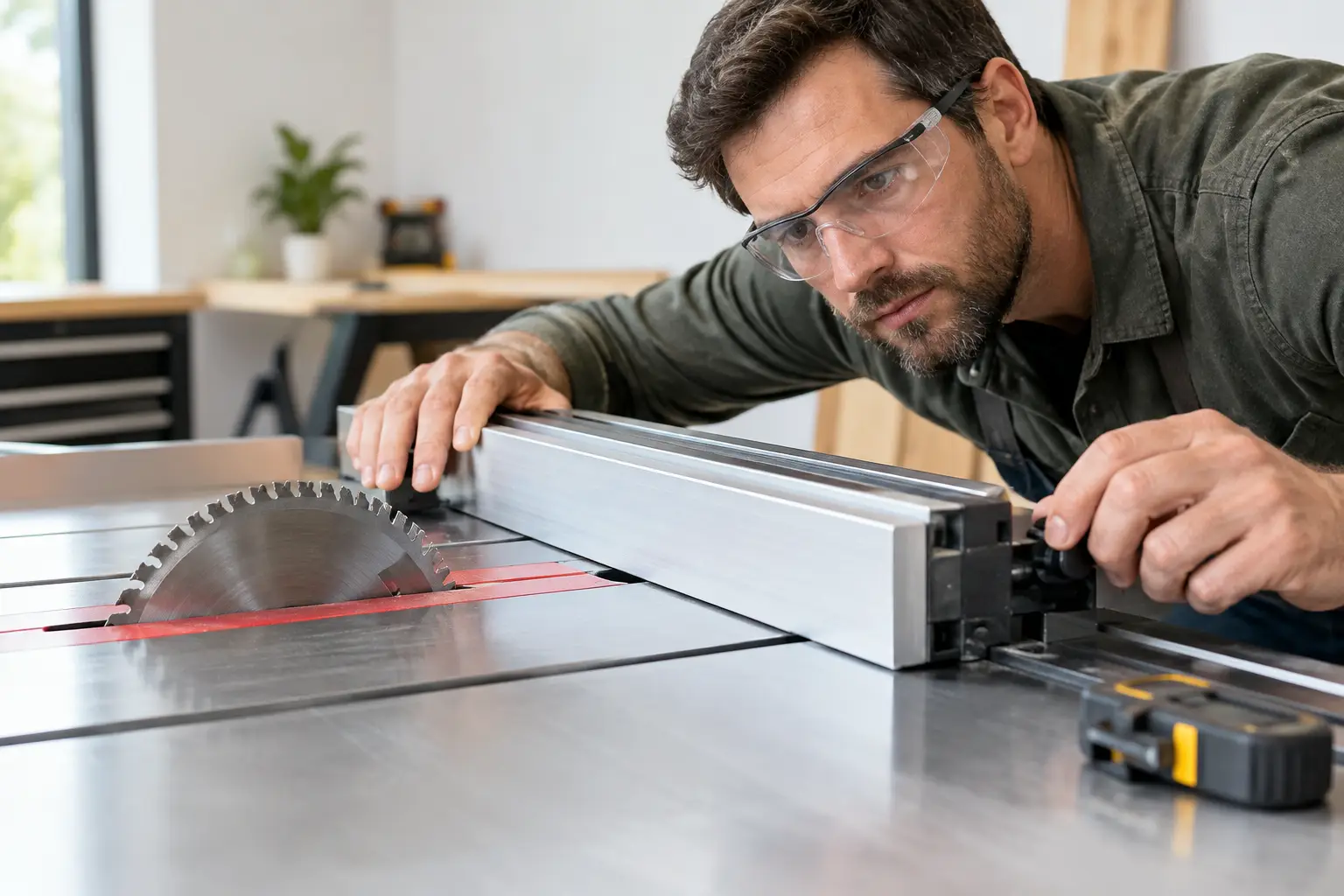
Do not assume the fence is perfectly aligned simply because the measurement scale reads correctly.
Check the actual alignment with an appropriate measuring tool and make test cuts before relying on the saw for precision work.
Plan a Safe Cutting Area in Your Garage
A compact table saw may occupy relatively little floor space, but the material passing through it needs considerably more room.
This is one of the most common mistakes when planning a small garage workshop.
People measure the machine, find a place for it, and then discover that they cannot comfortably feed an eight-foot board through the saw.
Instead of planning around the folded dimensions, consider the longest material you expect to cut.
For example, cutting an eight-foot board requires enough clearance for the material to enter the saw, pass through the blade, and remain supported after the cut.
You do not necessarily need a permanent eight-foot clearance in both directions. The required arrangement depends on the workpiece, cutting method, and support equipment.
A driveway can provide temporary space when weather and conditions allow. Inside the garage, a mobile workbench or folding support table can create additional room during cutting sessions.
Outfeed Support Is Essential for Longer Material
Outfeed support helps prevent long boards and panels from tipping as they leave the back of the saw.
Without adequate support, the weight of the material can affect your control and make the cut more difficult to manage.
Fortunately, you do not need a permanent outfeed table to solve this problem.
A folding worktable, adjustable roller stand, or mobile workbench can provide useful support when needed.
The important detail is height and alignment. A roller stand that sits too high or too low can cause the material to move unpredictably.
For a small garage, a folding or mobile solution is often more practical than building a large permanent table.
Our guide explains how much outfeed space a table saw needs and how to plan support around your available workshop area.
Keep the Floor Clear Around the Saw
A small garage has limited room to recover from an unexpected problem.
Keep electrical cords, dust-collection hoses, scrap wood, and other equipment away from the operator’s walking area.
Position the saw so that you can stand comfortably and maintain control of the workpiece throughout the cut.
Do not place the machine where you have to twist around storage cabinets or squeeze between other tools while feeding material.
If your garage is particularly narrow, consider moving other equipment to the walls and creating one dedicated cutting zone that can be opened when needed.
Dust Collection: What to Expect From a Portable Saw
Dust collection is one area where jobsite saws often fall short of larger stationary machines.
Many portable models have an open underside and gaps around the blade area. Even when connected to a vacuum, some fine dust can escape above and below the tabletop.
A common dust port size is 2-1/2 inches, which makes a shop vacuum a practical starting point for many small garage workshops.
However, collecting large wood chips and capturing fine airborne dust are two different things.
A shop vacuum may collect a significant amount of debris from the lower blade housing without capturing all the fine particles created during cutting.
Use the Shortest Practical Vacuum Hose
Hose length and configuration can affect airflow and suction at the tool.
For a small garage, keep the connection as direct as practical and avoid unnecessary reducers, sharp bends, and crushed hose sections.
Our guide explains how hose length reduces suction.
A properly maintained shop vacuum with a suitable filter can improve dust collection, but it should not be treated as a complete dust-control system.
Check the filter regularly and empty the collection container before it becomes excessively full.
If your vacuum loses performance, inspect the hose, connections, and filter before assuming the saw itself has a problem.
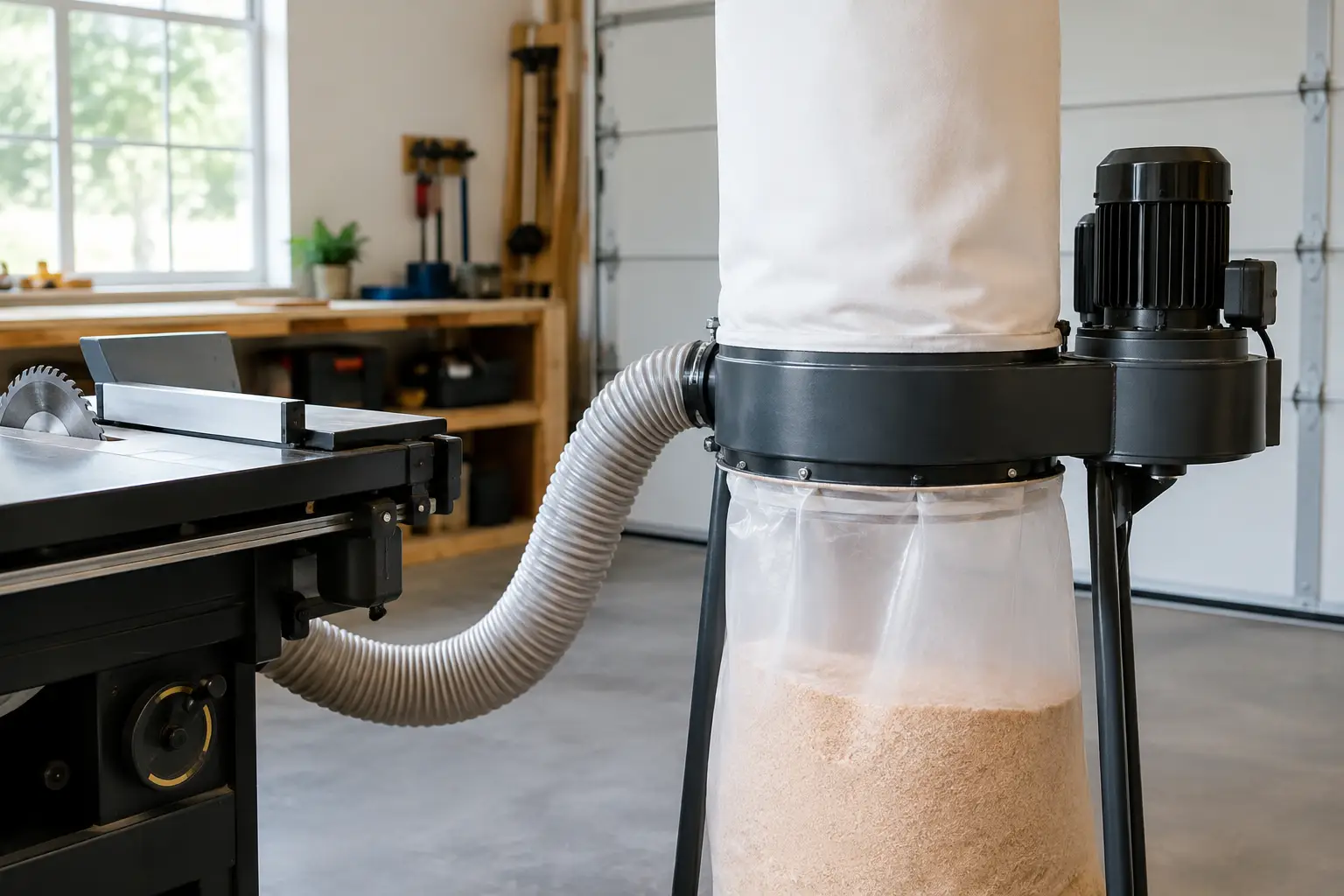
Consider Additional Dust Protection
Some jobsite saws allow the use of an additional dust-collection connection near the blade guard.
An overhead collection system can improve capture around the upper blade area, particularly during repeated ripping operations.
However, compatibility and clearance vary by machine.
You should also consider general workshop ventilation and appropriate respiratory protection when cutting MDF, plywood, and other materials that generate fine dust.
Do not rely on an ordinary shop vacuum alone to protect your lungs.
Improve Cutting Accuracy Before Your First Project
A portable table saw may move between storage and working positions frequently. That makes it worth checking the basic adjustments before starting a project.
You do not need to recalibrate the entire machine every time you use it, but you should verify that the important components remain properly aligned.
Start with these checks:
- Inspect the blade for damage, buildup, or missing teeth.
- Check that the blade is properly installed.
- Verify the blade angle at 90 degrees and, when needed, at 45 degrees.
- Check the blade’s alignment with the miter slot using an appropriate measuring method.
- Verify that the rip fence is parallel to the blade.
- Confirm that the fence locks securely.
- Make a test cut using scrap material.
Follow the manufacturer’s adjustment procedure and tolerances. Do not assume every saw uses the same calibration method.
Choose the Right Blade for Your Material
The blade supplied with a jobsite saw may be adequate for general construction work, but it might not produce the finish you want for furniture or cabinet projects.
Blade selection should match the material and type of cut.
A quality combination blade is a practical starting point for someone who works with a mixture of solid wood and sheet goods.
A dedicated ripping blade can be useful when cutting thicker hardwood along the grain. A suitable fine-tooth crosscut or plywood blade can help produce cleaner edges when working with veneered materials.
Keep the blade clean and sharp. A dull blade increases cutting effort and can contribute to poor results and dangerous operating conditions.
Also verify that replacement blades match the saw’s required diameter, arbor, and other manufacturer specifications.
Table Saw Safety in a Small Garage
Safety deserves special attention in a compact workshop.
A jobsite saw may be portable, but it is still a powerful cutting machine. Limited space can make poor positioning, inadequate support, and awkward material handling even more problematic.
Use the manufacturer’s blade guard and riving knife whenever the operation allows them to remain installed.
The riving knife helps prevent the kerf from closing against the back of the blade, reducing the chance of certain kickback situations.
Anti-kickback pawls provide additional protection when fitted and used as intended.
A push stick or push block should be available before you start making narrow cuts. Never try to control a small offcut by placing your fingers close to the blade.
Other important precautions include:
- Wear appropriate eye and hearing protection.
- Use respiratory protection appropriate for the material and exposure.
- Keep both hands away from the blade path.
- Stand out of the direct line of potential kickback.
- Support both the incoming material and the outfeed side.
- Never use a damaged or improperly installed blade.
- Disconnect power before making adjustments or changing the blade.
- Never reach over or behind a moving blade.
- Do not force material through the saw.
Avoid using the rip fence as a guide for crosscutting long boards. Use an appropriate miter gauge or crosscut sled instead.
Never remove safety components simply to make a particular cut more convenient. If a specialized operation requires a different guarding arrangement, follow the manufacturer’s instructions and use the appropriate approved equipment and procedures.
A clean, well-organized garage also makes a difference. You should have enough room to move without stepping over cords or trying to work around stored equipment.
When a Jobsite Saw Is Not the Best Choice
A portable table saw is an excellent solution for many home workshops, but it is not the right machine for every woodworking operation.
If you regularly process thick rough lumber, build large furniture pieces, or make repeated precision cuts throughout the day, you may eventually want a heavier machine.
A contractor or cabinet saw generally offers more mass, a larger working surface, and a different level of support for demanding work.
However, putting a large stationary machine into a one-car garage is not always the smartest decision.
You might gain cutting capacity but lose the ability to park your vehicle, move large workpieces, or access other tools.
For many small workshops, combining several compact machines produces a more useful workspace.
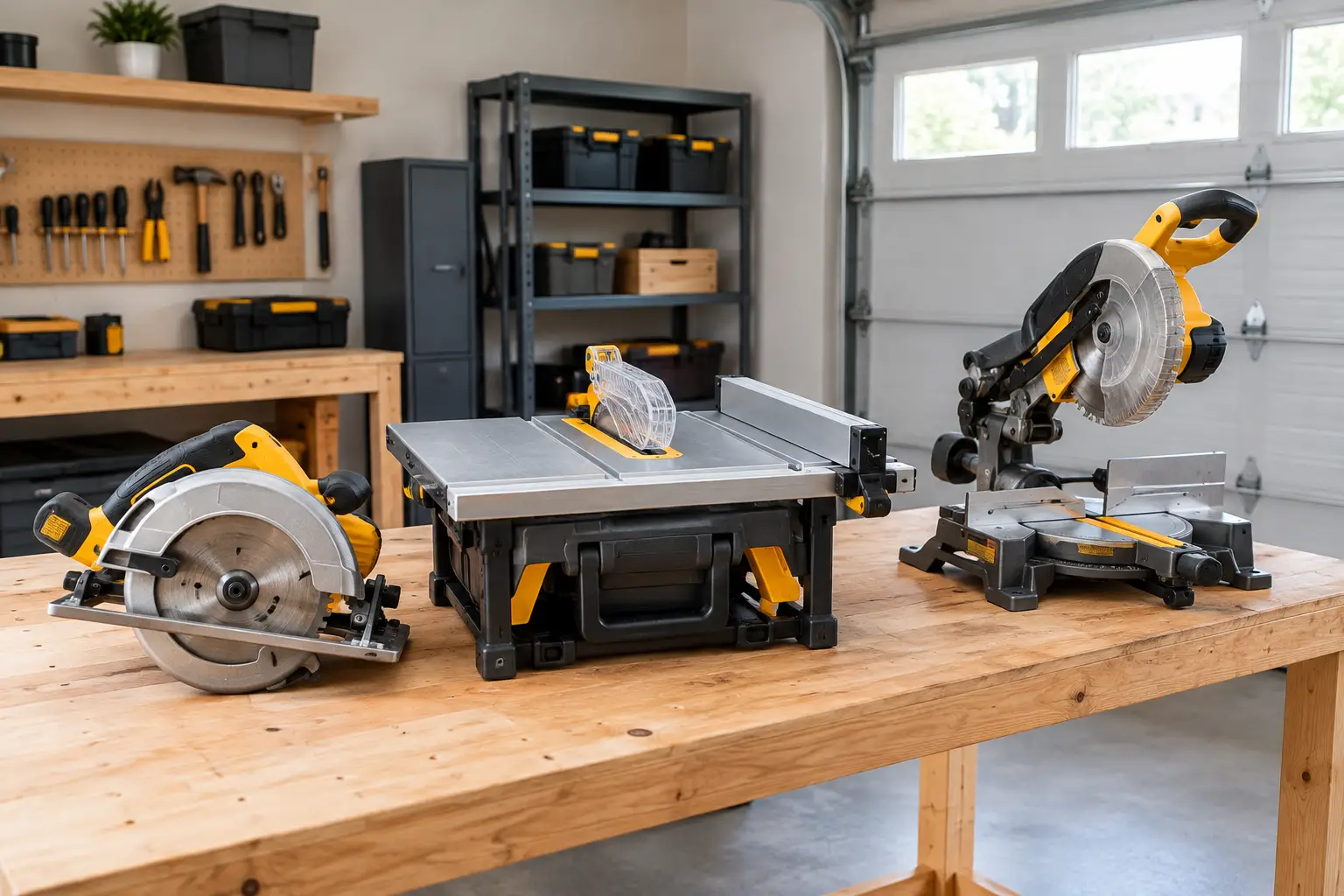
A jobsite table saw can handle repeatable ripping and smaller components, while a track saw can break down large plywood sheets. A miter saw can take care of many crosscuts, and a mobile workbench can provide additional assembly and outfeed space.
The goal is not to fit the largest possible machine into the garage. It is to create a workshop where each tool has a useful purpose without making the entire space difficult to work in.
Frequently Asked Questions About Jobsite Saws for Small Garages
What is the best size table saw for a small garage?
For many small garage workshops, an 8-1/4-inch compact jobsite saw provides a good balance between cutting ability and storage convenience.
A 10-inch model is worth considering if you regularly work with thicker lumber or need greater cutting depth and rip capacity.
The right choice depends on your projects and the space available for setup.
Is a jobsite table saw good enough for woodworking?
Yes. A quality jobsite table saw can handle many woodworking projects, including furniture components, shelving, cabinet parts, and workshop fixtures.
Its limitations are usually related to tabletop support, dust collection, motor refinement, and overall stability rather than an inability to produce accurate cuts.
Proper setup, a suitable blade, and a well-adjusted fence make a significant difference.
Can I use a jobsite saw in a one-car garage?
Yes, provided you have enough room to position the saw safely and support the material being cut.
A folding or wheeled stand makes it easier to store the machine when it is not in use.
You should also consider where the vehicle, workbench, dust collector, and other equipment will be positioned during cutting sessions.
Is a 10-inch jobsite saw better than an 8-1/4-inch model?
Not automatically.
A 10-inch saw generally offers greater cutting depth and can handle a wider range of material thicknesses.
An 8-1/4-inch saw may be more convenient when storage space and portability are the main priorities.
Choose according to the material you work with most often rather than assuming a larger blade is always better.
Can a jobsite table saw cut a full sheet of plywood?
Some jobsite saws have enough rip capacity to accommodate the width of a full sheet in a particular cutting orientation.
However, that does not mean handling a full 4-by-8-foot sheet on a compact saw is safe or practical for one person.
A track saw or circular saw is often a better choice for breaking down large panels before using the table saw for final sizing.
Do jobsite table saws need a dust collector?
Not necessarily. Many portable saws can connect to a shop vacuum through a compatible dust port.
However, a vacuum does not capture all airborne dust, especially around the top of the blade.
Good filtration, appropriate respiratory protection, and adequate workshop ventilation remain important.
Final Thoughts: Choose a Saw That Fits Your Entire Workshop
The best jobsite saw for a small garage is not necessarily the model with the largest rip capacity or the most elaborate stand.
It is the one that fits your projects, stores without creating problems, and can be set up with enough room to work safely.
For a garage that must serve as both a parking area and a woodworking shop, portability can be more valuable than having a large permanent machine.
Pay attention to blade size, fence quality, stand design, dust collection, and the support required for your typical workpieces.
A compact saw with a reliable fence, a stable setup, and proper outfeed support can be a very capable centerpiece for a home workshop.
Rather than sacrificing the entire garage to one large machine, build your workshop around tools that work together and give you room to move.

Leave a Reply