
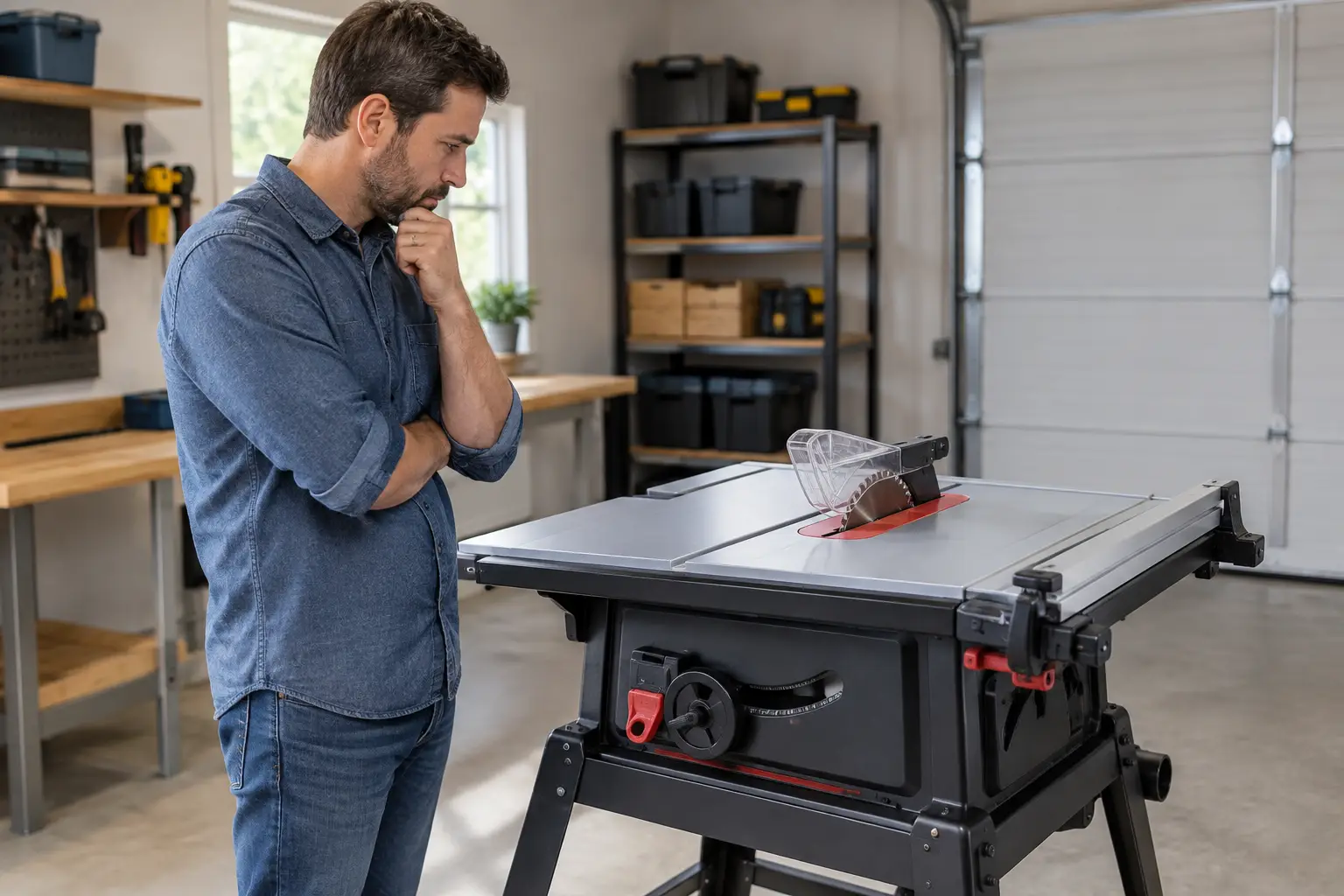
Choosing a table saw for a small garage is less about buying the biggest machine you can afford and more about finding the right balance between cutting capacity, accuracy, mobility, and available space.
A table saw can become the most useful machine in a one-car garage workshop. It can also become a permanent obstacle if the saw, stand, fence rails, outfeed area, and material path were never considered together.
For most home woodworkers, a compact jobsite table saw is a practical starting point because it combines a 120-volt power requirement with reasonable rip capacity and mobility. Larger contractor and cabinet saws can offer more stability and cutting capacity, but they require considerably more floor space and a more permanent shop layout.
The right table saw is the one that fits the work you actually do while leaving enough room to move, store lumber, collect dust, and use the rest of your garage.
Start With the Space Around the Table Saw
Before comparing blade sizes, motors, or rip capacities, measure your garage.
The footprint listed by a manufacturer tells you where the saw itself sits. It does not tell you how much room you need to feed material into the blade, support the workpiece as it exits, stand beside the fence, or move around the machine.
This distinction is especially important with sheet goods.
A 4-by-8-foot sheet of plywood is much larger than even a full-size table saw. If you regularly work with full sheets, you need a plan for supporting the material before and after the cut. In a small garage, trying to handle an entire sheet directly on a compact table saw can be awkward and difficult to control.
A better workflow is often to break large sheets down first with a circular saw and guide or a track saw. Once the panels are reduced to manageable sizes, the table saw can handle accurate ripping and repeatable cuts.
Think about the table saw as a working zone, not just a machine.
Measure:
- The width and depth of the saw
- The length of the fence rails
- Space in front of the blade
- Space behind the blade
- Room beside the fence
- Outfeed support
- Space needed to move around the machine
- Clearance from the garage door
- Clearance from shelving and stored lumber
A saw that fits perfectly against the wall may still be a poor choice if you have to move half the garage every time you use it.
Look Up, Too
Garage space is three-dimensional.
Folding stands, long boards, outfeed tables, overhead storage, garage-door tracks, and lighting can all interfere with a table saw setup.
If you plan to store the saw beneath shelving, check the folded height of the complete machine and stand. Also check how the fence rails extend when the saw is ready for use.
In a small garage, these details can matter more than a few extra inches of rip capacity.
Decide How You Will Use the Saw
There is no single table saw design that is ideal for every small workshop.
The main categories to consider are:
- Benchtop table saws
- Jobsite table saws
- Contractor saws
- Cabinet saws
The best category depends on the material you cut, how often you use the machine, and whether your garage needs to remain available for other purposes.
Benchtop Table Saws: Best When Space Is Extremely Limited
Benchtop saws are compact and relatively easy to store.
They make sense for occasional woodworking, small furniture projects, trim work, shelves, boxes, and other projects where you are not constantly cutting large or heavy stock.
The biggest advantage is storage. A compact saw can live on a workbench or dedicated cart and be moved when necessary.
The trade-off is support and stability.
A small benchtop saw has less table area than a larger jobsite or contractor saw. The included fence may also be lighter, and the machine itself may be more susceptible to movement when cutting larger workpieces.
If you choose a benchtop model, give it a stable platform.
A dedicated cart with a flat mounting surface, side support, and a small outfeed area can make a compact saw much easier to use.
For a very small garage, this approach can work well if most of your projects involve relatively small components rather than full sheets of plywood.
Jobsite Table Saws: A Practical Choice for Most Small Garages
For many one-car garages, a jobsite table saw provides the best combination of portability and capability.
Most corded jobsite models use a standard 120-volt household circuit and are designed around a 10-inch or smaller blade. Some compact models use an 8-1/4-inch blade to reduce the overall size and weight.
Their biggest advantage in a garage is mobility.
A saw on a folding or wheeled stand can be pushed against the wall when you need the floor space and brought into the working area when you are ready to cut.
That flexibility is extremely valuable if the garage still needs to hold a vehicle.
However, do not confuse portability with lack of capability.
Modern jobsite table saws can provide useful rip capacity, accurate fences, adjustable blade height and bevel controls, and enough power for many furniture and cabinet projects. Current buying guides also emphasize mobility and fence quality as major factors when choosing a saw for a compact workshop.
The stand matters almost as much as the saw.
Look for a stand that:
- Locks securely
- Does not wobble during cuts
- Folds or stores efficiently
- Provides a comfortable working height
- Can accommodate outfeed or side support
If the saw moves while you are pushing material through the blade, portability becomes a disadvantage rather than an advantage.
Contractor Saws: More Stability With a Larger Footprint
Contractor saws occupy the middle ground between portable jobsite machines and large cabinet saws.
They generally provide more mass, a larger work surface, and better stability than lightweight portable saws. For someone building furniture regularly, that additional stability can be valuable.
The downside is obvious in a small garage: the machine takes up more room.
A contractor saw becomes more attractive when woodworking is a major use of the garage and the machine can remain set up most of the time.
A quality mobile base can make a contractor saw more practical, but remember that mobility does not eliminate the space required to operate it.
You still need room for material support and a clear path around the machine.
Cabinet Saws: Excellent Machines, but a Serious Space Commitment
Cabinet saws are designed as stationary workshop machines.
Their heavier construction, enclosed bases, larger work surfaces, and powerful motors make them attractive for demanding woodworking. The additional mass can reduce vibration and provide a more substantial cutting platform.
But a cabinet saw is rarely the first choice when every square foot of a garage matters.
Before buying one, consider more than the machine’s footprint.
You also need to plan for:
- Electrical requirements
- Dust collection
- Fence rails
- Outfeed support
- Material storage
- Access for maintenance
- A mobile base if you need to move it
A cabinet saw can work in a compact garage, but only when the entire workshop has been designed around it.
Rip Capacity: How Much Do You Really Need?
Rip capacity is the maximum distance between the blade and the fence on the side where the manufacturer specifies the capacity.
It is one of the most important specifications to compare because it determines how wide a board or sheet-goods panel you can cut against the fence.
But bigger is not automatically better.
A compact table saw with approximately 24 to 25 inches of rip capacity may be sufficient for many furniture projects. Cabinet sides, shelves, drawer components, and smaller panels often do not require an extremely wide fence position.
If you regularly build cabinets or work with wider sheet-goods components, moving into the 30- to 32-inch range gives you more flexibility.
Some larger portable saws offer approximately 32 inches of rip capacity while still using a folding stand. That can be attractive when you want more capability without moving to a stationary cabinet saw.
However, there is an important catch.
Rip capacity does not equal sheet-goods handling capability.
A saw may have enough rip capacity to make a wide cut, but you still need to safely support a large plywood sheet before, during, and after the cut.
For a small garage, consider using a track saw or circular saw with a guide to break down full sheets first.
Then use the table saw for:
- Final ripping
- Narrower panels
- Cabinet components
- Repeat cuts
- Furniture parts
- Accurate dimensioning
This workflow can make a smaller saw much more useful.
Fence Quality Matters More Than a Huge Motor
One of the easiest mistakes when shopping for a table saw is focusing too heavily on motor power.
A powerful motor does not compensate for a poor fence.
The fence needs to lock securely and remain parallel to the blade during the cut. If it moves, flexes, or is difficult to position accurately, repeatable cuts become much harder.
This is why current table-saw buying guides consistently give fence design significant attention.
Rack-and-Pinion Fences
Rack-and-pinion fences are common on portable and jobsite saws.
They allow you to adjust the fence using a controlled mechanism rather than manually moving the fence and repeatedly checking both ends.
For a small garage where quick setup matters, this can be a major advantage.
T-Square Style Fences
Larger contractor and cabinet-style saws commonly use heavier T-square-style fences.
A good T-square fence can provide a very solid locking system and excellent repeatability.
When comparing fences, look for:
- Secure locking
- Easy-to-read measurement markings
- Minimal flex
- Smooth adjustment
- Parallel alignment
- Enough space for an auxiliary or sacrificial fence
Do not judge a fence only by its maximum capacity.
A smaller fence that stays accurately aligned can be more useful than a much larger fence that is difficult to adjust or does not lock consistently.
Consider Blade Size and Cutting Depth
Blade diameter affects the maximum depth of cut.
The most common sizes for small-shop table saws are 8-1/4-inch and 10-inch blades.
An 8-1/4-inch saw can be smaller and lighter, making it attractive when storage is a major concern. A 10-inch table saw generally provides greater cutting depth and broader accessory and blade availability.
If you regularly cut thicker hardwood or construction lumber, check the manufacturer’s published maximum cutting depth at 90 degrees.
Do not choose a blade size simply because a larger number sounds better.
Instead, ask:
What is the thickest material I actually expect to cut?
That answer will tell you more than the blade diameter alone.
Motor Power: Match It to the Material
Motor power matters, but it should be evaluated alongside blade quality, material thickness, feed rate, and the saw’s overall design.
For many portable table saws, a 15-amp motor is common and provides substantial capability for a home workshop.
That does not mean every 15-amp saw performs identically.
Ripping thick hardwood places considerably more demand on a portable saw than cutting thin plywood or softwood.
If your normal work involves hardwood furniture, thick stock, or long continuous rips, pay attention to how the saw handles sustained cuts rather than choosing solely by the advertised motor specification.
Blade condition matters as well.
A sharp, appropriate blade can make a noticeable difference in cutting performance. Use a blade designed for the material and type of cut instead of expecting one general-purpose blade to perform perfectly on everything.
Think About Your Garage Electrical Circuit
Electrical planning is easy to overlook when buying a table saw.
Many portable table saws are designed for 120-volt operation, making them convenient for home garages. Larger stationary machines may have different electrical requirements, including models designed for 240 volts.
Before buying a saw, know what circuit you will use and what other equipment is likely to run on it.
Avoid relying on long, undersized extension cords. Excessive cord length and insufficient conductor size can contribute to voltage drop and heat.
If you regularly use a high-draw tool in the garage, having an electrician evaluate the circuit can be worthwhile.
The goal is not simply to make the saw turn on. It is to provide an appropriate electrical setup for the tool you selected.
Dust Collection Is Especially Important in a Small Garage
Dust becomes a bigger problem as the workshop gets smaller.
In a large shop, some dust may settle before it becomes a major nuisance. In a one-car garage, the same dust can quickly cover the workbench, shelves, floor, and other tools.
Portable table saws commonly use smaller dust ports that work well with a shop vacuum. Larger stationary saws may be designed around 4-inch dust-collection hoses and higher-volume collectors.
This is one reason a dust collector can make more sense for a stationary workshop setup.
For a portable jobsite saw, a good shop vacuum with an appropriate hose and filtration can be a practical solution.
Do not assume that connecting any vacuum to any port will produce good collection.
Pay attention to:
- Hose diameter
- Hose length
- Number of bends
- Reducers and adapters
- Filter condition
- Dust separator use
- The design of the saw’s dust enclosure
Keep the hose as direct as practical.
Also remember that table saw dust collection is not perfect. Fine dust can escape above the table, around the blade guard, or through openings in the saw housing.
A clean filter and appropriate fine-dust filtration are important when working with wood dust inside an enclosed garage.
Make Safety Features Part of the Buying Decision
A table saw should never be selected on cutting performance alone.
Look for a properly designed riving knife, blade guard, anti-kickback features where applicable, and an accessible power switch.
The riving knife is particularly important because it helps keep the kerf from closing against the rear of the blade, reducing the conditions that can contribute to kickback.
Use the manufacturer’s guarding system as intended for the type of cut being performed.
For narrow rips, keep a push stick or appropriate push device within reach. Maintain a stable stance and avoid positioning yourself directly in the path behind the blade.
Long workpieces also need proper support.
Do not improvise an outfeed table from unstable boxes, loose bins, or anything that can move when the workpiece reaches it.
Safety also includes the area around the saw.
If you have to squeeze between a vehicle and a shelving unit to reach the power switch, change the setup.
A machine that cannot be accessed comfortably is difficult to operate safely.
Do You Need a Mobile Base or Rolling Stand?
For a small garage, mobility can be one of the most valuable features a table saw can have.
A jobsite saw with a folding stand can often be stored against a wall. A contractor or cabinet saw may need a dedicated mobile base.
The important thing is not simply whether the saw has wheels.
The wheels should allow you to move the machine easily but lock firmly when you are cutting.
Before buying a mobile base, check:
- Maximum weight capacity
- Wheel size
- Locking mechanism
- Overall added height
- Clearance around the saw
- Whether the base interferes with dust collection
A good mobile setup allows you to change the garage from storage mode to woodworking mode without spending half an hour rearranging everything.
Don’t Forget the Miter Gauge and Accessories
The table saw itself is only part of the system.
Check what is included and what you will need to add later.
Useful accessories can include:
- Quality table saw blades
- Push sticks
- Push blocks
- Outfeed support
- Side support
- Dust separator
- Shop vacuum
- Featherboards
- Clamps
- Auxiliary fence material
- Mobile base or folding stand
The included miter gauge on an entry-level saw may be perfectly adequate for basic work, but it is worth evaluating if you expect to make frequent crosscuts or angled cuts.
Also check the saw’s compatibility with the accessories you expect to use.
Choose Based on Your Typical Garage Projects
Your projects should determine the saw category.
For Occasional DIY Projects
If you mainly build shelves, small tables, simple storage projects, trim, and occasional furniture, a compact benchtop or jobsite saw may be enough.
Prioritize:
- Small footprint
- Easy storage
- Reliable fence
- 120V operation
- Quick setup
For Furniture Projects
If you regularly build furniture from hardwood and plywood, a 10-inch jobsite saw with a good fence or a compact contractor saw may make more sense.
Prioritize:
- Fence accuracy
- Stable stand
- Adequate rip capacity
- Blade quality
- Dust collection
- Material support
For Cabinet Building
Cabinet work places greater demands on rip capacity and material handling.
A jobsite saw can still work, especially when paired with a separate sheet-breakdown method, but a contractor or larger stationary saw may become more attractive if cabinetry is a regular part of your work.
Prioritize:
- Approximately 30 inches or more of rip capacity if your projects require it
- Accurate fence
- Stable work surface
- Outfeed support
- Dust collection
- Adequate electrical capacity
The important point is that the biggest saw is not automatically the right saw.
A Simple Small-Garage Table Saw Buying Checklist
Before buying, answer these questions:
- Where will the saw be stored?
- Where will it be used?
- Can you move it without assistance?
- How wide is the widest material you normally cut?
- Do you work with full 4-by-8 sheets?
- Can you break large sheets down before using the table saw?
- Is the fence easy to adjust and lock securely?
- Does the saw fit your available electrical circuit?
- What dust collection system will you use?
- Where will the material be supported before and after the blade?
- Can the garage still function normally when the saw is set up?
- Can you store the saw without blocking doors, vehicles, or other tools?
If you can answer those questions before shopping, you will eliminate many unsuitable machines before getting distracted by horsepower numbers and oversized rip-capacity claims.
Final Thoughts
The best table saw for a small garage is not necessarily the most powerful or the one with the largest rip capacity.
It is the machine that fits your workflow.
For many one-car garages, a portable jobsite table saw provides a useful combination of 120-volt operation, mobility, reasonable rip capacity, and relatively small storage requirements. A benchtop saw can make sense when space is extremely limited, while a contractor or cabinet saw becomes more practical when woodworking is the primary purpose of the garage.
Pay particular attention to fence quality, rip capacity, blade size, cutting depth, dust collection, mobility, electrical requirements, and material support.
Most importantly, think about the entire cutting process rather than the machine alone.
If you can break down large sheets separately, roll the saw into position when needed, connect realistic dust collection, provide stable outfeed support, and return the machine to storage without rearranging the entire garage, you have chosen a table saw that works with your space instead of against it.
A small garage does not require a small woodworking capability. It requires a table saw and shop layout that are designed around the space you actually have.



Leave a Reply