
As an Amazon Associate I earn from qualifying purchases.
A good dust collector filter does more than keep sawdust from blowing back into your garage. The right filter helps maintain airflow, keeps fine dust from recirculating through the shop, and can make a noticeable difference in how often you need to clean your tools and work surfaces.
That matters even more in a small woodworking shop.
In a one-car garage, the collector may be only a few feet from your table saw, planer, or workbench. There is less room for dust to disperse, less space for a large filtration system, and usually no dedicated mechanical ventilation. If the filter restricts airflow or allows too much fine dust through, you notice the problem quickly.
But choosing a filter is not as simple as buying the lowest micron rating you can find.
The best dust collector filter for a small shop needs to match the collector, maintain useful airflow, provide enough filter surface area, seal properly, and be practical to clean.
Here is what to look for.
What Does a Dust Collector Filter Do?
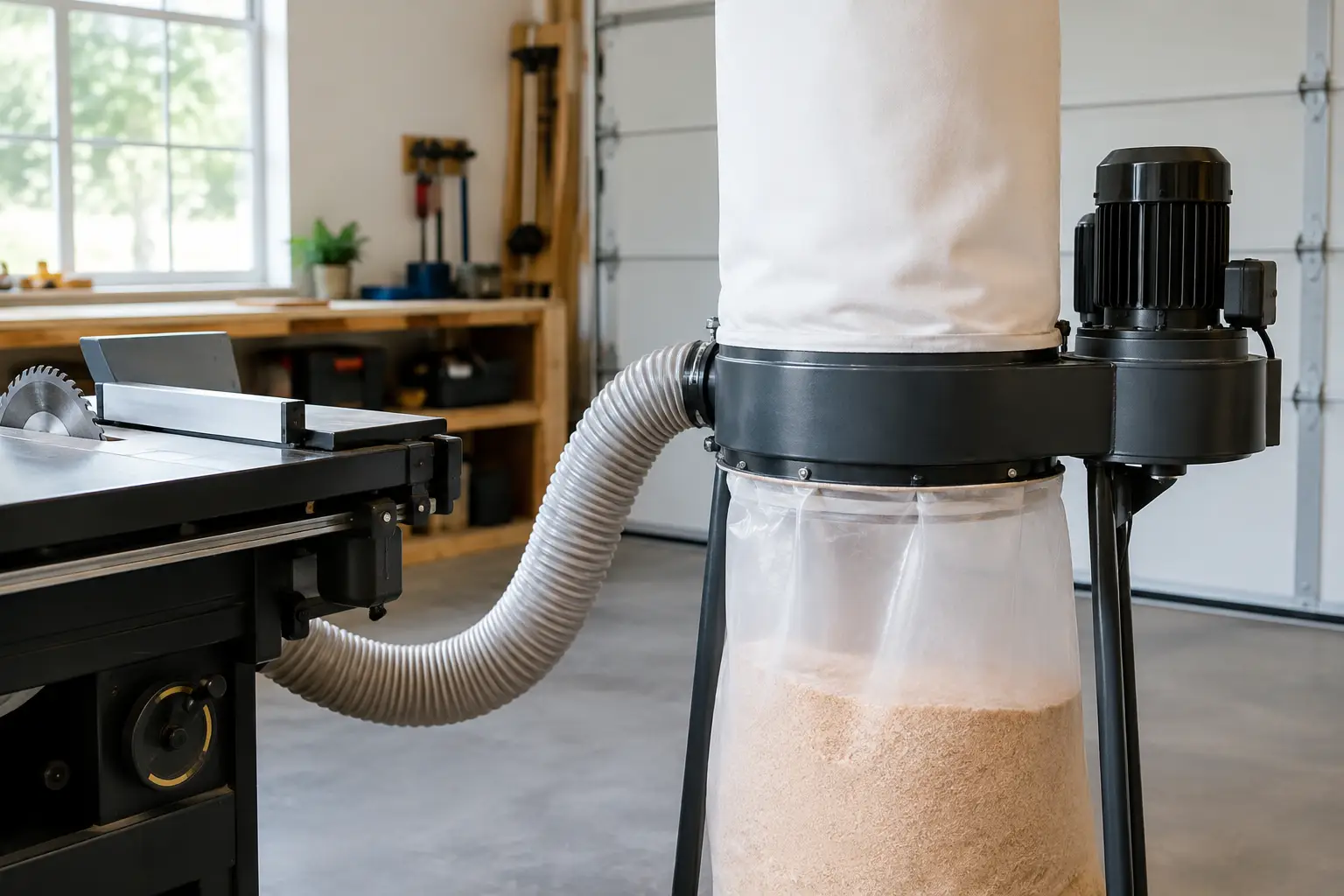
A dust collector pulls dust-laden air away from a woodworking machine and separates the material from the air stream. Larger chips and debris fall into the collection bag or drum, while the filter captures particles that remain suspended in the air.
The filtered air then leaves the collector.
This makes the filter an important part of the entire dust collection system, but it is not the only part that determines performance.
A fine filter cannot compensate for poor dust capture at the machine.
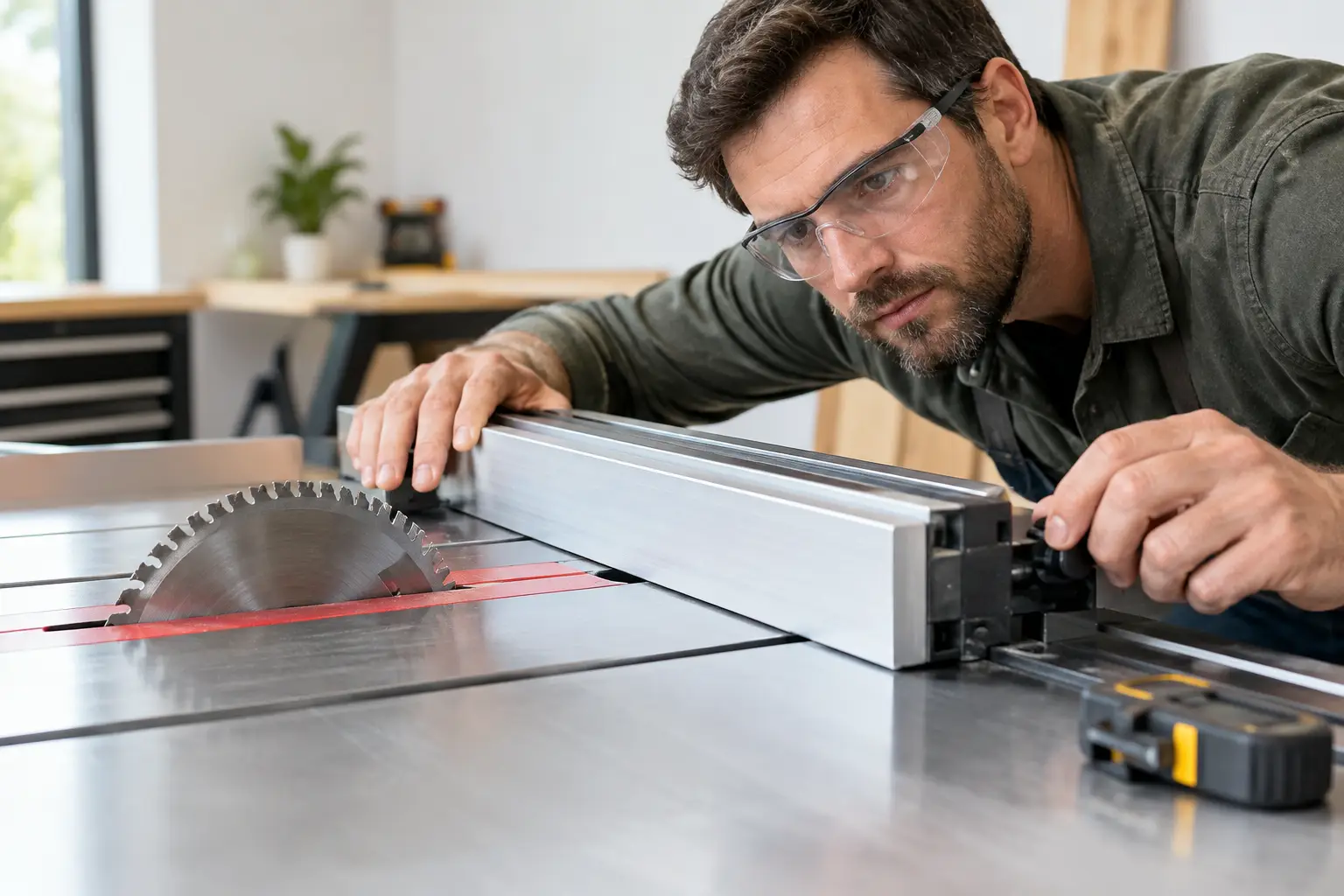
For example, a table saw can throw dust above and behind the blade before that dust ever reaches the lower collection port. NIOSH research has shown that local exhaust positioned close to the dust source can significantly improve dust control on table saws.
The same basic principle applies to a small garage shop: capture dust at the source first, then filter what reaches the collector.
Why Filter Micron Rating Matters
Dust collector filters are commonly described by a micron rating.
A micron, or micrometer, is one-millionth of a meter. A smaller particle size is finer than a larger one, so a filter designed to capture smaller particles can provide finer filtration.
However, don’t make the mistake of treating the micron number as the complete performance specification.
A filter labeled 1 micron is not automatically better in every situation than another filter labeled 2 microns. The actual result depends on the filter media, construction, available surface area, airflow, sealing, and how the rating was determined.
This is one reason a large pleated cartridge can be a much better upgrade than simply replacing one filter bag with another filter that has a lower advertised micron number.
For a small woodworking shop, 1-micron-class filtration is a useful target for a general-purpose collector, while finer cartridge options can make sense when fine-dust filtration is a priority.
The important thing is to consider the entire filter design rather than shopping by the smallest number printed on the package.
Filter Surface Area Is Just as Important as Micron Rating
One of the most overlooked dust collector filter specifications is filter surface area.
A cartridge filter uses pleats to pack a large amount of filter media into a relatively small physical space. More usable filter area can help the collector move air through the media with less restriction while also providing more room for dust to accumulate.
That matters because every filter creates some resistance.
As dust loads the media, resistance can increase and airflow can decrease. Current testing and comparison work on dust collector filters shows why filter loading, static pressure, airflow, and fine-dust capture should be considered together rather than looking at micron rating alone.
This is especially important in a small garage shop where the collector may be used several times a week.
A tiny cartridge with an impressive filtration number may not be the best practical choice if it loads quickly and causes a noticeable drop in airflow.
When comparing cartridge filters, look at:
- Filter surface area
- Pleat depth and design
- Micron rating
- Collector compatibility
- Cleaning method
- Filter diameter and height
- Replacement cost
- Airflow restriction
Dust Collector Bag vs. Cartridge Filter
For many small-shop owners, the biggest filter decision is whether to keep a fabric bag or upgrade to a cartridge.
Fabric Filter Bags
Filter bags are inexpensive and simple.
They are commonly found on entry-level single-stage dust collectors and can work reasonably well for collecting larger chips from machines such as planers and jointers.
The problem is fine dust.
Some stock bags have relatively coarse filtration, and the bag can gradually load with dust and restrict airflow. A collector may still appear to be working while its performance at the machine has deteriorated.
A finer replacement bag can be an inexpensive upgrade, especially if the collector is used occasionally.
Pleated Cartridge Filters
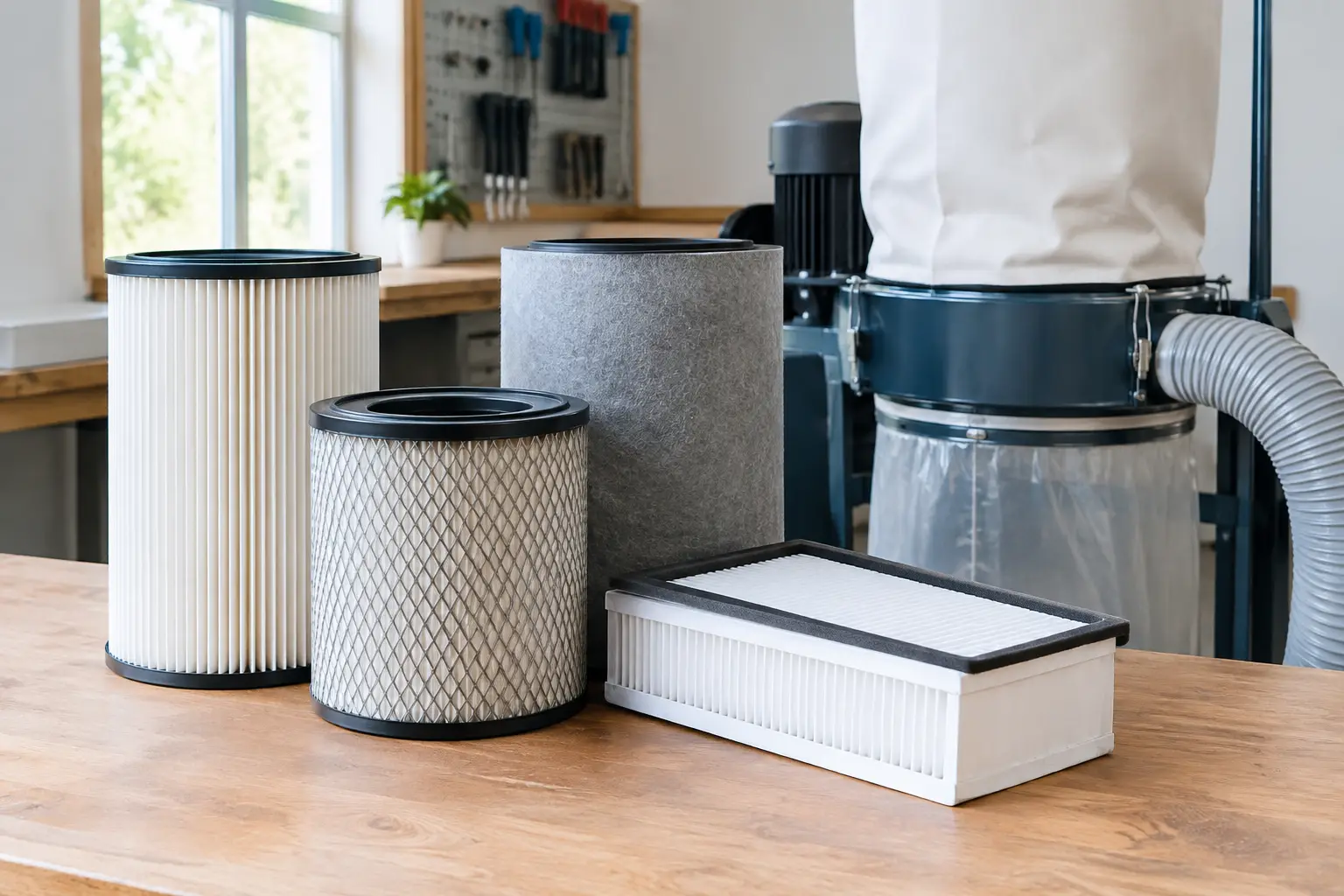
A cartridge filter uses pleated media to provide substantially more surface area than a flat or loosely woven bag of similar dimensions.
This design makes cartridges attractive for small shops that produce a lot of fine dust.
Many cartridge collectors also include a cleaning mechanism such as a crank, paddle, or internal cleaning system. This allows dust accumulated on the filter to be knocked loose without removing the cartridge every time it needs attention.
For a hobbyist who regularly uses a table saw, planer, jointer, router table, or miter saw, a good cartridge filter can be a worthwhile upgrade.
The trade-off is cost, size, and sometimes additional restriction.
A cartridge is not automatically better simply because it is a cartridge. The design and amount of filter media still matter.
Comparing dust collector bags and cartridge filters? → Browse Dust Collector Filters on Amazon to compare replacement filters and compatible options for your shop.
What Is the Best Filter Rating for a Small Woodworking Shop?
There is no single micron rating that is perfect for every collector.
For a typical small garage woodworking shop, a 1-micron-class filter is a reasonable starting point if your collector is compatible with it.
A finer cartridge may be appropriate when fine-dust filtration is a higher priority, provided the collector can maintain adequate airflow through that filter.
The mistake is buying a filter based only on filtration rating.
Think about these three things together:
Filtration: How effectively does the filter capture fine particles?
Airflow: How much useful airflow remains after the filter and ductwork are connected?
Filter area: How much media is available before the filter becomes heavily loaded?
A filter that performs well in all three areas is much more useful than one that wins on micron rating alone.
Match the Filter to Your Dust Collector
Before ordering any replacement filter, check the physical specifications of your collector.
The filter needs to match:
- Mounting diameter
- Mounting ring
- Gasket location
- Thread or clamp arrangement
- Filter height
- Filter diameter
- Collection system design
The seal around the filter is particularly important.
If dusty air can bypass the filter through a damaged gasket or poorly fitted mounting ring, the filtration media cannot do its job.
This is why a premium aftermarket filter that fits poorly can actually be a worse choice than a slightly less expensive filter that seals correctly.
Measure the existing filter and compare those dimensions with the manufacturer’s specifications before purchasing.
Ready to find a replacement filter that fits your collector? → Browse Dust Collector Filters on Amazon and compare filter sizes, styles, and replacement options.
Consider Your Biggest Dust-Producing Tool
Your filter choice should be based partly on the machines you actually use.
A benchtop planer can produce a huge volume of chips in a short period of time. A jointer behaves similarly.
A table saw creates a mixture of chips and fine dust, and its dust collection performance depends heavily on how well the saw enclosure captures the material.
A miter saw presents another challenge because much of the dust is thrown behind and around the blade instead of being naturally pulled toward the collection port.
If you use a miter saw regularly, improving the collector filter alone will not solve the problem.
A properly designed hood and a good collection connection can make a much bigger difference.
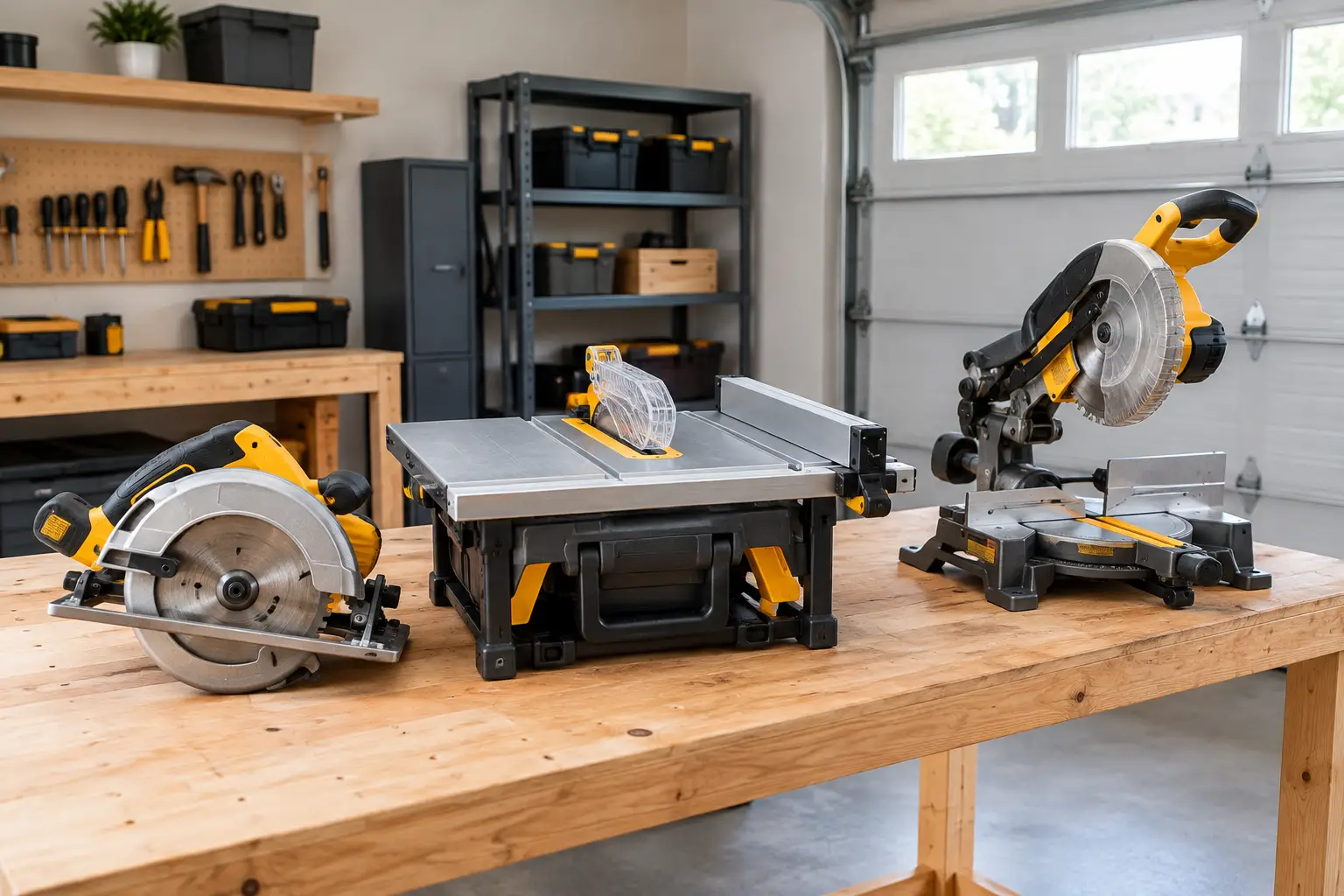
For more information on choosing a compact saw for this type of shop, see a miter saw.
Airflow Matters More Than the Number on the Collector Box
One of the biggest mistakes when choosing dust collection equipment is focusing exclusively on the advertised CFM number.
Many manufacturers publish airflow under conditions that do not represent a complete working setup.
Once you add a hose, elbows, fittings, blast gates, a separator, and a loaded filter, the airflow available at the machine can be substantially lower.
That is why a collector’s real-world performance depends on the entire system.
Current small-shop comparisons increasingly emphasize airflow at the tool rather than relying solely on free-air manufacturer ratings.
For a small garage shop, keep the system simple:
- Use the largest practical hose size.
- Keep hose runs as short as possible.
- Avoid unnecessary elbows.
- Avoid crushed or sharply bent flex hose.
- Use properly sized fittings.
- Keep the filter clean.
- Empty the collection bag or drum before it becomes packed.
A high-quality filter cannot overcome a severely restricted duct system.
Why Hose Diameter Matters
A 4-inch hose has approximately four times the cross-sectional area of a 2-inch hose.
That does not mean a 4-inch hose automatically produces four times the CFM. Actual airflow depends on the collector, static pressure, hose length, fittings, filter resistance, and tool connection.
However, reducing a collector designed around a larger connection to a much smaller hose can create significant resistance.
This is why a dust collector intended for stationary woodworking equipment should generally use the largest practical connection all the way to the machine.
For handheld sanders and small portable tools, a shop vacuum or dust extractor may be more appropriate because those machines are designed around smaller hoses and higher static pressure.
Single-Stage Collectors and Filter Upgrades
A single-stage collector can be a practical solution for a small garage workshop because it is relatively compact and can move considerably more air than many shop vacuums.
If you are comparing single-stage options, see this guide to the best portable dust collector for a small one-car garage.
One advantage of a single-stage collector is that filter upgrades are often straightforward.
You may be able to replace a coarse stock bag with a finer filter bag or install a pleated cartridge designed specifically for that collector.
Before upgrading, however, check whether the collector’s motor and impeller can maintain useful airflow with the replacement filter.
A finer filter that creates excessive restriction can reduce collection performance at the tool.
When a Cartridge Filter Makes the Most Sense
A cartridge filter is particularly attractive when:
- You use your dust collector frequently.
- Fine dust is a major concern.
- Your collector currently uses a coarse filter bag.
- You have enough vertical clearance for a cartridge.
- The collector has adequate airflow for the replacement filter.
- You want a reusable filter rather than repeatedly replacing bags.
- Your filter has enough surface area for the amount of dust your shop produces.
For a small one-car garage, physical dimensions matter.
Some cartridge collectors are tall enough to interfere with overhead garage-door tracks or storage.
Measure the collector with the filter installed, not just the filter itself.
Filter Cleaning Is an Airflow Maintenance Task
A dirty filter is not just a cosmetic problem.
As dust accumulates on the filter media, airflow can decline. You may notice the difference at the machine before you notice anything wrong with the filter itself.
Typical signs include:
- A planer fills with chips faster than normal.
- More dust remains around the table saw.
- The hose feels weaker.
- Fine dust begins appearing around the collector.
- The collector takes longer to clear debris.
- The filter looks heavily loaded.
Use the cleaning mechanism supplied by the manufacturer whenever possible.
If your cartridge has a crank or internal cleaning paddle, operate it with the collector turned off and allow the loosened dust to settle before opening the collection container.
Do not automatically use compressed air to clean a filter.
High-pressure air can damage some filter media and can turn the dust trapped inside the filter into a cloud inside your garage. Follow the filter manufacturer’s cleaning instructions instead.
When Should You Replace a Dust Collector Filter?
Cleaning can extend filter life, but filters do eventually need replacement.
Consider replacing a filter when:
- The media is torn.
- The filter no longer seals correctly.
- The gasket is damaged.
- Cleaning no longer restores reasonable airflow.
- The pleats are permanently packed with dust.
- The filter has been damaged by moisture or improper cleaning.
- Dust is bypassing the media.
- The collector continues to perform poorly despite an otherwise unrestricted system.
Do not wait until the filter is visibly falling apart.
A filter can become inefficient or overly restrictive before obvious physical damage appears.
Can a Pre-Separator Help Your Filter?
Yes.
A cyclone or pre-separator can remove a large portion of chips and heavier debris before the material reaches the dust collector or shop-vac filter.
This can be especially useful with a planer or jointer, where a large amount of material can be generated in a short period.
The main benefit is reduced filter loading.
However, a separator also introduces another component into the airflow path.
That means another hose, fitting, or chamber can add resistance.
The best setup is therefore not necessarily the one with the most components. Keep the separator close to the collector, use appropriately sized connections, and avoid unnecessary hose length.
Dust Collector vs. Shop Vac vs. Air Cleaner
These machines are often confused, but they solve different problems.
A dust collector is designed primarily for stationary woodworking machines that produce chips and larger volumes of dust.
A shop vacuum or dust extractor is better suited to portable tools, sanders, routers, and machines with smaller dust ports.
An ambient air cleaner handles fine airborne particles that escape the source-capture system and remain suspended in the room.
You should not expect one machine to perform all three jobs equally well.
For a small garage workshop, a practical setup might include a dedicated dust collector for a table saw or planer, a shop vacuum for portable tools, and ambient filtration when the shop produces significant airborne fine dust.
NIOSH and OSHA both emphasize controlling wood dust as close to its source as practical, rather than relying solely on general room filtration.
Common Dust Collector Filter Mistakes
Buying the lowest micron rating
A smaller advertised micron number does not automatically mean better overall performance.
Look at filtration, surface area, airflow, and compatibility together.
Ignoring filter size
A filter that technically fits may not have enough surface area for your workload.
Using an undersized hose
A restricted hose can reduce airflow enough to undermine an otherwise good dust collection system.
Letting the filter become heavily loaded
A dirty filter can restrict airflow even when the collector motor is working normally.
Ignoring the filter seal
Air that bypasses the filter is not being filtered.
Overfilling the collection bag
A packed collection bag or drum can interfere with airflow and make the collector work less effectively.
Expecting the collector to capture every particle
Some dust escapes the machine’s collection hood before it ever enters the hose.
That is why machine-level capture remains so important.
What to Look for in a Dust Collector Filter
If you are shopping for a replacement filter for a small garage shop, use this checklist:
1. Correct fit: The filter must physically fit and seal properly.
2. Appropriate filtration: Look for a filter designed to handle fine woodworking dust rather than simply choosing the smallest micron number.
3. Large filter surface area: More usable media can help maintain airflow as the filter loads.
4. Reasonable airflow resistance: A highly restrictive filter can hurt collection performance.
5. Easy cleaning: A built-in cleaning mechanism can make regular maintenance much easier.
6. Adequate capacity: Match the filter and collector to the amount of dust your machines produce.
7. Suitable dimensions: Make sure the complete collector still fits comfortably in your garage.
8. Replacement availability: A filter is much easier to live with when replacement media is readily available.
Final Thoughts
The best dust collector filter for a small shop is not necessarily the filter with the lowest micron rating.
It is the filter that fits your collector correctly, provides appropriate fine-dust filtration, has enough surface area, can be cleaned effectively, and allows the system to maintain useful airflow.
For many small woodworking shops, upgrading from a coarse stock bag to a quality 1-micron-class bag or a well-designed pleated cartridge can be a worthwhile improvement.
But remember that the filter is only one part of the system.
Keep the hose short and appropriately sized. Reduce unnecessary restrictions. Empty the collection container before it becomes overloaded. Clean the filter regularly. Most importantly, improve dust capture at the machine itself.
A well-chosen filter can make a compact garage dust collection system considerably more practical. The goal is not simply to collect a pile of sawdust. The goal is to capture that dust before it spreads throughout your small shop and becomes a problem you have to clean up later.
Need a replacement dust collector filter for your small shop? → Browse Dust Collector Filters on Amazon and compare bags and cartridge filters for your setup.

Leave a Reply