
As an Amazon Associate I earn from qualifying purchases.
Choosing the right dust collection hose can make a bigger difference than many garage woodworkers expect. You can have a powerful dust collector, a clean filter, and a well-designed machine port, yet still end up with chips around the tool if the hose is undersized, excessively long, kinked, or leaking at the connections.
That matters even more in a one-car garage workshop. Space is limited, the dust collector may need to move from one machine to another, and the same hose may be expected to work with a table saw, planer, router table, or smaller benchtop tool.
So what size dust collection hose do you actually need?
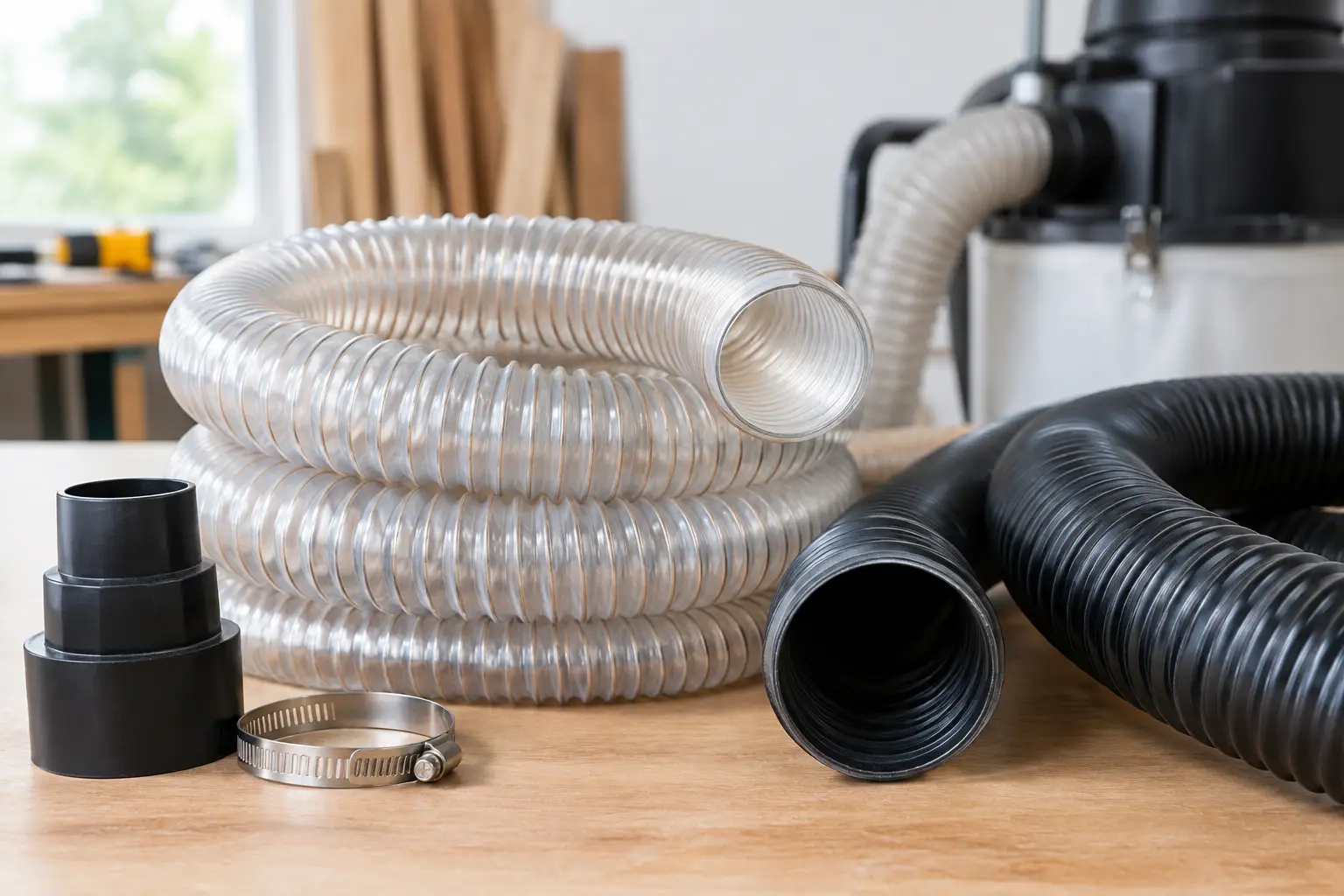
For most small woodworking shops, 4-inch hose is the practical choice for a dust collector serving larger stationary machines, while 2-1/2-inch hose is commonly used with shop vacuums and smaller tools. The important part is keeping the hose, fittings, collector, and machine port compatible instead of choosing a hose based on diameter alone.
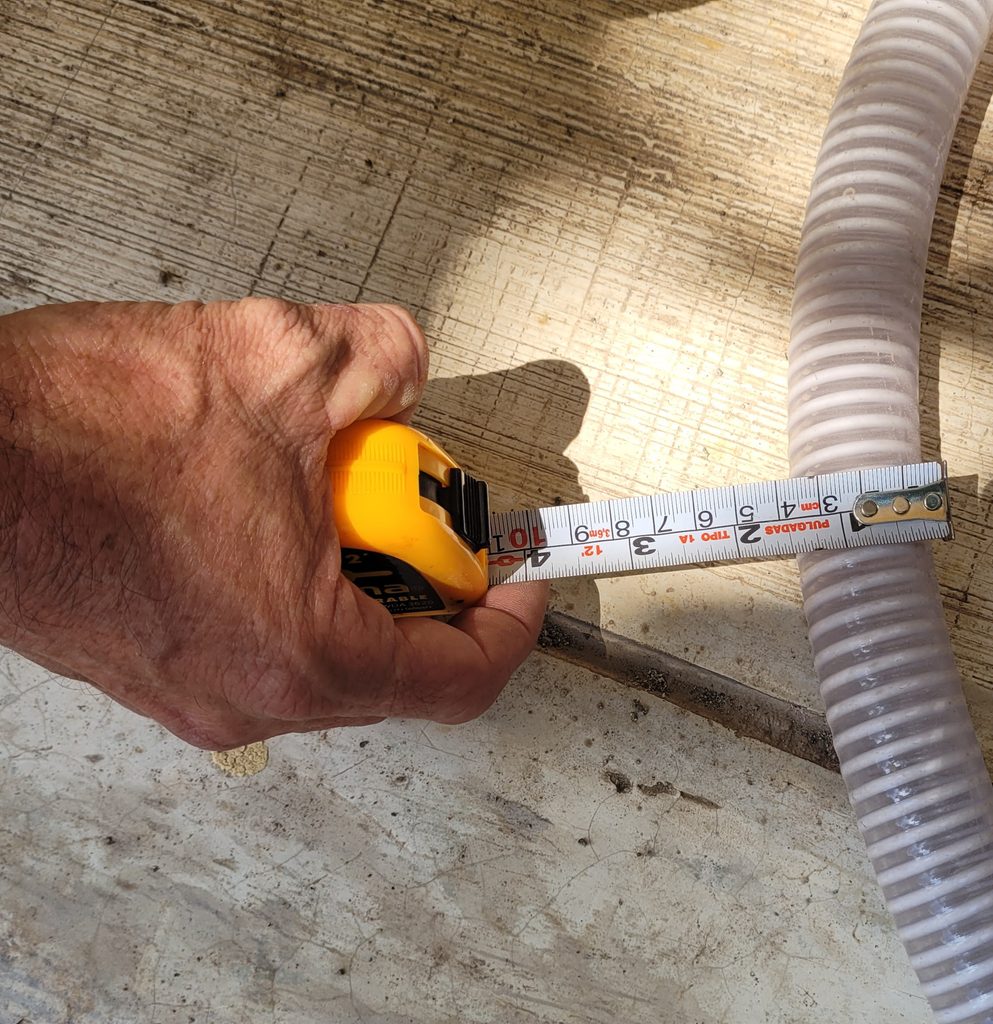
My 2-inch hose measured in my small garage – actual size is just over 2 inches.
Recommended Dust Collection Hoses & Accessories
Find the right hose size, length, and fittings for your small garage workshop.
| Product Type | What to Look For | Check Price |
|---|---|---|
| 4-Inch Dust Collection Hose | For compatible dust collectors and machines with 4-inch ports. | Check Price → |
| 2.5-Inch Dust Collection Hose | For compatible compact dust collection setups and smaller machine ports. | Check Price → |
| Dust Collection Hose Adapters | Match the hose diameter to the tool’s dust port and collector inlet. | Check Price → |
| Hose Clamps & Fittings | Choose compatible sizes to secure connections and reduce air leaks. | Check Price → |
As an Amazon Associate, we earn from qualifying purchases.
Match dust collection hose diameter to the machine
Diameter is the first decision because it determines how much air the system can move. A larger hose has substantially more cross-sectional area than a smaller one. That means a 4-inch hose does far more than look slightly bigger than a 2 1/2-inch hose. It gives a dust collector a much easier path for moving the volume of air needed to capture chips and fine dust.
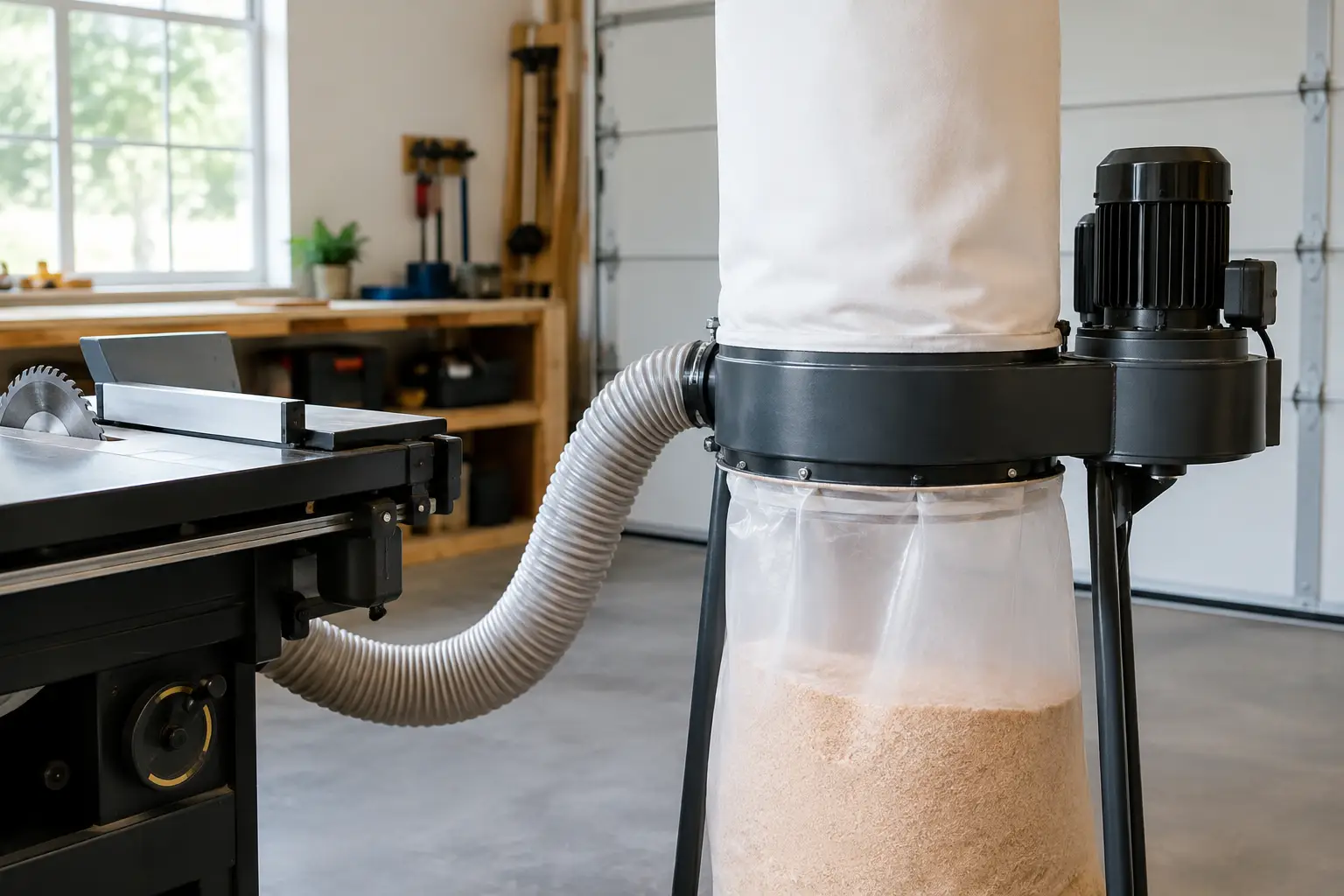
For most hobbyist garage shops, 4-inch hose is the practical standard for a single-stage dust collector serving one machine at a time. It works well with table saws, planer ports, jointers, bandsaws, and many larger router tables. If your collector has a 4-inch inlet and your tool has a 4-inch dust port, keeping that diameter all the way through is usually the best choice.
A shop vacuum operates differently. Its smaller hose, commonly 1 1/4, 1 7/8, or 2 1/2 inches, supports higher static pressure but lower total airflow. That makes it a reasonable fit for a random-orbit sander, track saw, miter saw hood, handheld router, or other tool with a small port. A vacuum cannot become a true dust collector just by attaching a 4-inch hose, and reducing a 4-inch collector line to a small tool port limits what the collector can actually deliver.
This is why a miter saw can be frustrating. Many saws have a 1 1/2- to 2 1/2-inch port, but the blade throws dust with enough force that port collection alone misses a large percentage of it. A shop vacuum connected directly to the port often performs better than a large collector reduced down to the same size. Adding a rear hood can help, but it needs enough airflow and an open capture area rather than a tiny hose connection alone.
A practical diameter guide
| Hose size | Best fit | Small-shop limitation |
|---|---|---|
| 1 1/4 to 1 7/8 inch | Sanders, handheld tools, compact dust ports | Clogs easily with chips and has limited airflow |
| 2 1/2 inch | Shop vacs, miter saws, benchtop machines | Too restrictive for most full-size collectors |
| 4 inch | Single-machine dust collectors, table saws, planers, jointers | Bulky to store and awkward around small handheld tools |
| 5 to 6 inch | Higher-airflow systems and larger stationary machines | Usually excessive for a typical one-car garage setup |
Do not choose hose diameter based only on the opening at the end of the tool. Check the collector inlet, the machine port, and every reducer or fitting between them. One restrictive fitting can become the narrowest point in the system and cut performance noticeably.
Hose length and bends reduce real airflow
Manufacturer CFM ratings are measured under favorable conditions. Your actual airflow falls when air travels through long hose runs, sharp elbows, restrictive ports, dirty filters, and loose connections. In a compact shop, hose length is often the easiest loss to control.
Use the shortest hose that lets you work safely. A 6- to 10-foot connection is often enough when a portable collector sits near the active machine. If you need 20 feet of hose to reach every corner of the garage, the collector may be convenient to leave in one place, but the airflow penalty can outweigh that convenience. Moving a wheeled collector 10 feet closer is often more effective than buying a larger motor.
Flexible hose creates more resistance than smooth metal duct because its internal ribs disturb airflow. That does not make flexible hose a bad choice. It is often the right choice for a shared garage because it coils, moves, and stores easily. The trade-off is that it should be used for the final connection to the machine, not as a substitute for an entire fixed duct system.
Avoid unnecessary tight bends. A hose pulled around the corner of a table saw cabinet or pinched between the wall and a rolling tool cart can lose airflow and eventually wear through. Use broad curves whenever possible. If a permanent turn is needed, a long-radius elbow is better than forcing a flexible hose into a kink.
For a mobile setup, measure the actual route with a tape measure while the machine is in its working position. Include the path around outfeed space, walkways, and the location where the collector will sit. Then buy only a little extra length for repositioning. Excess hose is not harmless slack. It collects dust in its ribs, snags on casters, and occupies valuable floor area.
Choose the hose material for your workflow
Most small-shop buyers will choose between clear flexible PVC hose and black rubber or EVA-style hose. Each has a place.
Clear PVC hose makes blockages easy to spot. That is useful when a planer sends shavings into the line or when a reducer is prone to clogging. It is widely available in 4-inch sizes and works well for portable dust collectors. The downside is stiffness, particularly in colder garages. A long PVC hose can resist coiling and pull against lightweight machines when you move them.
Rubber or EVA hose is usually more flexible and easier to manage around a rolling work area. It can be a better choice for a collector that moves from a table saw to a router table to a planer. Higher-quality flexible hose also tends to hold up better where it repeatedly bends. It costs more, so it makes sense to use it where flexibility matters rather than replacing every short stationary connection.
Thin, lightweight hose is tempting because it is inexpensive and easy to hang on a wall. It is also more likely to collapse under suction, split at the cuffs, or develop holes after being dragged across concrete. For a garage shop, durability matters because hoses frequently get stepped on, rolled over, and moved around vehicles.
→ Compare Flexible Dust Collection Hoses and Adapters on Amazon
Grounding and static: use perspective
Plastic dust hose can build static electricity, especially in dry climates. You may feel a sharp nuisance shock when touching the hose or a machine. A grounding wire run along a hose can reduce static buildup, and it is common on larger collection systems.
Grounding is sensible housekeeping, but it should not distract from the larger safety priorities: capture dust at the source, maintain filters, empty the bin before it overfills, and avoid using damaged electrical equipment. If you add grounding wire, keep it protected from snagging and make secure connections to appropriate grounded metal components. Do not assume a loose wire wrapped around plastic hose solves every risk.
Fittings and adapters decide whether the system works
Dust ports are rarely standardized. A nominal 4-inch port may measure slightly under or over 4 inches, while a benchtop tool may have an odd metric-sized outlet. Measure the outside diameter of a male port and the inside diameter of a female opening before ordering fittings.
The most useful small-shop setup usually includes a few reliable adapters, not a wall full of random reducers. Keep a dedicated hose and fitting arrangement for your primary collector tools, then a separate shop-vac hose kit for sanding and smaller ports. Constantly stepping from 4 inches down to 2 1/2 inches and back again wastes time and creates places for leaks.
Use hose clamps on larger collector connections. They are more secure than tape and make maintenance easier. For a frequently moved shop-vac connection, a friction-fit cuff or quick-connect fitting can be worthwhile, provided it does not create a sharp internal restriction. Tape remains useful for sealing a small leak or stabilizing a loose adapter, but it should not be the foundation of the system.
Blast gates are helpful when several machines share fixed ducting. In a portable, one-hose garage arrangement, they can add cost and bulk without much benefit. A simple capped wye or a dedicated connection at each machine may be all you need. Buy complexity only when it solves a recurring workflow problem.
Build a hose setup that stores quickly
A dust collection hose should not live across the floor between projects. It blocks walkways, gathers damage from rolling tools, and makes it harder to bring the car back into the garage. Wall hooks, a wide hose hanger, or a simple reel location near the collector can keep it controlled without crushing it.
Keep the final flexible section long enough to connect comfortably, but disconnect it when the machine is stored vertically or rolled against a wall. This is especially useful for mobile planers and jobsite table saws, where a hanging hose can turn a compact footprint into an awkward one.
Before buying another collector or chasing a higher advertised CFM number, inspect the path the air already takes. A short, correctly sized, well-sealed hose often makes the existing equipment work like the machine you thought you bought.
→ See Dust Collection Hoses, Adapters, and Accessories on Amazon
Frequently Asked Questions
What size dust collection hose is best for a small woodworking shop?
For many small shops, 4-inch hose is the practical choice for a dedicated dust collector serving stationary machines. A 2-1/2-inch hose is commonly better suited to shop vacuums and smaller tools. Always match the hose to the collector and machine ports.
Is 2-1/2-inch or 4-inch hose better?
Neither is automatically better. A 4-inch hose is designed to move more air and is commonly used with dust collectors, while 2-1/2-inch hose is common with shop vacuums and smaller tools. The correct choice depends on the equipment being connected.
Does a longer dust collection hose reduce suction?
A longer hose generally adds resistance and can reduce airflow, especially when combined with small diameters, ribbed interiors, sharp bends, and restrictive fittings. Use the shortest practical hose for your layout rather than adding unnecessary length.
Can I connect a 4-inch hose to a 2-1/2-inch dust port?
Yes. Use a properly sized 4-inch-to-2-1/2-inch reducer or adapter. Whenever possible, keep the 4-inch section as long as practical and make the reduction close to the smaller machine port.
How do I measure a dust collection port?
Measure the actual diameter of the port and determine whether the hose or fitting needs to fit inside or over it. Also check whether the hose specification refers to inside diameter or outside diameter. Do not rely solely on the nominal size printed on the product.
Does flexible hose reduce airflow?
Flexible hose can create more resistance than smooth ducting because of its internal ribs and shape. However, flexible hose is often the most practical option for a portable garage workshop. Keep it as short and straight as practical.
Final Takeaway
The right dust collection hose is not necessarily the biggest, longest, or most expensive one.
For most one-car garage workshops, the better approach is to match the hose diameter to the collector and machine, keep the larger diameter for as much of the system as possible, use reducers only when necessary, minimize unnecessary length and bends, and make every connection secure.
A 4-inch hose is a strong starting point for many stationary machines connected to a dust collector, while a 2-1/2-inch hose makes sense for many shop-vac and smaller-tool applications.
Most importantly, look at the entire airflow path rather than the hose alone. A clean filter cannot compensate for a crushed hose, a clogged reducer, a badly sized adapter, or a dozen unnecessary bends.
In a small garage, a simple system that is correctly sized, sealed, easy to move, and easy to store will usually serve you better than a complicated setup built around maximum hose size or maximum advertised CFM.

Leave a Reply