
As an Amazon Associate I earn from qualifying purchases.
A shop vacuum can collect sawdust at the tool, and a dust collector can handle the chips coming off a table saw or planer. But neither necessarily captures all the fine dust that escapes into the room. That is where air filtration for a small garage workshop becomes useful.
In a one-car garage, airborne dust has nowhere to go. It can settle on workbenches, stored lumber, cabinets, and tools, sometimes long after you have finished cutting or sanding. The smaller the workspace, the more noticeable this becomes.
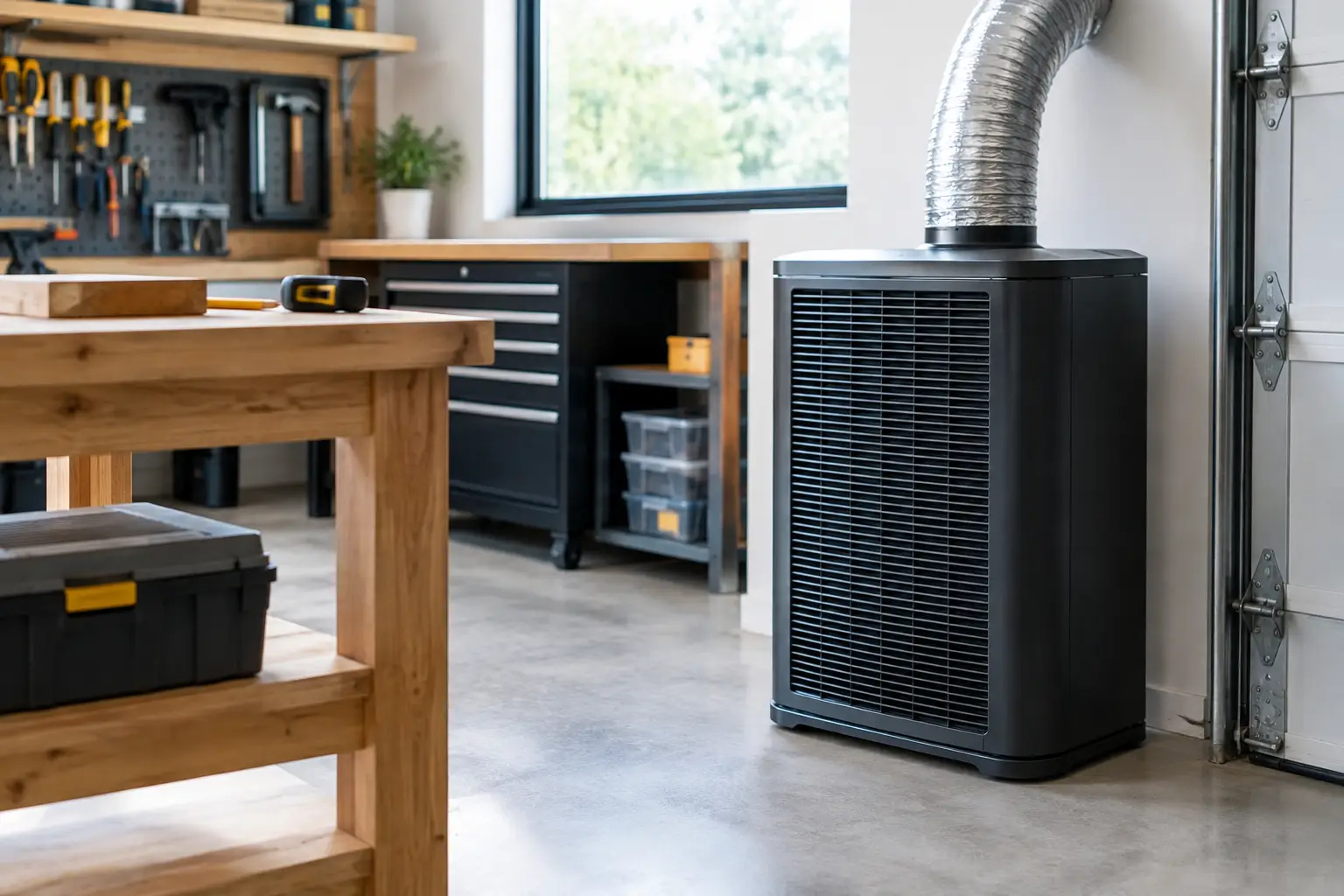
An ambient air filtration system helps capture some of that suspended dust by pulling workshop air through filters and circulating cleaner air back into the room.
The goal is not to turn your garage into a laboratory. It is to reduce airborne dust, improve your overall dust-control setup, and keep the equipment from taking over the limited space you need for woodworking.
If your garage still needs to accommodate a vehicle, storage cabinets, and a workbench, choosing the right air cleaner involves more than looking at the highest CFM number on a product listing.
Air Filtration vs. Dust Collection: What’s the Difference?
Dust collection and ambient air filtration perform two different jobs. Understanding the difference is important before spending money on either system.
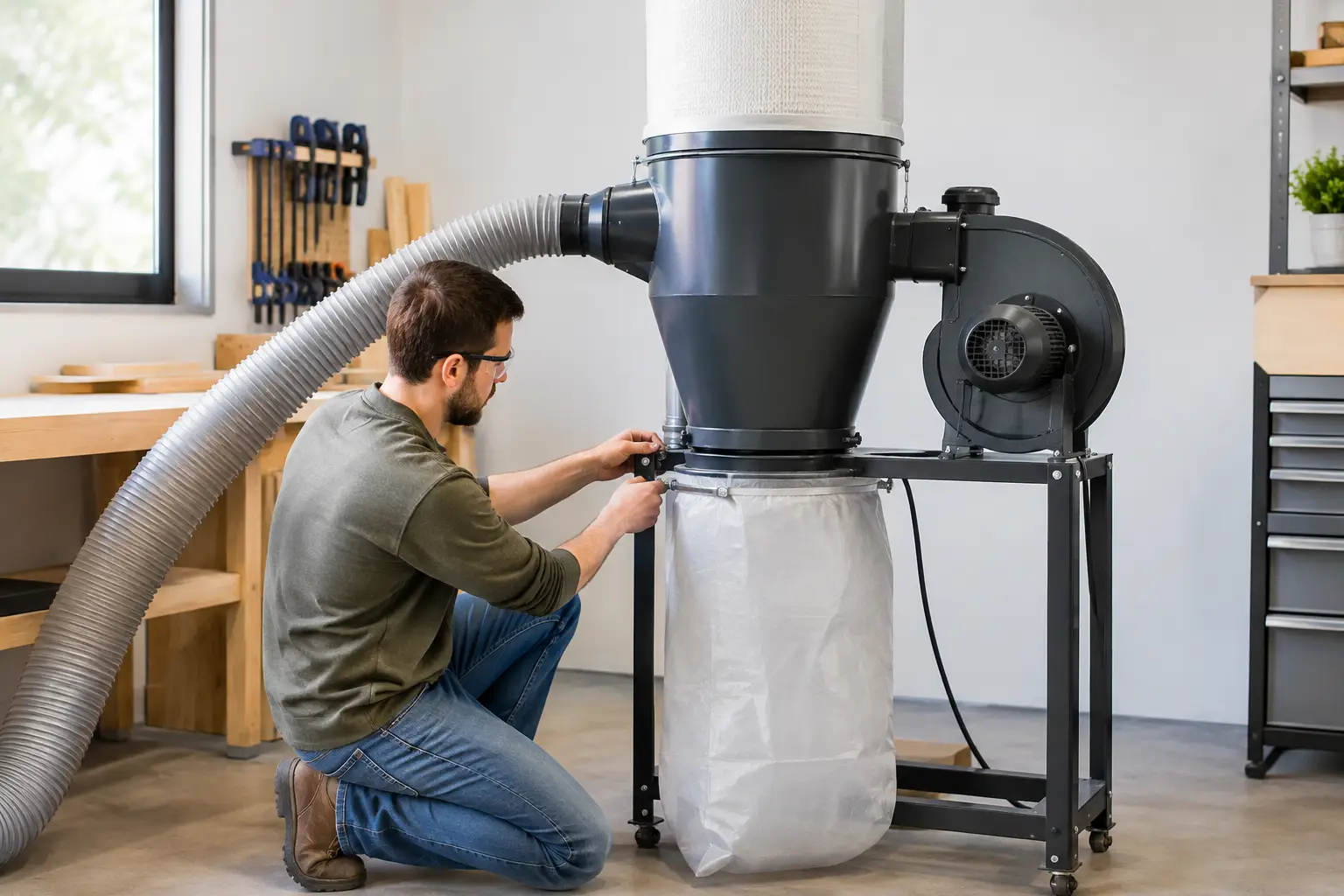
Dust collection captures debris at the source. A shop vacuum or dust collector connects directly to a machine through a hose and collection port. When properly sized and connected, it removes a significant amount of sawdust and wood chips before they spread throughout the garage.
For example, a table saw with an effective lower dust shroud and an overarm collection guard can capture dust from more than one direction.
Ambient air filtration handles some of the dust that escapes. An air cleaner draws air from the surrounding room, passes it through one or more filters, and returns filtered air to the workspace.
This is particularly useful when working with:
- Table saws that release dust around the blade.
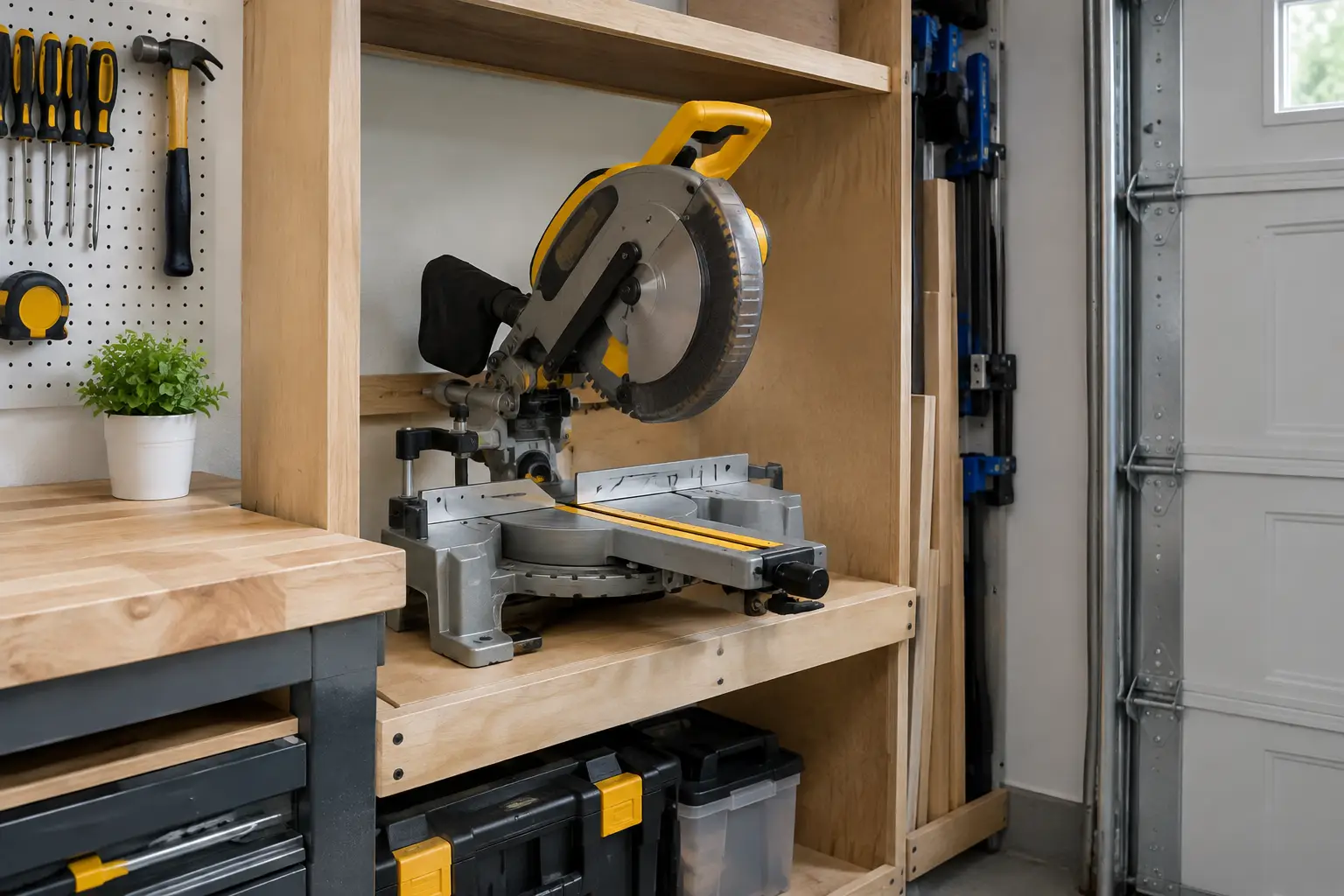
- Miter saws with inefficient factory dust bags.
- Random-orbit sanders and other sanding equipment.
- Routers and handheld woodworking tools.
- Operations where the machine’s dust port does not capture everything.
However, an air filtration system cannot replace a properly connected dust collector or shop vacuum.
It does not capture a cloud of dust at the exact moment it enters your breathing zone. It also cannot prevent every particle from settling on nearby equipment.
Think of source collection as your first line of defense and ambient filtration as additional dust control for the entire room.
Why Fine Wood Dust Is a Problem in a Small Garage
Large wood chips are easy to notice. You see them on the floor, around the table saw, or underneath the workbench. Fine dust is different.
Smaller particles can remain suspended in the air longer, depending on their size, air movement, and other conditions. Some eventually settle on surfaces, while others may be carried around the room by fans, open doors, and ventilation systems.
In a one-car garage, the problem becomes more noticeable because several activities happen in a relatively small area.
You might have a table saw near the workbench, a miter saw against one wall, and a storage rack just a few feet away. Sanding one board can leave a thin layer of dust across several surfaces.
There is also a health consideration.
Wood dust exposure has been associated with respiratory irritation, allergic reactions, asthma, and other health effects. OSHA identifies wood dust as a workplace hazard, particularly when repeated exposure occurs.
This is why keeping a workshop clean should involve more than sweeping the floor at the end of the day.
A practical dust-control routine should include:
- Capturing dust directly at woodworking machines.
- Using an appropriate ambient air filtration system.
- Cleaning work surfaces with a suitable vacuum.
- Avoiding compressed air that redistributes dust into the breathing zone.
- Using appropriate respiratory protection when needed.
Opening the garage door can help with general ventilation, but it is not a substitute for effective dust collection or filtration.
How Much CFM Do You Need for a Small Garage Workshop?
CFM stands for cubic feet per minute. It measures how much air a filtration unit is designed to move.
When comparing workshop air cleaners, CFM is one of the most important specifications. However, choosing a unit simply because it has the highest advertised airflow is not necessarily a good decision.
You first need to estimate the volume of your workspace.
Multiply the garage’s length by its width and ceiling height.
For example, consider a one-car garage with these dimensions:
| Measurement | Size | |—|—:| | Length | 20 feet | | Width | 12 feet | | Ceiling height | 8 feet | | Total air volume | 1,920 cubic feet |
Now consider an air cleaner rated at 400 CFM.
The theoretical calculation is:
400 CFM × 60 minutes = 24,000 cubic feet per hour.
Divide that number by the garage’s volume:
24,000 ÷ 1,920 = 12.5 theoretical air changes per hour.
That sounds impressive, but there is an important detail.
The calculation assumes the unit actually moves 400 CFM continuously and that air is distributed evenly throughout the garage. Real-world performance can be lower because of filter loading, installation restrictions, and air circulation patterns.
The published maximum CFM is not necessarily the airflow you will get on the lowest or middle speed.
Using Air Changes per Hour to Size Your Air Cleaner
Air changes per hour, commonly abbreviated as ACH, provide another way to compare filtration capacity with room size.
The calculation is:
Required CFM = Room volume × Desired ACH ÷ 60.
For the 1,920-cubic-foot garage in our example, here is what different theoretical air-change targets would require:
| Target air changes | Required airflow | |—|—:| | 4 ACH | 128 CFM | | 6 ACH | 192 CFM | | 8 ACH | 256 CFM | | 10 ACH | 320 CFM |
These are planning calculations, not universal safety standards or guarantees of dust removal.
For a small woodworking garage, using approximately 6–8 theoretical air changes per hour as an initial comparison point can help narrow down suitable equipment.
The important thing is to compare airflow at the speed you will actually use, rather than relying exclusively on the maximum advertised number.
If you regularly sand wood or operate several dust-producing machines, having additional airflow capacity can be useful.
What Type of Filter Should You Look For?
Airflow is only part of the equation. The filter determines what size particles the system can capture and how effectively it performs that job.
Many workshop air cleaners use a two-stage filtration arrangement.
The first stage is usually a washable or replaceable prefilter. It captures larger particles and helps protect the finer filter behind it.
The second stage handles smaller airborne particles that pass through the prefilter.
When comparing products, look for clear information about:
- Filter efficiency.
- Particle size tested.
- Filter classification, if provided.
- Replacement filter availability.
- Replacement costs.
- Airflow with the filters installed.
You may encounter terms such as MERV and HEPA.
MERV is a rating system used to describe the particle-removal efficiency of filters under standardized testing conditions. A higher MERV rating generally indicates better performance across specified particle sizes, but it does not automatically mean that a filter is suitable for every air cleaner.
HEPA is a specific high-efficiency filtration classification with defined testing requirements. A manufacturer advertising a one-micron filter is not necessarily offering a HEPA filter.
Also, be careful with claims such as “removes 99% of dust.” That statement is incomplete unless the manufacturer identifies the particle size, testing conditions, and filtration stage involved.
For a garage woodworking shop, I would prioritize a well-documented filtration system with readily available replacement filters over vague marketing claims.
The Best Air Filtration Setup Uses Two Systems
For most small garage workshops, combining source collection with ambient air filtration is more practical than relying on one oversized machine.
The first system should be matched to your woodworking tools.
A portable dust collector with a 4-inch hose is generally better suited to machines with larger dust ports and higher chip volumes, such as table saws, planers, and jointers.
A shop vacuum provides higher static pressure through a smaller hose. This makes it a better match for many sanders, track saws, routers, and compact benchtop machines.
The second system is an ambient air cleaner.
It helps capture some of the fine dust that escapes the collection hose, machine enclosure, or factory dust port.
This combination makes more sense than buying a powerful dust collector and expecting it to clean the entire garage when it is connected to only one machine.
Which System Should You Buy First?
If your budget is limited, prioritize source collection.
For example, connecting a shop vacuum directly to a random-orbit sander can prevent a substantial amount of sanding dust from entering the room in the first place.
An ambient air cleaner can help capture some of what escapes, but it cannot undo all the exposure that occurs before the particles reach its intake.
Once your main tools have suitable dust collection, adding an air filtration unit becomes a useful next improvement.
Where Should You Place an Air Filtration System?
Placement can make a noticeable difference in how well an air cleaner circulates air throughout a small garage.
A ceiling-mounted unit is often a practical choice because it keeps the floor available for a vehicle, rolling tool carts, and larger workpieces.
However, the ceiling is not automatically the best location if the installation creates obstructions or interferes with the garage door mechanism.
Before mounting anything, check:
- Ceiling joists and suitable mounting points.
- Garage door tracks and the opener.
- Overhead lighting and electrical fixtures.
- Clearance for sheet goods and long boards.
- Access to filters for regular maintenance.
- Space around the intake and exhaust openings.
The intake needs enough clearance to draw air freely. The discharge should help move filtered air through the room rather than immediately sending it back toward the intake.
In many rectangular garages, positioning the unit along the length of the room can help establish a circulation pattern.
Avoid creating a short circulation loop where the cleaner repeatedly pulls in its own recently discharged air while leaving other areas relatively stagnant.
Should You Install It Directly Above the Table Saw?
Not necessarily.
Placing the air cleaner directly above your main dust-producing machine may seem logical, but the best location depends on the unit’s intake design, exhaust direction, and the room’s layout.
A position slightly offset from the machine may produce better overall circulation.
The objective is to move air through the workshop without disrupting dust collection at the tool or blowing dust toward your breathing zone.
What If You Do Not Have Ceiling Space?
A compact wall-mounted or portable air cleaner may be a better option.
A floor-standing unit can work in a small garage, but it takes up valuable space and can be exposed to accidental impacts from lumber, carts, and other equipment.
If you use a portable model, keep its intake unobstructed and position it away from areas where large chips accumulate.
A secure wall shelf or suitable elevated platform may be a better arrangement than placing the machine underneath a crowded workbench.
Always follow the manufacturer’s mounting and clearance instructions.
Noise, Operating Speed, and Daily Use
Noise is easy to overlook when comparing air filtration systems.
A unit may advertise excellent airflow at its highest setting, but if it becomes too loud to use comfortably, you may end up switching it off whenever you are working at the bench.
For a small garage workshop, variable-speed operation is particularly useful.
You can run the unit at a higher setting during sanding or cutting and reduce the speed during quieter activities such as measuring, assembly, or layout work.
Before buying, compare the published noise levels at different speeds rather than looking at a single decibel figure.
Also consider where you plan to mount the machine. A unit positioned close to your workbench may sound noticeably louder than one mounted farther away.
Remote controls and programmable timers are useful features for ceiling-mounted models. They allow you to change settings without climbing a ladder or interrupting your work.
In a compact workshop, convenience matters because the best filtration system is the one you actually use.
How Long Should You Run an Air Filtration System?
For most woodworking sessions, running the air cleaner only after you finish cutting is not the best approach.
A more practical routine is to operate it before dusty work begins, keep it running during the session, and allow additional time for filtration after the machines are switched off.
For example:
- Turn on the air cleaner before starting woodworking.
- Keep it running while cutting, sanding, and routing.
- Continue running it after the dusty work is finished.
- Use a timer to avoid having to return to the garage to switch it off.
A post-work period of 30–60 minutes can be a reasonable starting routine, although the appropriate time depends on the room, airflow, filter condition, and amount of dust generated.
A timer is particularly convenient when the garage is used for both woodworking and vehicle storage.
Remember that circulating air does not guarantee that every airborne particle has been captured. Source collection and appropriate respiratory protection remain important.
Filter Maintenance: Keep the Airflow Consistent
Even a good air cleaner can lose performance when its filters become clogged.
In a woodworking shop, the prefilter usually collects most of the larger airborne debris. Checking it regularly helps prevent unnecessary airflow restriction.
Follow the manufacturer’s instructions for cleaning or replacing each filter.
Some prefilters are washable, while others should only be vacuumed or replaced. The same cleaning method should not automatically be applied to every filter type.
Watch for these signs:
- Reduced airflow from the discharge.
- Visible dust buildup on the prefilter.
- A filter replacement indicator, if available.
- Increased fan noise or a noticeable change in performance.
- A filter that has reached its recommended service interval.
Do not rely on dark discoloration or odor alone to determine whether a filter needs replacement.
Also, avoid using compressed air to clean filter media unless the manufacturer specifically permits that method. Blowing dust out of a filter can damage the material and redistribute concentrated particles into the workshop.
When possible, perform filter maintenance outside the garage. Use appropriate respiratory protection and clean nearby surfaces with a suitable HEPA-rated vacuum rather than a leaf blower or compressed air.
Replacement filter availability is another reason to research a unit before purchasing it. An inexpensive air cleaner can become less attractive if replacement filters are difficult to find or unusually expensive.
What an Air Filtration System Cannot Do
Ambient air filtration is useful, but it has limitations that are important to understand.
First, it cannot correct poor dust collection at a machine.
A leaky hose, undersized connection, poorly designed dust port, or inadequate collector can allow large amounts of debris to escape before an air cleaner has a chance to capture it.
Miter saws are a good example.
Their factory dust bags often collect some coarse debris, but the open cutting area allows considerable dust to escape around the blade.
A better hood, enclosure, or dedicated vacuum connection may improve dust control more than upgrading the ambient air cleaner.
If miter saw dust is a recurring problem in your garage, see this guide to miter saw dust collection in small garages.
Second, a particle filter does not necessarily remove gases, vapors, or chemical fumes.
Woodworking sometimes involves paints, stains, adhesives, finishes, and solvents. These materials can release contaminants that ordinary particulate filters are not designed to capture.
Some air cleaners include activated carbon or other gas-phase filtration media, but their effectiveness depends on the type and amount of media, the contaminant, and the operating conditions.
Do not assume that a standard woodworking air cleaner makes solvent fumes or finishing operations safe indoors.
Appropriate ventilation and product-specific safety precautions are still necessary.
Finally, an ambient air cleaner is not personal protective equipment. It should not replace suitable respiratory protection when working with materials or processes that create hazardous airborne dust.
MDF, plywood, pressure-treated lumber, painted wood, and materials with unknown coatings deserve particular attention. Understand what you are cutting and follow the appropriate safety precautions.
Frequently Asked Questions About Air Filtration for Small Garage Workshops
Is an air filtration system worth it for a one-car garage workshop?
Yes, it can be a useful addition, especially if you regularly cut, sand, or route wood in an enclosed garage.
A small workspace allows dust to spread across nearby tools, storage areas, and work surfaces. An ambient air cleaner helps capture some of the fine airborne particles that escape source collection.
However, it should complement a shop vacuum or dust collector rather than replace one.
How many CFM do I need for a small woodworking garage?
The answer depends on the volume of the garage and the air changes you want to achieve.
For example, a 20-by-12-foot garage with an 8-foot ceiling contains 1,920 cubic feet of air.
A theoretical target of 6–8 air changes per hour would require approximately 192–256 CFM.
Actual performance depends on the air cleaner’s delivered airflow, filter condition, and room circulation.
Is a shop air cleaner the same as a dust collector?
No.
A dust collector connects to woodworking machines and captures chips and dust near the source.
An ambient air cleaner circulates room air through filters to capture some of the fine particles

Leave a Reply