
As an Amazon Associate I earn from qualifying purchases.
A miter saw is one of the most useful tools in a small garage workshop, but storing one can be surprisingly difficult. Even a compact model needs more room than its base suggests, especially if it has sliding rails, a dust collection hose, or a separate stand.
The challenge becomes even greater in a one-car garage where you also need room for a vehicle, workbench, lumber storage, and other power tools.
The best way to store a miter saw in a small garage is to use a setup that protects the tool while keeping it easy to access. Depending on how often you make cuts, that could mean a rolling cart, a folding stand, a wall-mounted storage system, or a compact miter saw station.
You do not necessarily need a permanent workbench or a large cabinet. In many small garages, a mobile setup that rolls against the wall between projects is the more practical solution.
| Product | Best For | Check Price |
|---|---|---|
| DEWALT DWX726 | Rolling storage and mobility | Check Price → |
| WEN MSA330 | Folding and portable setup | Check Price → |
| DEWALT DWX724 | Compact folding storage | Check Price → |
1. Measure Your Miter Saw Before Choosing a Storage Location
Before building a shelf or buying a storage cart, measure the actual dimensions of your miter saw. Choosing a storage solution based only on the width of its base is a common mistake.
Measure these four dimensions:
- Width: Measure from the left side of the base to the right side, including attached extensions.
- Depth: Measure from the front of the saw to the back of the sliding rails, if applicable.
- Height: Measure the saw with the cutting head lowered and secured.
- Weight: Check the manufacturer’s specifications before choosing a shelf, cart, or mounting system.
Pay particular attention to sliding compound miter saws. Their rails can add considerable depth, and some models require additional clearance behind the motor when the cutting head moves.
Also account for the dust port, attached hose, power cord, carry handles, and any accessories that remain connected during storage.
If you own a sliding model, test the full movement of the rails before deciding how close the saw can sit to a wall. Some designs allow the rails to remain in front of the saw, while others require additional rear clearance.
Think about how you will remove the saw, too. A cabinet that fits the tool perfectly may become frustrating if you have to lift it over other equipment every time you need to make a cut.
If your garage must still hold a vehicle, measure the available wall and floor space with the vehicle parked in its normal position.
The goal is to find a storage location that works with your entire garage layout, not just the dimensions of the saw.
2. Use a Rolling Miter Saw Cart to Save Floor Space
A rolling cart is one of the most practical storage solutions for a small garage, particularly if you use your miter saw several times a month rather than every day.
Instead of leaving the saw permanently in the middle of the workshop, mount it on a compact cart that can be moved against a wall when the job is finished.
A good miter saw cart should have:
- Locking casters that prevent movement during operation.
- A stable base wide enough to support the saw.
- Enough clearance for the motor, rails, and dust connection.
- A working height that allows comfortable cutting.
- Storage for commonly used accessories.
You can also add a lower shelf for a shop vacuum, extra blades in protective cases, clamps, and measuring tools.
However, do not make the cart so narrow that it becomes unstable when you pull the cutting head forward or support a long board. Stability matters more than saving the last few inches of floor space.
One useful approach is to build the cart around the actual dimensions of your saw rather than following generic plans designed for a different model.
If you want to use the cart as a temporary cutting station, make sure its top is level and rigid. Lock the wheels before cutting and provide separate support for long workpieces.
When you finish, disconnect the saw, clean the work surface, secure the cutting head, and roll the cart back into its parking position.
For a shared one-car garage, this arrangement can make a significant difference because the center of the floor remains available for other activities.
3. Consider a Folding Miter Saw Stand
A folding miter saw stand is another good option when permanent storage space is limited.
Unlike a fixed workbench, a folding stand can be collapsed after use and stored along a wall or in a designated corner.
Most models provide adjustable support arms that extend on both sides of the saw. These supports are particularly useful when cutting long boards, trim, or framing lumber.
Before purchasing one, check the following:
- The stand’s maximum supported weight.
- Compatibility with your specific saw.
- The folded dimensions.
- The width of the support arms.
- Whether the wheels make it easy to move around the garage.
A folding stand is especially useful if you occasionally take your saw outside or use it for projects away from your workshop.
However, folding stands are not always the most compact storage solution. Some still occupy considerable floor space, even when collapsed.
They can also become awkward to move if the garage has other equipment, lumber racks, or a vehicle parked nearby.
If your primary concern is keeping the saw out of the way between projects, a compact rolling cart may be more convenient. If portability is more important, a folding stand is worth considering.
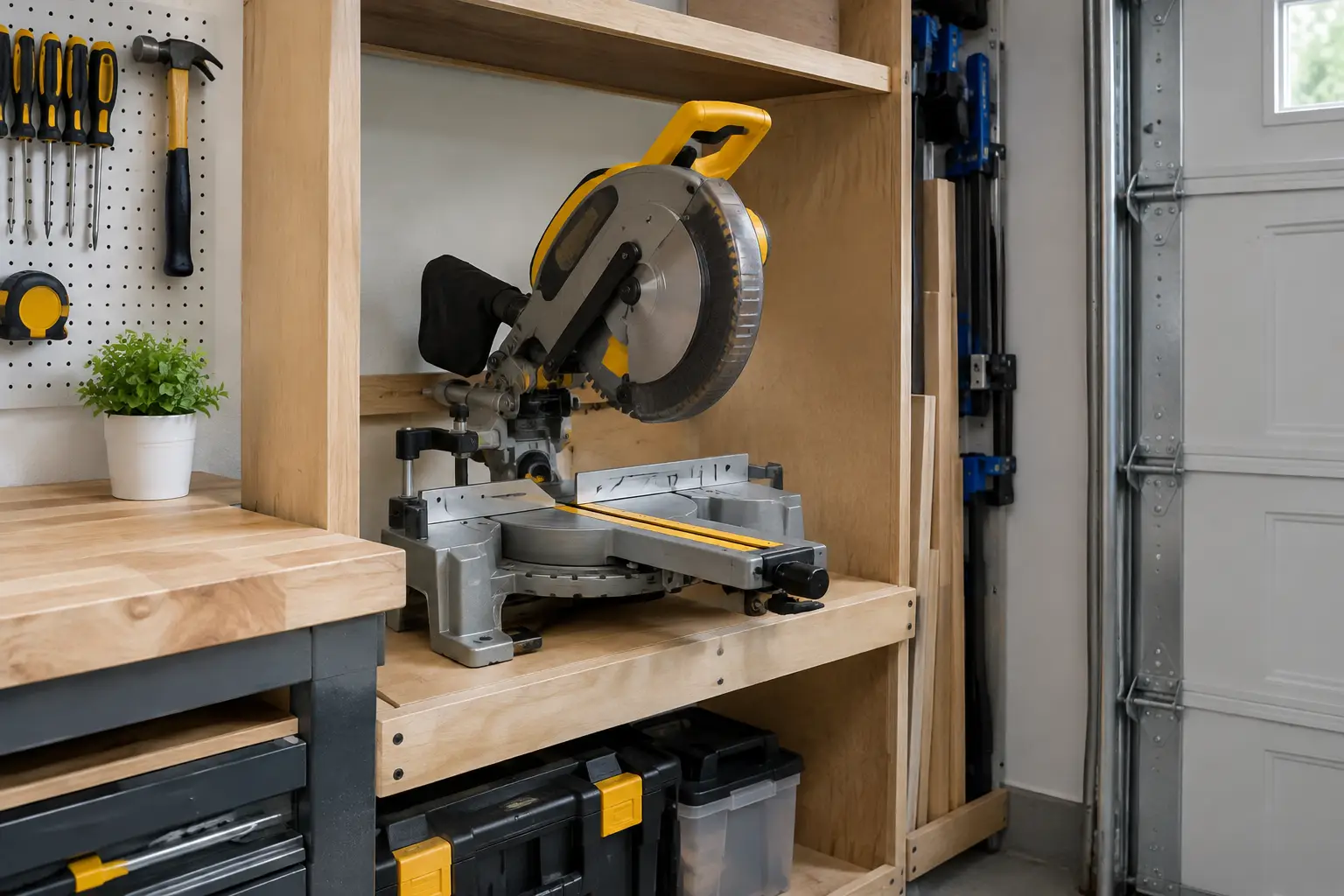
4. Build a Compact Miter Saw Station Against the Wall
If you use your miter saw frequently, a dedicated station can make your workshop much more efficient.
A wall-mounted miter saw bench provides a permanent location for the tool, with additional storage underneath and support surfaces on both sides.
The biggest advantage is that you can organize the surrounding space around your normal cutting workflow.
For a small garage, avoid building an oversized station that takes up more room than the saw itself.
Consider these design features:
- A recessed area for the saw when the model and installation allow it.
- Fold-down support wings for longer boards.
- Shelves or drawers underneath.
- A dedicated location for measuring tools and clamps.
- Space for a shop vacuum or dust collection hose.
The height of the surrounding work surfaces is particularly important. Ideally, the support surfaces should align with the saw table so that long boards remain level as they approach and leave the blade.
For a non-sliding saw, a relatively shallow bench may be sufficient, depending on the model. Sliding saws generally need more depth or a properly designed recessed section.
Do not assume that a 24-inch-deep bench will accommodate every saw. Measure the complete stored and operating envelope before building anything.
A fixed station is a good investment when your garage is primarily a workshop and you have an uninterrupted wall available.
If you need to park a car inside every night, however, a permanent station may take away valuable space that you cannot easily recover.
5. Use Wall-Mounted Storage or a Fold-Down Shelf
When floor space is extremely limited, storing a miter saw off the floor may seem like the obvious solution.
Wall-mounted storage can work, but the mounting system must be designed for the actual weight and dimensions of the saw.
Never assume that an ordinary garage shelf can safely support a full-size sliding miter saw.
Before installing a wall-mounted system:
- Check whether the saw manufacturer allows the proposed mounting arrangement.
- Select brackets or a shelf rated for the complete load.
- Secure the mounting system to appropriate structural framing, not just drywall.
- Include a retaining system that prevents the saw from sliding or falling.
- Make sure you can lift and remove the saw without twisting your back or losing control.
A fold-down shelf can be particularly useful in a compact workshop. When the saw is not needed, the platform folds against the wall, leaving more open floor space.
However, the shelf must lock securely into its working position and provide adequate support before the saw is used. A storage bracket is not automatically a safe cutting stand.
For heavier 12-inch sliding models, floor-level storage is often the more practical choice.
If lifting the saw onto a high shelf feels uncomfortable, choose a lower cart or cabinet instead. Saving floor space is not worth risking a dropped tool or an injury.
6. Store the Miter Saw Under a Workbench When Possible
If you already have a workbench, the space underneath it may provide an excellent storage location.
This approach is particularly useful when the saw is not used every day and you want to avoid adding another cabinet or cart.
There are several ways to organize this area:
- Place the saw on a low platform with locking casters.
- Use a dedicated pull-out shelf designed to support its weight.
- Keep the saw in a

Leave a Reply