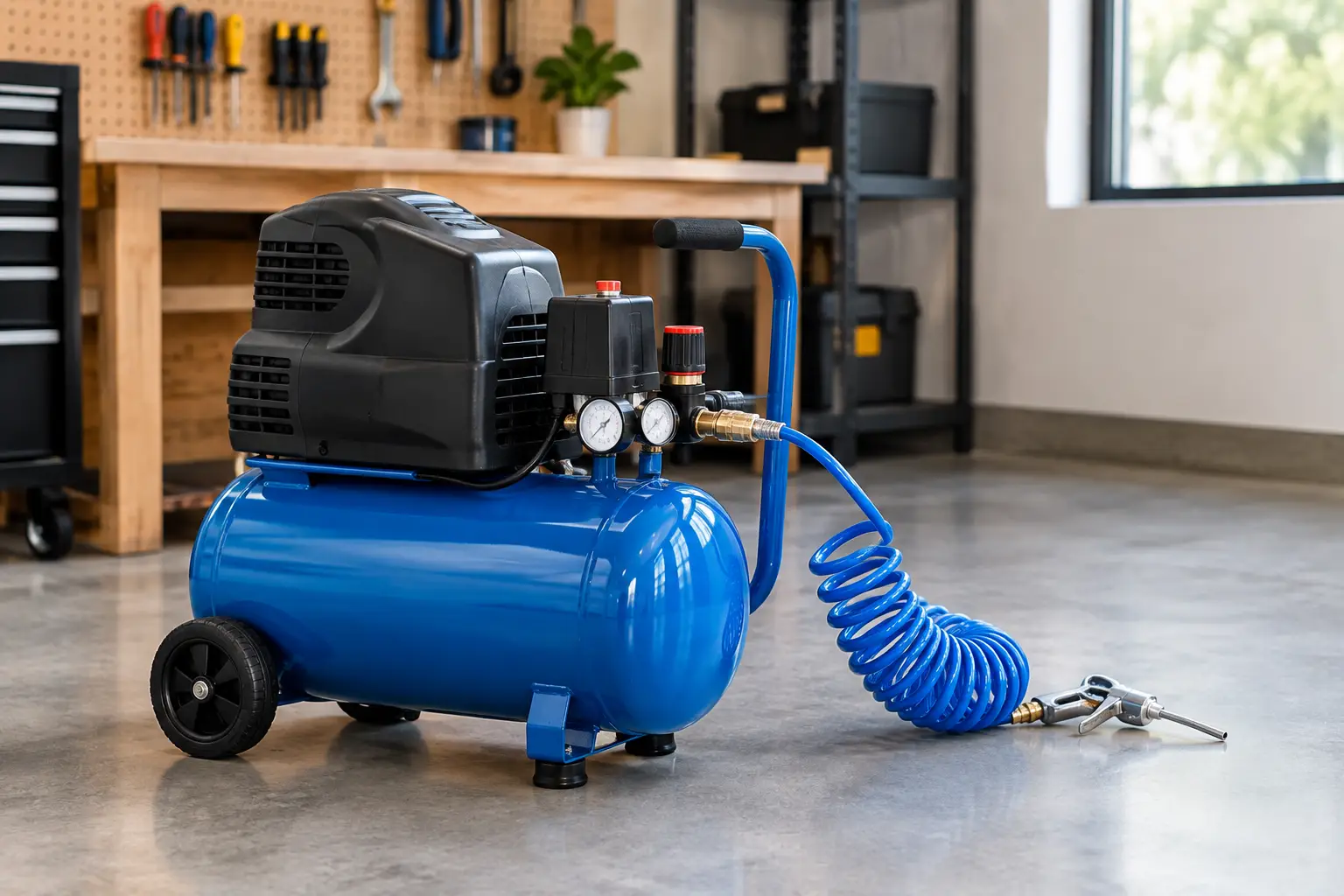
A portable air compressor can be one of the most useful tools in a small garage, but it can also become an awkward, noisy obstacle if you buy by tank size or peak PSI alone. For most one-car garage shops, the right compressor is not the largest model you can afford. It is the one that supplies enough real airflow for the work you do, rolls or stores out of the way easily, and does not overload the same circuit serving your saws and dust collection.
Air compressors earn their floor space because they handle jobs that are slow or inconvenient by hand: inflating tires, blowing off machinery, running a brad nailer, cleaning filters, and occasionally powering light pneumatic tools. The catch is that these tasks have very different air demands. A compressor that is excellent for trim work may run continuously with a die grinder. Matching the machine to the workload prevents a common small-shop mistake: buying a compact unit that is technically portable but frustrating to use.
Start With CFM, Not Tank Gallons
CFM, or cubic feet per minute, measures how much air a compressor can deliver. It is the specification that determines whether a tool can run continuously or whether you will spend time waiting for the tank to recover. Manufacturers commonly list CFM at 90 PSI because that is a useful reference point for many shop tools. Compare compressors at the same pressure whenever possible.
Tank capacity still matters, but it does a different job. The tank is stored air. A larger tank lets you fire more brads, fill a tire, or make a short burst with an impact wrench before the motor needs to catch up. It does not make an undersized pump produce more airflow over time.
For a small garage shop, these ranges are practical starting points:
| Typical use | Useful compressor output at 90 PSI | What to expect | |—|—:|—| | Tires, blowing dust, brad and pin nailers | 1 to 2 CFM | A compact 1 to 3-gallon unit usually works well. | | Finish nailers, staplers, occasional small impact wrench use | 2 to 4 CFM | A 4 to 6-gallon pancake or twin-stack compressor is often the sweet spot. | | Framing nailers and intermittent spraying | 4 to 6 CFM | Choose a higher-output portable model and plan for more noise and space. | | DA sanders, die grinders, continuous paint spraying | 8+ CFM | Most portable units are a poor fit for sustained use. |
Pneumatic nailers use air in short bursts, so even a modest compressor can keep up. Air-hungry tools such as random-orbit pneumatic sanders consume air almost constantly. A sander rated at 10 CFM will overwhelm a 2.6 CFM pancake compressor no matter how large the tank seems on the sales label. The tool may run for a minute, then slow down while the compressor runs hard trying to recover.
Choose a Portable Air Compressor That Actually Stores Well
Portability means more than a carry handle. In a compact garage, consider where the compressor sits during use, where it goes after use, and how often it needs to move around a parked vehicle.
A 6-gallon pancake compressor is a practical default for many DIY woodworkers. Its round, low-profile tank is stable, its footprint is usually manageable, and it has enough reserve air for trim nailers and routine maintenance. The trade-off is that pancake units are often loud, and many have no wheels. If it needs to travel from a back-wall shelf to the driveway often, lifting a 30- to 40-pound machine gets old quickly.
A twin-stack model is narrower and often easier to tuck beside a cabinet or under a workbench. Its taller shape can be less stable on uneven ground, but it may use less floor width than a pancake unit. Small hot-dog compressors are easy to carry and useful for a dedicated brad nailer, though their smaller tanks cause more frequent cycling.
Wheelbarrow-style compressors and larger vertical tanks can offer substantial output, but they deserve an honest space check. They may be portable in the sense that they have wheels, yet they can occupy the parking lane or block access to a table saw. If a tool requires moving three other items before you can use it, it will be used less often.
Measure the compressor with its hose connection installed, not just the tank dimensions. The regulator, couplers, and hose bend often add several inches. Also leave clearance around the motor for cooling and access to the drain valve.
Noise and Electrical Limits Matter in a Garage
Small direct-drive compressors are loud. Ratings in the 80 to 90 decibel range are common, and that sound reflects off drywall, concrete, and a closed garage door. A compressor that seems tolerable at a retail store can feel much louder in a confined workspace.
If you regularly work early, share walls with living space, or have close neighbors, a quieter compressor is worth considering. Low-noise models commonly operate closer to the 60 to 70 decibel range. They cost more and may have lower output for their size, but the difference is meaningful when the compressor cycles repeatedly during a project.
Most homeowner compressors run on a standard 120-volt circuit. That does not mean every garage outlet is equally suitable. A compressor draws a heavy startup load, especially as it restarts under pressure. Running it from a light-duty extension cord can cause voltage drop, slow starting, overheated cords, and premature motor wear.
Use a dedicated wall outlet when possible. If an extension cord is unavoidable, use a short, heavy-gauge cord rated for the compressor load. Avoid sharing the circuit with a table saw, shop vacuum, space heater, or dust collector. In a small shop, the easiest way to trip a breaker is to forget that two high-draw tools are on the same branch circuit.
Hose Size Changes Real-World Performance
The compressor rating is only the start of the air system. A long, narrow hose restricts airflow, particularly with tools that need high volume. For brad nailers, a 1/4-inch hose is usually adequate and easy to coil. For an impact wrench, spray gun, or anything with higher consumption, a 3/8-inch hose reduces restriction and gives the tool a better chance of receiving the air it needs.
Keep the hose as short as the job allows. Every extra length, sharp bend, quick-connect fitting, and reducer adds resistance. That does not mean a 50-foot hose is unusable. It means you should not expect the same performance at the far end of a thin 100-foot hose as you would from a short, larger-diameter line.
A small compressor also benefits from a quality regulator and readable gauge. Set pressure at the tool’s recommended operating range rather than automatically turning the regulator all the way up. Excess pressure wastes stored air, increases hose stress, and can damage tools designed for lower pressure.
Moisture Control Is Part of the Setup
Compressed air carries water vapor, and compression turns that vapor into liquid moisture in the tank and hose. For occasional nailing and tire inflation, draining the tank after use is usually enough. Open the drain valve only after releasing pressure and follow the manufacturer’s instructions. This simple habit prevents internal corrosion and extends tank life.
If you spray finish, paint metal, or use air tools that need clean, dry air, add an inline water separator near the point of use. A filter mounted directly at the compressor helps, but a second small filter near the spray gun is often more effective because air cools and sheds moisture as it travels through the hose.
Oil-free compressors are the straightforward choice for most home garages. They require less routine maintenance and eliminate concerns about pump oil reaching a finish. Oil-lubricated models can be quieter and longer-lived, but they add maintenance and are generally less convenient for a compressor that must be stored tightly after each session.
A Practical Buying Decision for Most Small Shops
For a garage used mainly for woodworking, household repairs, and vehicle maintenance, look for a 120-volt, oil-free compressor with roughly a 4- to 6-gallon tank and at least 2.5 CFM at 90 PSI. That range handles brad nailers, finish nailers, staplers, tire inflation, and basic cleanup without consuming the footprint of a large stationary unit.
Step up in airflow only when your actual tool list demands it. If you plan to spray cabinets, run an impact wrench frequently, or operate a framing nailer all afternoon, a higher-CFM wheeled unit may be justified. For continuous sanding, serious blasting, or production spraying, consider whether pneumatic tools are the right fit for the space at all. Modern corded and battery tools often avoid the compressor, hose, noise, and air-volume problem entirely.
The best place for a compressor is often a low shelf or rolling cart near an outlet, with enough room to remove it without rearranging the shop. Coil the hose separately, drain the tank after use, and keep the intake filter clear of sawdust. A portable air compressor should make small jobs quicker, not become another machine you have to work around before the work can begin.
What Is the Best Portable Air Compressor Size for a Small Garage Shop?
For many one-car garage workshops, the 4- to 8-gallon range is a practical middle ground.
A smaller compressor makes sense if your work is primarily:
Brad nailing
Pin nailing
Stapling
Tire inflation
Light blow-off work
Occasional small pneumatic tools
A higher-output portable compressor makes more sense if you regularly use:
Finish nailers
Framing nailers
Impact wrenches
Multiple nailers
Other tools with higher CFM requirements
If your main goal is continuous sanding, grinding, or painting, do not choose a compressor simply because it fits the garage.
Instead, compare the tool’s required CFM with the compressor’s actual air delivery and consider a larger compressor if necessary.
Final Buying Advice
The best portable air compressor for a small garage shop is not necessarily the smallest, quietest, largest, or most powerful model.
It is the one that fits the actual workload of your workshop.
For a typical one-car garage used for woodworking, DIY repairs, tire inflation, and occasional pneumatic tools, a compact electric compressor with a moderate-size tank and sufficient CFM at 90 PSI can provide an excellent balance of capability and portability.
If you mainly use nailers, prioritize convenient storage, reasonable noise, and enough airflow for the tools you use.
If automotive work is a major part of your garage, pay closer attention to CFM and recovery when choosing a compressor for impact tools.
And if you plan to use air-hungry tools continuously, do not let a compact tank size convince you that a small compressor is enough. In that situation, the pump’s actual air delivery and duty cycle matter far more.
For a small garage, every square foot matters. The right portable compressor should give you useful compressed air without turning your workshop into a maze of equipment, hoses, and machines.
Choose based on CFM first, tank size second, and footprint, noise, electrical requirements, and storage as part of the complete decision.

Leave a Reply