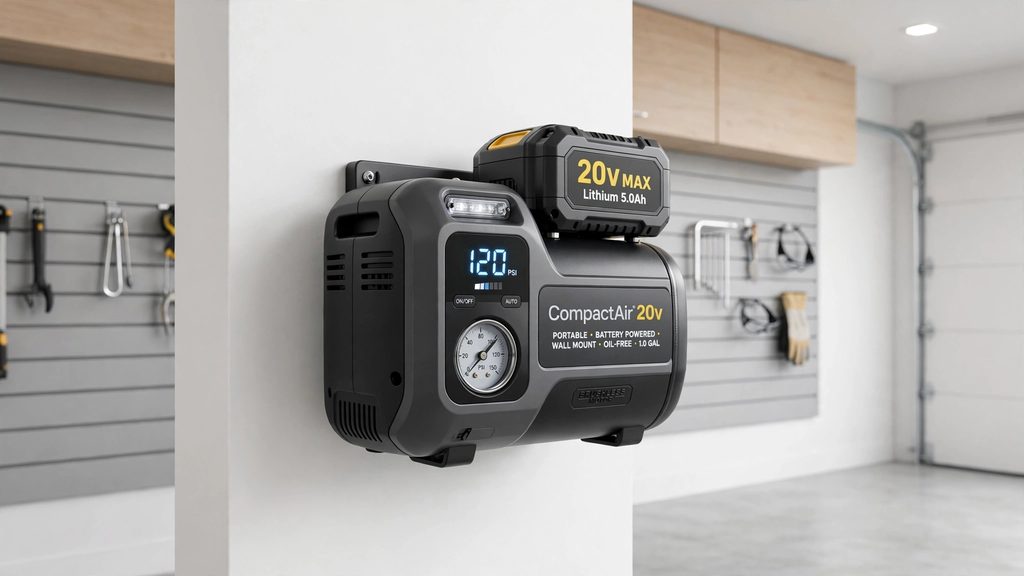
A good air compressor can be one of the most useful tools in a small garage. It can inflate vehicle tires, power finish and brad nailers, handle small maintenance jobs, and provide compressed air without taking up the floor space required by a large stationary compressor.
The challenge is finding a model that provides enough air for common garage tasks without turning a one-car garage into a workshop dominated by a compressor.
For many small workshops, a cordless model makes sense because it can be used wherever you need it without connecting to a wall outlet. The DEWALT DCC2520T1 is particularly interesting because it combines a 2.5-gallon tank with a brushless motor, oil-free pump, and DEWALT’s 20V MAX battery platform.
There is one important point about the phrase “wall mount,” though. The DCC2520T1 is a portable compressor, not a compressor specifically designed for permanent wall mounting. If your goal is to keep the compressor off the garage floor, think in terms of safe vertical storage or a properly supported shelf, rather than attaching the compressor directly to the wall.
Best Battery Air Compressor for a Small Garage
DEWALT DCC2520T1 20V MAX 2.5-Gallon Brushless Cordless Air Compressor
The DEWALT DCC2520T1 is a strong choice for a small garage when portability and storage space are more important than high-volume continuous airflow.
It has a 2.5-gallon tank and delivers 1.0 SCFM at 90 PSI. DEWALT specifies approximately 125 PSI maximum pressure when operated with a 20V battery and up to 140 PSI with a compatible 60V FLEXVOLT battery.
The kit includes a 20V/60V MAX 6.0Ah FLEXVOLT battery and charger, making it more convenient for someone who does not already have a compatible battery.
DCC2520T1 Specifications
| Feature | DEWALT DCC2520T1 |
|---|---|
| Compressor type | Cordless |
| Battery platform | DEWALT 20V MAX / compatible FLEXVOLT |
| Tank capacity | 2.5 gallons |
| Air delivery | 1.0 SCFM at 90 PSI |
| Maximum pressure | Approximately 125 PSI on 20V / 140 PSI on 60V |
| Pump | Oil-free |
| Motor | Brushless |
| Weight | 21.5 lb |
| Dimensions | 14 x 12.5 x 15.5 inches |
| Noise level | Approximately 80 dBA |
| Quick-connect | 1/4-inch industrial |
| Regulator | OneTurn |
| Battery included | Yes, 6.0Ah |
| Charger included | Yes |
These specifications come from DEWALT’s product information and instruction manual.
Why a Cordless Air Compressor Makes Sense in a Small Garage
Space is often the biggest limitation in a one-car garage.
A conventional stationary compressor can provide much more airflow, but it also needs a dedicated location, an electrical connection, and enough clearance around the equipment. Once you add a workbench, storage cabinets, tools, vehicles, and other equipment, floor space becomes valuable.
A cordless compressor changes that equation.
You can keep it on a shelf when it is not needed and move it next to the vehicle, workbench, or project when you need compressed air.
There is also no extension cord running across the garage floor while the compressor is operating.
That can be particularly convenient for:
- Inflating car and truck tires
- Inflating bicycle tires
- Inflating sports equipment
- Operating compatible brad nailers
- Operating compatible finish nailers
- Small trim projects
- General garage maintenance
- Occasional compressed-air tasks
The important limitation is airflow. A cordless compressor can be extremely convenient without being suitable for every pneumatic tool.
Is 2.5 Gallons Enough for a Small Garage?
For many homeowners, a 2.5-gallon tank is a useful middle ground.
It is considerably more substantial than a small portable tire inflator, but it remains compact enough to move around a garage.
The tank stores compressed air, while the pump replenishes that air as pressure drops. The size of the tank therefore matters, but it does not tell you how much air the compressor can continuously deliver.
For that, look at SCFM.
The DCC2520T1 is rated at 1.0 SCFM at 90 PSI.
That makes it much better suited to intermittent-use applications than tools that consume large amounts of air continuously.
For example, a compatible brad nailer can use short bursts of compressed air. A pneumatic grinder or sander can demand air continuously and may quickly exceed what a compact cordless compressor can comfortably supply.
This distinction is critical when choosing a compressor for a garage workshop.
What Can the DEWALT DCC2520T1 Run?
The best way to answer this question is to compare the compressor’s airflow with the tool manufacturer’s air requirement.
For light-duty and intermittent applications, the DCC2520T1 can be a practical choice.
Brad and Finish Nailers
This is one of the most logical applications.
Nailers use short bursts of air rather than continuous airflow. DEWALT also specifically markets the compressor around nailing applications and reports more than 850 shots per charge with a 6.0Ah battery under its specified test conditions.
Your actual battery life will vary depending on the nailer, nail size, material, pressure setting, and frequency of use.
Tire Inflation
A 2.5-gallon tank is useful for garage tire maintenance.
The cordless design also means you can take the compressor directly to the vehicle instead of moving the vehicle closer to an outlet.
For occasional tire inflation, this is one of the advantages of having a compressor rather than relying solely on a small 12V inflator.
Pneumatic Tools
This is where you should be more selective.
Always compare the tool’s required SCFM with the compressor’s 1.0 SCFM at 90 PSI rating.
A low-consumption nailer may be a good match.
A high-demand impact wrench, die grinder, sander, or other continuous-use pneumatic tool can require substantially more airflow.
The tank can temporarily supply stored air, but it cannot make a low-CFM compressor behave like a large shop compressor.
Can You Mount the DEWALT DCC2520T1 on a Garage Wall?
This is the most important distinction for anyone searching for a “wall-mounted battery air compressor.”
The DCC2520T1 is a portable compressor. DEWALT’s documentation describes it as a cordless compressor and provides its operating and storage instructions, but it does not turn the compressor into a purpose-built wall-mounted unit.
For that reason, I would not recommend drilling into the compressor housing, modifying the frame, or creating your own attachment points.
If floor space is the issue, a better approach is to create a dedicated storage location.
For example, a properly constructed garage shelf can keep the compressor above the floor while still allowing you to remove it when you need to use it.
The shelf should be designed to safely support the compressor and battery, and it should not interfere with ventilation, controls, hoses, or other operating components.
The compressor should also remain easy to remove.
That matters because the biggest advantage of the DCC2520T1 is portability. Permanently attaching it to the wall would work against one of the reasons to choose a cordless compressor in the first place.
Best Storage Setup for a Small Garage
If you have a one-car garage, vertical storage can make a significant difference.
Instead of dedicating floor space to the compressor, you can keep it on a sturdy shelf when it is not being used.
A practical setup might include:
- A strong garage storage shelf
- A designated location for the battery charger
- A small hose hanger
- A nearby outlet for charging the battery
- Enough clearance around the compressor
- Easy access for removing the compressor
Avoid putting the compressor in a location where moisture, excessive heat, or debris could create problems.
Also remember that the compressor needs to be accessible for maintenance and operation.
A storage location that looks efficient but makes it difficult to remove the compressor is not necessarily a better garage setup.
Cordless vs. Corded Air Compressor for a Small Garage
A cordless compressor is not automatically better than a corded compressor.
The better choice depends on how you use your garage.
| Feature | Cordless Compressor | Corded Garage Compressor |
|---|---|---|
| Portability | Excellent | Limited |
| Power source | Battery | AC power |
| Floor-space flexibility | Excellent | Moderate |
| Runtime | Limited by battery | Essentially unlimited while powered |
| Continuous air tools | Limited | Usually better |
| Tire inflation | Excellent | Excellent |
| Brad nailers | Very good | Very good |
| Heavy pneumatic tools | Limited | Better with appropriate CFM |
| Storage flexibility | Excellent | Moderate |
| Best for | Small jobs and mobility | Higher-volume workshop use |
The advantage of the cordless option is convenience.
The advantage of a traditional electric compressor is generally greater airflow and unlimited runtime while connected to power.
If your garage is primarily used for woodworking, automotive repair, or frequent pneumatic-tool use, airflow should be one of your first buying considerations.
If your garage is mainly for DIY projects, trim work, tire inflation, and occasional maintenance, portability can be much more valuable.
Battery Platform Is a Major Advantage
If you already own DEWALT 20V MAX tools, the DCC2520T1 becomes more attractive because you can keep your batteries within one tool ecosystem.
The kit itself includes a 6.0Ah battery and charger, but the compressor is designed around DEWALT’s 20V MAX platform and can also take advantage of compatible FLEXVOLT batteries.
That can be useful in a small workshop because you do not need a completely separate battery system just for the compressor.
For someone who already owns several DEWALT cordless tools, this is a practical advantage that a generic cordless compressor may not provide.
Brushless Motor and Oil-Free Pump
The DCC2520T1 uses a brushless motor and oil-free pump. DEWALT also uses a heavy-duty roll-cage design to protect important components.
The oil-free pump means there is no compressor oil to change as part of normal pump lubrication.
The roll cage is also useful in a small garage where tools are frequently moved around.
The compressor weighs 21.5 pounds, so it is still substantial enough to feel like a real tank compressor, but it remains much easier to move than many larger stationary garage units.
How Loud Is It?
Cordless does not mean silent.
DEWALT lists the DCC2520 at approximately 80 dBA during operation.
That is worth considering if your garage is attached to your home or if you frequently work in an enclosed space.
Some competing cordless compressors are marketed with lower noise ratings. For example, Milwaukee’s M18 Fuel compact compressor is listed at 68 dBA and 1.2 SCFM at 90 PSI, while the DEWALT offers the larger 2.5-gallon tank and a lower 21.5-pound weight.
In other words, cordless compressors still involve trade-offs between tank capacity, airflow, weight, and noise.
Who Should Buy the DEWALT DCC2520T1?
The DCC2520T1 makes the most sense for a garage owner who values portability and already works within the DEWALT battery ecosystem.
It is particularly well suited to someone who needs compressed air for:
- Tire inflation
- Brad nailers
- Finish nailers
- Light DIY projects
- Trim work
- Occasional garage maintenance
- Projects where an electrical outlet is inconvenient
Its compact dimensions and 21.5-pound weight also make it easier to store than a large stationary compressor.
Who Should Choose a Different Compressor?
A different compressor may make more sense if your priority is high-volume compressed air.
The DCC2520T1’s 1.0 SCFM at 90 PSI is the limiting factor for many demanding pneumatic tools.
If you regularly use a pneumatic impact wrench, die grinder, air sander, paint sprayer, or another high-CFM tool for extended periods, look for a compressor based primarily on the tool’s required SCFM rather than tank size or battery convenience.
This is one of the biggest mistakes people make when buying a small compressor.
A larger tank does not automatically solve a low-airflow problem.
What to Look for in a Small Garage Air Compressor
If the DEWALT is not the right fit for your workshop, use these specifications when comparing alternatives.
1. SCFM at 90 PSI
This is one of the most important specifications for pneumatic tools.
Compare the compressor’s output with the tool’s air requirement.
2. Tank Size
A larger tank can provide more stored air and reduce how frequently the pump needs to cycle for certain tasks.
However, tank size should not replace airflow as your primary specification.
3. Maximum PSI
Maximum pressure matters, but a higher PSI number does not automatically mean a compressor delivers more usable air.
Look at PSI and SCFM together.
4. Battery Runtime
For cordless compressors, battery capacity matters.
A larger battery can provide more runtime, but actual runtime depends heavily on how frequently the compressor cycles.
5. Weight and Dimensions
This is particularly important in a small garage.
A compressor that is technically powerful but difficult to move may not be the best choice for a one-car workshop.
6. Noise
Check the manufacturer’s noise rating if you plan to use the compressor frequently inside an enclosed garage.
7. Pump Type
Oil-free pumps can reduce maintenance requirements and are common on compact cordless compressors.
Final Verdict
For a small garage where portability, storage, and cordless convenience are priorities, the DEWALT DCC2520T1 is a compelling option.
Its 2.5-gallon tank keeps the compressor compact while providing more capability than a simple tire inflator. The brushless motor, oil-free pump, roll-cage design, OneTurn regulator, and 20V MAX/FLEXVOLT compatibility make it well suited to a small DIY workshop. DEWALT rates it at 1.0 SCFM at 90 PSI, with approximately 125 PSI maximum pressure on 20V and 140 PSI with 60V operation.
The biggest limitation is also clear: 1.0 SCFM at 90 PSI is not enough for every pneumatic tool.
For tire inflation, nailers, trim projects, and occasional garage maintenance, that limitation may not matter much.
For continuous high-air-demand tools, a larger corded compressor with substantially higher CFM is likely a better fit.
And if your main reason for searching for a “wall-mounted battery air compressor” is limited floor space, consider using the DCC2520T1 as a portable compressor that is stored vertically or on a properly supported shelf, rather than trying to permanently mount the compressor itself.
For a one-car garage workshop, that combination of cordless operation, compact dimensions, and easy storage is where this type of compressor makes the most sense.
Leave a Reply