
As an Amazon Associate I earn from qualifying purchases.
A table saw can produce a surprising amount of dust during a single afternoon of ripping plywood, breaking down sheet goods, or cutting framing lumber. In a one-car garage, that dust can quickly spread beyond the saw and settle on workbenches, stored tools, shelves, and anything else nearby.
The good news is that effective table saw dust collection does not necessarily require a large, permanent dust collection system. For a small garage workshop, the better approach is to match the collection method to the saw, keep the hose run short, improve the enclosure around the blade, and capture dust as close to the source as possible.
The most effective setup addresses two areas: below the table and above the blade. The lower collection point handles the chips and dust that fall into the saw housing, while an upper pickup can capture fine dust thrown from the blade before it spreads through the garage.
Start With Your Table Saw’s Dust Port
The first step is identifying how your table saw is designed to collect dust.
Many portable and jobsite table saws use a dust port around 2 1/2 inches in diameter. Larger contractor, hybrid, and cabinet-style saws commonly use a 4-inch port, although the exact design varies by manufacturer and model.
The port diameter is important, but it is not the only factor that determines collection performance. The internal blade shroud, cabinet openings, hose diameter, hose length, fittings, filter condition, and the collector’s airflow under load all affect how much dust actually reaches the collection system.
What your saw may need
| Table saw setup | Practical starting point | Best suited for | |—|—|—| | Portable or jobsite saw with 2 1/2-inch port | Shop vacuum with fine-dust filtration | Occasional ripping and sheet-goods work | | Contractor or cabinet saw with 4-inch port | Dust collector with a short 4-inch hose | Higher-volume woodworking | | Saw with limited or no lower collection | Collector plus an improved under-saw shroud | Older or open-base saws |
Looking for a compact dust collection solution?
→Check out our recommended shop vacs and dust collectors for small garage workshops.
Always check the owner’s manual for the recommended dust-collection connection before modifying the saw.
A 4-inch dust collector can be connected to a table saw with a smaller port by using an appropriate reducer, but the smaller port becomes a restriction in the system. That does not automatically make the setup ineffective. It simply means that the collector cannot deliver the same airflow through a 2 1/2-inch opening that it could through a properly sized 4-inch connection.
The important point is to avoid assuming that a bigger collector automatically solves the problem.
Why Table Saw Dust Collection Needs Two Capture Points
A table saw does not produce dust in only one place.
Some chips and dust fall through the throat plate and move into the blade housing. Other fine particles are carried upward and forward by the spinning blade and escape above the table.
That is why a table saw can still leave a dusty work area even when a shop vacuum or dust collector is connected to the lower port.
NIOSH research on table saw dust control found that traditional extraction below the table may not adequately control the high-speed dust generated by the blade. A local exhaust hood positioned above the blade was able to significantly reduce dust emissions in laboratory testing.
For a small garage workshop, think of the system this way:
Below the table: capture the bulk of the chips and dust.
Above the table: capture the fine dust that escapes around the blade.
You do not necessarily need both systems on a portable saw, but understanding the two sources makes it much easier to diagnose poor collection.
Improve the Dust Collection Under the Table
The lower collection point is usually the easiest place to start.
If your table saw already has a dust port, make sure the factory shroud and collection path are clean. Remove accumulated chips and check that the hose connection fits securely.
A loose connection can allow dust to escape and can also introduce unwanted air leaks into the system.
The area around the blade is particularly important. Some saws have a relatively enclosed blade housing, while others have large openings around the motor and elevation mechanism. An enclosed cabinet generally gives the collector a better-defined path for moving air toward the dust port.
That does not mean you should seal every opening.
A table saw still needs an intentional path for air to enter the enclosure. If you close gaps indiscriminately, you may simply reduce the airflow available to move dust toward the port.
Instead, look for large openings that allow dust to escape without contributing much useful airflow. Small modifications can sometimes improve collection, but they should be made carefully and tested after each change.
After making several cuts, inspect the inside of the saw and look for where chips are accumulating. That tells you much more than simply looking at the collector’s advertised CFM.
Add Above-Table Dust Collection When Fine Dust Is a Problem
If your table saw regularly leaves a visible plume of dust above the workpiece, improving the lower port alone may not solve the problem.
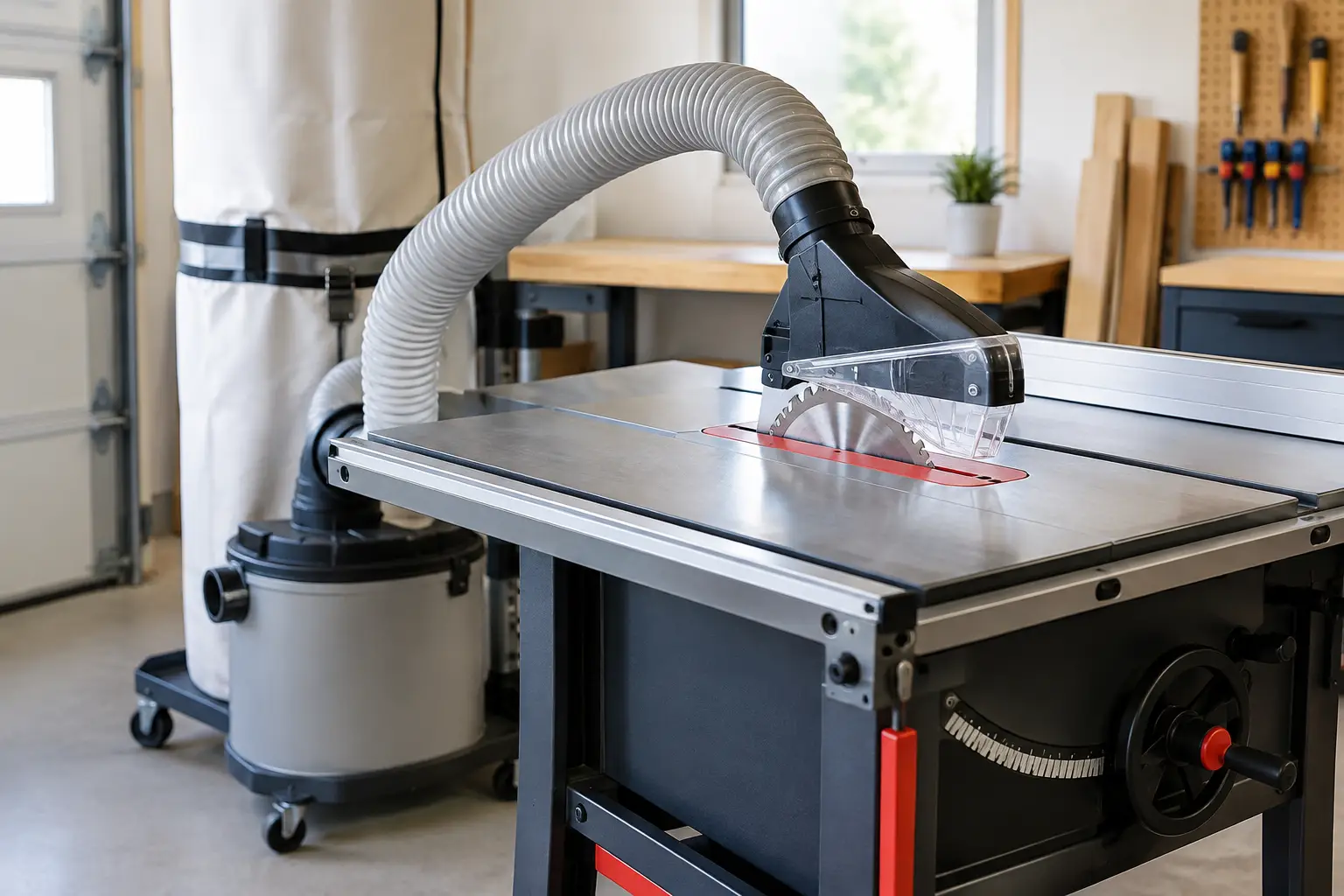
An overarm dust collection system or a blade guard with an integrated dust port places the pickup close to the blade. That allows the system to capture dust before it has a chance to disperse through the garage.
This approach is particularly useful when cutting MDF, plywood, melamine, and other materials that can produce a large amount of fine dust.
Commercial overarm systems vary considerably. Some combine the dust pickup with a blade guard, while others function primarily as a dust hood. That distinction matters.
A dust hood is not automatically a blade guard.
If you install an aftermarket overarm system, make sure you understand whether it provides actual blade guarding and kickback protection for your particular saw. Some commercial overarm products explicitly state that they do not provide kickback protection.
Do not remove the factory blade guard simply because an overhead dust hood is installed unless the replacement system is specifically designed and approved for that purpose.
Keep the riving knife and other manufacturer-recommended safety equipment in place whenever the cut allows it.
Need More Airflow?
See our recommended portable dust collectors for table saws with 4-inch dust ports.
Need More Airflow?
→See our recommended portable dust collectors for table saws with 4-inch dust ports.
Shop Vac or Dust Collector for a Small Garage?
The best choice depends largely on the table saw and the way you use your workshop.
Shop Vac for a Portable Table Saw
For a portable or jobsite table saw with a 2 1/2-inch dust port, a good shop vacuum is often the most practical solution.
A shop vac is compact, easy to move, and designed to produce relatively high static pressure through smaller hoses. That makes it a natural match for a small table saw connection.
For a garage workshop, look for:
- A 2 1/2-inch connection
- Fine-dust filtration
- A disposable collection bag or suitable dust bag
- Enough capacity for your typical cutting sessions
- A hose that is short enough to avoid unnecessary resistance
- Wheels or a compact footprint that make storage easy
A bag can also make maintenance easier because it catches a large portion of the debris before it reaches the main filter.
If you frequently cut MDF or other dusty sheet goods, a vacuum with high-efficiency filtration can be particularly useful.
Dust Collector for a Contractor or Cabinet Saw
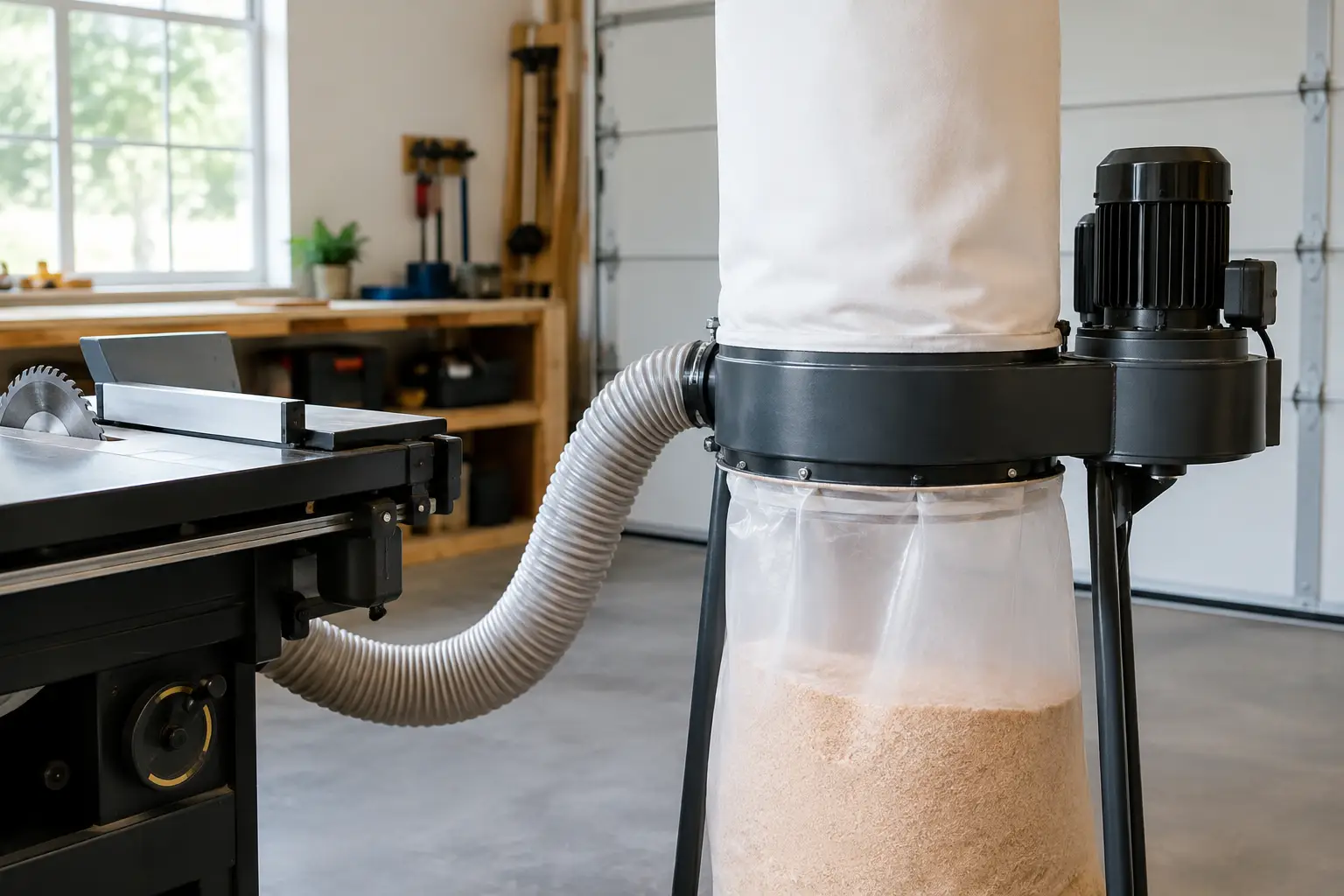
A single-stage dust collector is usually a better fit for a table saw designed around a 4-inch dust port.
The larger hose allows substantially more airflow than a typical shop-vac hose, provided the collector and the rest of the system are capable of delivering it.
For a one-car garage, mobility is important.
A collector on a mobile base can be rolled into position when you are using the saw and moved out of the way when the garage needs to return to parking or storage duty.
Permanent ductwork can make sense in a dedicated shop, but it is not automatically the best solution for a small garage with only a few machines.
Cut Down on Filter Clogging
→ See our recommended cyclone separators for small garage woodworking shops.
Use a Cyclone or Separator for High-Volume Cutting
A table saw can fill a small vacuum surprisingly quickly when you are repeatedly ripping lumber or breaking down plywood.
A cyclone separator or pre-separator can intercept much of the larger debris before it reaches the vacuum or dust collector’s main filter.
That provides two practical benefits.
First, you empty the collection container instead of the vacuum itself.
Second, the main filter can stay cleaner for longer, which helps preserve airflow.
The disadvantage is that the separator takes additional space and adds another hose connection. In a small garage, that matters.
If you use a separator, consider mounting the vacuum and separator on the same rolling cart. Keeping the entire collection system together makes it easier to move and store.
Keep the Hose Short and Direct
Hose layout can have a surprisingly large effect on dust collection performance.
Every hose, bend, reducer, connector, and filter adds resistance to the system. The longer and more restrictive the path becomes, the less airflow reaches the saw.
For a shop vacuum connected to a 2 1/2-inch table saw port, keep the 2 1/2-inch hose as large and short as practical.
Avoid unnecessarily stepping down to a smaller hose.
For a table saw with a 4-inch dust port, keep the 4-inch hose all the way to the saw whenever practical. If a reducer is required, use it near the machine and avoid adding a long length of smaller hose afterward.
Flexible hose is convenient, especially in a garage where equipment moves around, but unnecessary loops and sharp bends add resistance.
A short hose with gentle bends is generally easier for the collector to handle than a long hose routed around storage cabinets, shelves, and other equipment.
Make the Hose Work With Your Garage, Not Against It
Dust collection should not create a new workshop problem.
On a portable table saw, route the hose so it does not interfere with the fence, outfeed support, blade-height adjustment, or the operator’s movement.
Secure the hose to the saw stand when necessary, but leave enough slack for normal adjustments.
If the saw is stored against a wall, disconnect the hose before folding or moving the saw rather than forcing the hose into a sharp bend.
For a one-car garage, this small detail matters because the table saw may need to move several times during a typical project.
A dust collection system that takes five minutes to assemble and blocks the path to the garage door is much less likely to be used consistently than one that can be connected in seconds.
Pay Attention to Filtration
Collecting the visible chips is only part of dust control.
Fine wood dust can remain suspended in the air after cutting, particularly when collection at the source is incomplete. OSHA identifies local exhaust ventilation as a primary engineering control for wood dust and recommends removing dust at or near the source.
That is why filtration should be considered alongside collection.
A collector with a basic filter may remove large chips while allowing some fine particles to return to the garage. A properly maintained fine-dust filter can improve the amount of particulate captured by the system.
Keep the filter clean according to the manufacturer’s instructions.
As the filter loads with dust, airflow can decrease. Lower airflow at the saw means less effective capture.
If you clean filters with compressed air, do it in an appropriate outdoor location rather than simply blowing accumulated fine dust around an enclosed garage.
Wear Appropriate Respiratory Protection When Needed
Dust collection is an engineering control. Respiratory protection is an additional measure when exposure cannot otherwise be adequately controlled.
NIOSH recommends limiting exposure to wood dust, and OSHA identifies both engineering controls and appropriate personal protective equipment as ways to address exposure.
For hobbyists working with dusty materials, especially during extended cutting or cleanup, appropriate respiratory protection may provide an additional layer of protection.
Do not treat a respirator as a replacement for source capture.
The better approach is to capture dust at the saw first, keep the collection system maintained, clean the workspace without redistributing dust, and use appropriate PPE when necessary.
How to Improve Poor Table Saw Dust Collection
If your saw is already connected to a vacuum or collector but the garage is still dusty, work through the system from the saw outward.
1. Check the hose connection
Make sure the hose is fully seated and that the adapter is not loose.
2. Inspect the filter
A loaded filter can restrict airflow and reduce collection performance.
3. Empty the collection container
A full bag or collection bin can interfere with normal airflow.
4. Look inside the blade housing
Accumulated chips may indicate that the internal collection path or shroud is not moving debris effectively.
5. Check for unnecessary restrictions
Look for sharp bends, crushed hose sections, undersized adapters, and unnecessarily long runs.
6. Inspect cabinet openings
Large gaps may allow dust to escape before it reaches the collection port.
7. Improve the upper collection point
If most of the visible dust is coming from above the table, improving the lower port will not completely solve the problem. Consider an appropriate blade guard or overarm collection system.
8. Test one change at a time
Make several cuts after each modification and inspect where dust is accumulating.
This approach is more useful than simply buying a larger collector and hoping for a dramatic improvement.
A Practical Setup for a Small Garage
For most owners of a portable 10-inch table saw, a practical starting setup is a quality shop vacuum with fine-dust filtration, a short 2 1/2-inch hose, and a separator if the saw is used regularly for plywood or lumber.
Keep the vacuum close to the saw.
You might store it underneath an outfeed table, on a compact rolling cart, or beside the saw when the garage is being used as a workshop.
For a stationary contractor or cabinet saw with a 4-inch dust port, a mobile dust collector with fine filtration and a short 4-inch hose is a more natural match.
If the collector also serves a planer, router table, jointer, or other stationary tool, quick-connect fittings can make switching between machines much easier.
For a table saw that produces noticeable dust above the blade, consider adding an appropriate upper collection system as well. If your collector does not have enough capacity to operate both collection points effectively, using a separate shop vacuum for a small upper port can be a practical small-shop solution.
The Best Table Saw Dust Collection Setup Is the One You Will Actually Use
A small garage does not need an oversized dust collection system just because a larger collector has a higher CFM number.
The system needs to match the saw.
For a portable table saw, that usually means a compact shop vacuum, a properly sized hose, good filtration, and short runs.
For a larger saw with a 4-inch port, a mobile dust collector provides more airflow and better suits the larger connection.
And when fine dust continues escaping above the table, the next improvement is not necessarily a bigger collector. It may be better dust capture at the blade, using an appropriate overarm or blade-guard collection system.
Keep the hose short, maintain the filter, minimize unnecessary restrictions, and inspect where dust actually accumulates after making a few cuts.
In a one-car garage, the goal is not to create a commercial woodworking dust system. The goal is to build a table saw dust collection setup that captures chips and fine dust effectively, fits the available space, and is simple enough to use every time you turn on the saw.
Build a Better Table Saw Dust Collection Setup
→ See our recommended dust collection equipment for small garage workshops.

Leave a Reply