
As an Amazon Associate I earn from qualifying purchases.
A 560 CFM dust collector can be enough for a small garage workshop, especially if you use one stationary woodworking machine at a time and keep the hose connection short. For a one-car garage with a table saw, band saw, router table, or benchtop planer, a compact collector in this airflow range can be a practical starting point.
However, the advertised CFM rating does not tell the whole story. Actual airflow depends on the collector’s design, filter condition, hose diameter, fittings, dust ports, and the resistance created by the entire collection system.
The most important consideration is whether the collector can meet the dust-collection requirements of your specific machines. A compact 560 CFM unit may work well with some tools but fall short with a wide planer, large jointer, or drum sander that requires substantially more airflow.
For a small garage workshop, the goal is to choose a collector that fits your machines, available space, and working habits—not simply to buy the unit with the biggest number on the label.
What Does 560 CFM Mean?
CFM stands for cubic feet per minute. It measures the volume of air a dust collector moves over time.
A collector advertised at 560 CFM has a stated airflow rating of 560 cubic feet per minute under the conditions used to establish that rating. That number should not automatically be interpreted as the airflow delivered at a connected woodworking machine.
Once you connect a hose, fittings, a filter, and a dust port, the system creates resistance. The collector’s actual airflow depends on how its fan performs against that resistance.
This is why two dust collectors with similar advertised CFM ratings can produce different results in a real garage workshop.
A short, relatively straight 4-inch hose connected to a machine with an appropriate dust port creates a different operating condition from a long flexible hose with several bends, reducers, and a restrictive separator.
Advertised CFM vs. Actual Airflow
When comparing dust collectors, distinguish between maximum airflow and airflow under operating conditions.
Maximum airflow figures are useful for an initial comparison, but they do not establish how much air will reach your machine. A manufacturer’s fan performance curve, which relates airflow to static pressure, can provide a more meaningful picture of how a collector performs under resistance.
In a small workshop, several factors influence the result:
- Hose length: Longer hoses generally add resistance.
- Hose diameter: An undersized connection can restrict airflow.
- Fittings and bends: Tight turns and unnecessary adapters can increase resistance.
- Filter condition: A loaded filter can reduce airflow.
- Dust port design: A narrow or poorly positioned port can limit collection.
- Machine enclosure: Gaps and ineffective hoods can allow dust to escape.
- Separator design: A separator may reduce filter loading but also introduce additional resistance.
A compact collector works best when the entire system is designed around its capabilities.
Is 560 CFM Enough for Common Garage Workshop Tools?
For many hobby woodworkers, 560 CFM is most appropriate as a single-machine dust collection system. It can be useful for stationary tools with compatible dust ports, but suitability depends on the machine’s requirements and the collector’s actual performance.
The following table provides an initial guide. It is not a substitute for the dust-collection specifications in your machine’s manual.
| Workshop tool | Is 560 CFM a reasonable option? | What to consider |
|---|---|---|
| Benchtop planer | Potentially | Check the manufacturer’s airflow requirements and chip output |
| Band saw | Often worth considering | Blade area, lower cabinet, and dust-port design affect collection |
| Router table | Potentially | An enclosed cabinet and fence collection can improve results |
| Miter saw | Potentially | A properly designed rear hood may be important |
| Jobsite table saw | Potentially | Under-table collection may leave dust around the blade |
| Contractor table saw | Depends on design | Cabinet openings and port size affect performance |
| Cabinet table saw | Depends on requirements | Verify airflow needs and lower and upper collection arrangements |
| 6-inch jointer | Verify first | Larger ports and continuous chip production may require more capacity |
| Wide planer | Often needs more capacity | Check the specified minimum airflow |
| Drum sander | Do not assume it is sufficient | Some models require substantially more than 560 CFM |
| Multiple machines simultaneously | Generally not ideal | Available airflow is divided among open branches |
The distinction between a small workshop and a small machine matters. A compact garage can contain equipment that requires more airflow than a modest collector can provide.
For example, the Powermatic PM2244 drum sander manual specifies a minimum 800 CFM dust collector. A 560 CFM model should not be considered an adequate replacement simply because the machine is installed in a small space.
Compare dust collectors for your small garage workshop and check their published airflow ratings, filtration, and connection sizes before choosing a model. → Shop Dust Collectors on Amazon
Is 560 CFM Enough for a Benchtop Planer?
A 560 CFM collector may be suitable for some benchtop planers, particularly models designed for a compatible 4-inch collection connection. However, the correct choice depends on the planer’s requirements and how efficiently the system transports chips.
Planers can generate large quantities of shavings in a short period. Even when the collector is reasonably powerful, a restricted hose or poorly designed adapter can interfere with chip removal.
For better results:
- Position the collector close to the planer.
- Use the largest practical hose diameter permitted by the machine and collector.
- Avoid unnecessary bends and restrictive adapters.
- Keep the filter and collection bag in good condition.
- Check the planer hood and dust port for blockages.
- Empty the collection bag before accumulated material interferes with operation.
If chips begin accumulating inside the machine’s collection path, inspect the entire system before assuming the motor is too small.
For frequent surfacing of wide boards or sustained heavy use, consider a collector with greater capacity if the planer’s specifications call for it.
Is 560 CFM Enough for a Table Saw?
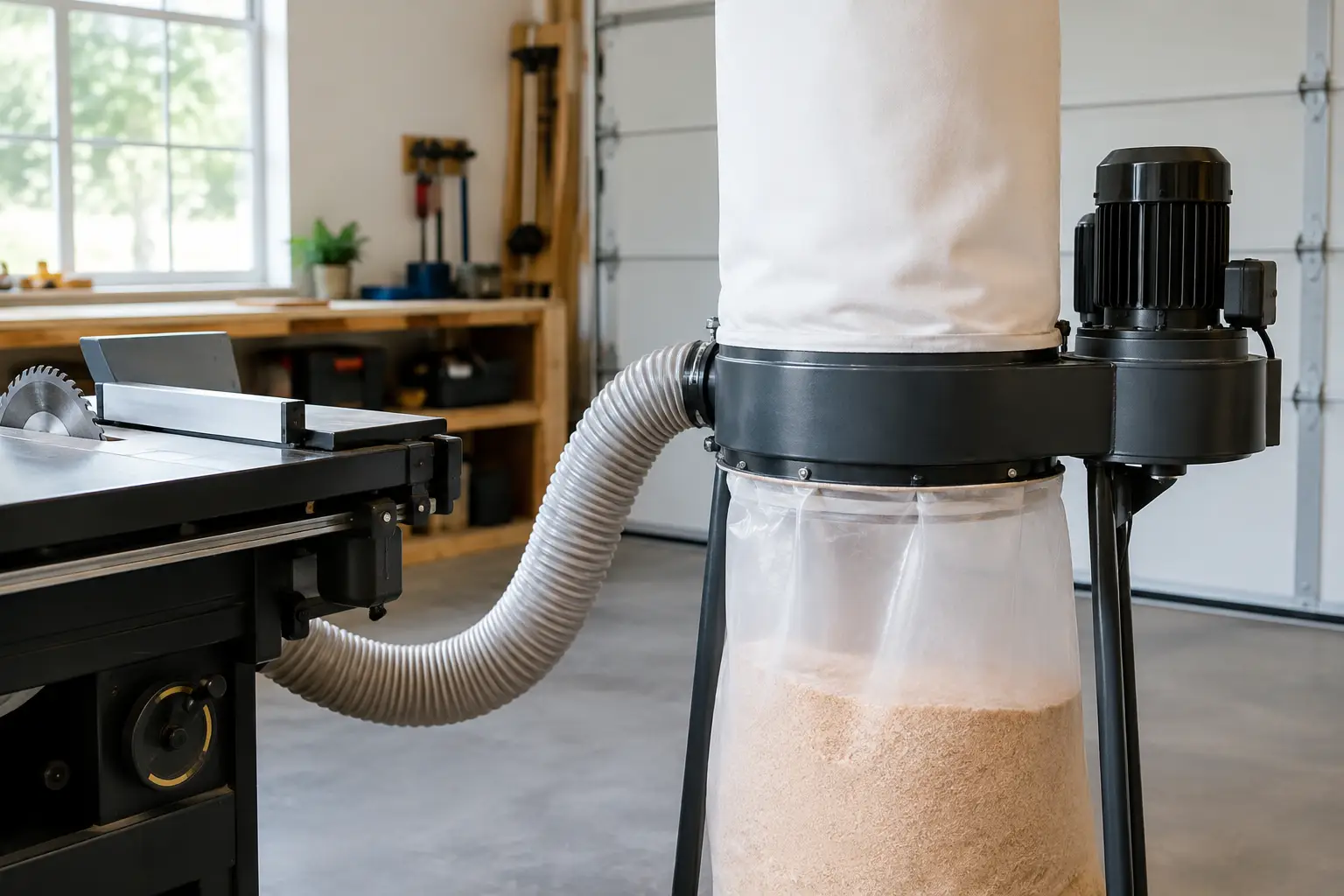
For some small-shop table saws, 560 CFM can provide useful collection below the table. The result depends on the saw’s construction, dust-port size, enclosure, and the collector’s airflow under load.
Table saws are challenging because dust does not leave the blade in just one direction. Some falls into the cabinet, while other particles escape around the blade and above the table.
Connecting a collector to the lower dust port can capture a portion of the debris, but it may not control all the airborne dust.
A better setup may include:
- An adequately sized lower dust port.
- A cabinet or enclosure that limits unnecessary air leakage.
- A properly designed upper-blade collection hood where compatible.
- A short hose run with minimal restrictions.
- A collector that meets the saw manufacturer’s requirements.
Improving the collection hood and enclosure can make a meaningful difference. However, these changes do not compensate for a collector that cannot provide the airflow the machine needs.
For a more detailed setup, see this guide to table saw dust collection for a small garage.
Is 560 CFM Enough for a Miter Saw?
A 560 CFM collector may help with miter-saw dust, but the saw’s collection design is often just as important as the airflow rating.
Many miter saws send dust backward and upward as the blade cuts. Their factory dust ports may capture some of the debris while allowing a considerable amount to escape around the machine.
A rear collection hood can help direct dust toward the extraction point. Its shape, opening size, and position should be compatible with the saw’s movement and the space required to handle long boards.
If dust continues escaping, check the hood and port alignment before automatically upgrading the collector.
A larger collector may help when insufficient airflow is the problem, but it cannot guarantee effective collection from a poorly designed pickup area.
See the guide to miter saw dust collection for small garages for additional setup ideas.
Why the Hose Diameter Matters
A 560 CFM collector is commonly paired with a 4-inch connection, making that diameter a useful starting point when the machine supports it.
The internal cross-sectional area of a circular hose increases substantially with diameter. A nominal 4-inch circle has approximately 12.6 square inches of cross-sectional area, while a 2.5-inch circle has approximately 4.9 square inches.
That difference affects how air and debris move through the system. It does not, however, mean that either hose will automatically deliver a particular CFM.
A small dust port can restrict the flow even when the main hose is larger. Adapters and reductions also affect the system’s resistance.
Use a hose that matches the manufacturer’s recommendations and the machine’s connection. Do not enlarge or reduce a port without checking whether the resulting arrangement supports the required airflow.
For stationary machines designed around a 4-inch collection connection, a properly fitted 4-inch hose is often a sensible choice.
Dust Collector vs. Shop Vacuum
A dust collector and a shop vacuum serve overlapping but different purposes.
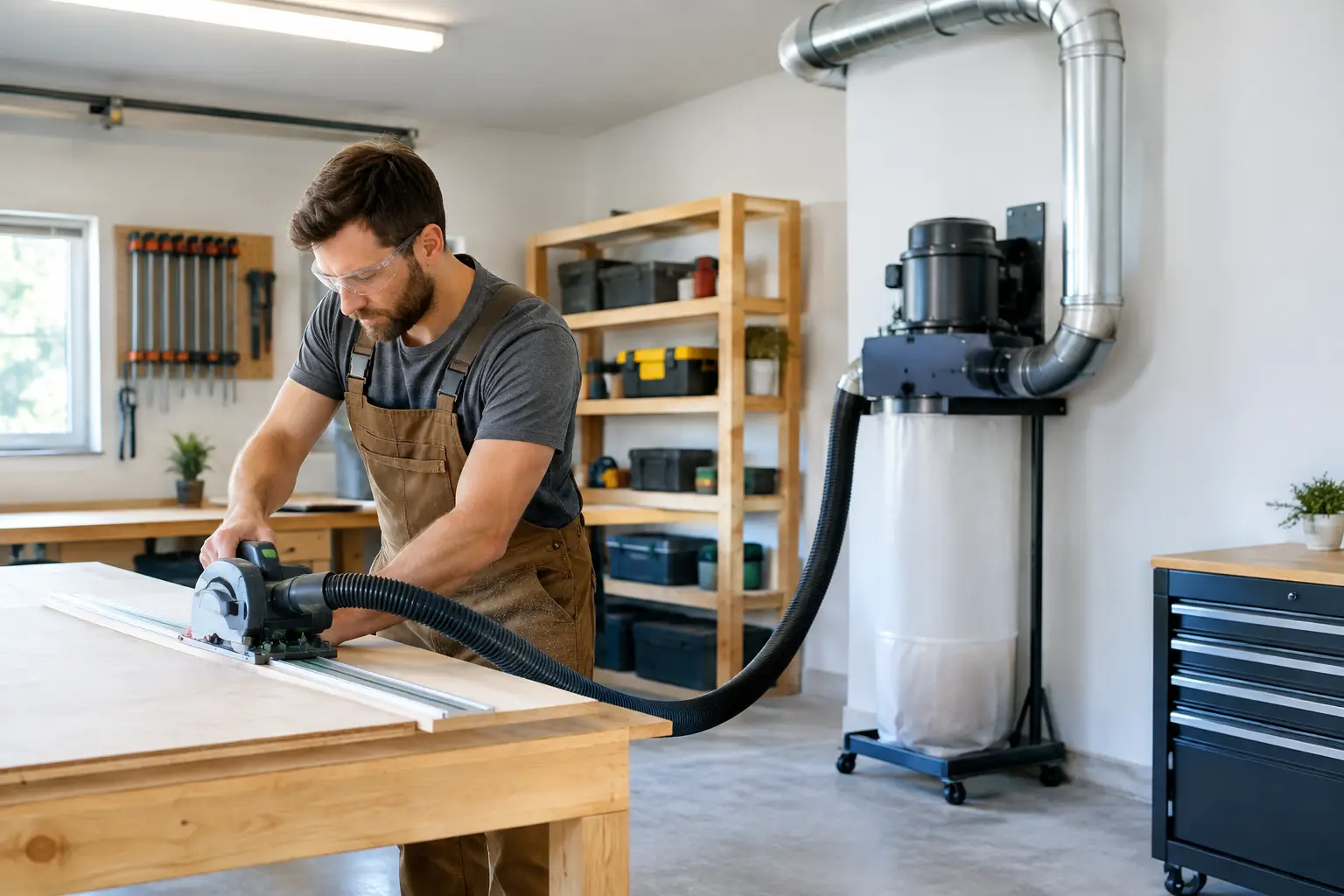
A traditional dust collector moves a relatively large volume of air through a larger hose. A shop vacuum generally works with smaller hoses and is suited to many handheld tools that require concentrated extraction through a small port.
For a small garage workshop, a dust collector is worth considering for:
- Table saws with compatible collection ports.
- Band saws.
- Router tables.
- Benchtop planers that meet its airflow requirements.
- Other stationary machines designed for higher-volume extraction.
A shop vacuum or dedicated dust extractor may be a better match for:
- Random orbital sanders.
- Track saws.
- Circular saws.
- Small handheld routers.
- Biscuit joiners.
- Other portable tools with smaller dust ports.
The correct choice depends on the tool’s extraction requirements, not simply on which device has the higher advertised CFM.
Many hobby workshops benefit from owning both. A compact dust collector can serve stationary machinery, while a shop vacuum or suitable extractor handles portable tools.
Neither device should be assumed to capture every fine particle released during woodworking.
How Hose Length Affects a 560 CFM Collector
In a one-car garage, it is tempting to leave the dust collector against one wall and run a long hose to every machine. That arrangement is convenient, but it can add unnecessary resistance.
A mobile collector allows you to move the unit closer to the machine currently in use.
Try to maintain a connection that is:
Short, direct, and appropriately sized.
Avoid long, restrictive hose runs with multiple tight bends and unnecessary adapters.
A short flexible hose is often practical when you use one machine at a time and regularly rearrange the garage to accommodate a vehicle.
If your setup requires long permanent ductwork, several branches, or multiple machines operating together, evaluate whether a larger collector is more appropriate.
Should You Use a 4-Inch Hose or Permanent Ductwork?
For many one-car garages, a mobile collector and a short hose are simpler than installing permanent ductwork.
A flexible setup is particularly useful when:
- You operate one machine at a time.
- Your tools are spread around the garage.
- You need to preserve parking space.
- You frequently change the workshop layout.
- Your collector is portable.
- Your hose connections can remain relatively short.
Permanent ductwork becomes more attractive when several stationary machines remain in fixed positions and you want convenient connections throughout the workshop.
However, a network of ducts introduces design considerations, including diameter, fittings, branch layout, airflow requirements, and resistance. A small collector should not be expected to perform like a larger central system merely because the ducts are installed permanently.
For a compact garage, simplicity is often the better starting point.
What Happens When the Filter Gets Dirty?
A dust collector’s performance can change as its filter accumulates material.
Depending on the filter design and operating conditions, accumulated dust can increase resistance and reduce the airflow available to the machine.
If collection becomes noticeably worse, inspect the system before replacing the collector.
Check these components:
- Filter condition and cleaning requirements.
- Collection bag or drum capacity.
- Hose blockages and crushed sections.
- The machine’s dust port and hood.
- Blast-gate position.
- Separator connections.
- The collector inlet.
- The impeller area, following the manufacturer’s maintenance and safety instructions.
Always disconnect power before inspecting internal components.
Filtration is also important. A filter’s stated micron rating describes a particle-size specification under the relevant test conditions; it does not, by itself, establish the overall efficiency of the complete collector or prove that the unit removes all hazardous airborne dust.
Choose filtration appropriate to your woodworking needs and follow the manufacturer’s cleaning and replacement schedule.
Is a Dust Separator Worth Using With 560 CFM?
A dust separator can reduce the amount of chips and debris that reaches a collector’s filter or collection bag.
This can be useful when working with a planer, jointer, or table saw that produces substantial quantities of material.
However, a separator adds another component to the airflow path. Its ports, internal design, connections, and hose arrangement can introduce additional resistance.
Before adding one to a 560 CFM system, consider:
- Whether the separator is appropriately sized.
- Whether its connections match the rest of the system.
- How much additional hose is required.
- Whether it can handle the material produced by your machine.
- Whether the manufacturer provides relevant airflow or performance information.
A separator is not automatically an improvement in every setup. Its benefit depends on whether the reduction in filter loading outweighs the additional resistance and maintenance.
Looking for a compact dust collector for a one-car garage? Compare available models by airflow rating, filtration, connection size, and footprint to find one that suits your workshop. → Browse Dust Collectors on Amazon
Is One Machine at a Time the Best Use for 560 CFM?
For many small garage workshops, yes.
A mobile collector can be connected to the table saw when cutting, moved to the planer when surfacing lumber, and connected to the router table when routing.
This approach concentrates the available airflow on the active machine instead of distributing it across multiple open branches.
Opening several blast gates simultaneously can reduce the airflow available at each connection. The exact result depends on the collector, duct layout, and system resistance, so do not assume that a 560 CFM rating can support several tools simply because their combined ports fit the ductwork.
For a compact collector, using one machine at a time is often the more practical arrangement.
When Is 560 CFM Not Enough?
A larger dust collector deserves consideration when your workshop contains machines with higher airflow requirements or a collection layout that introduces substantial resistance.
Examples include:
- A jointer whose manufacturer specifies greater airflow.
- A wide planer designed for higher-volume chip extraction.
- A drum sander with a minimum airflow requirement above 560 CFM.
- A large table saw with demanding collection requirements.
- Long duct runs with several bends and branches.
- Multiple machines that need to operate simultaneously.
- A permanent collection system serving several stationary tools.
The manufacturer’s specifications should take priority over general workshop guidelines.
For example, the Powermatic PM2244 manual specifies a minimum 800 CFM dust collector. A 560 CFM model would not meet that published minimum based on its advertised rating.
Before buying, identify the most demanding machine in your workshop and check its required airflow, connection size, and other collection specifications.
The fact that a garage is small does not mean every tool inside it can operate effectively with a compact collector.
When Should You Upgrade to a Larger Dust Collector?
A 560 CFM collector can be a sensible starting point for a hobbyist who uses compatible machines individually and prioritizes floor space.
However, upgrading may make sense if you expect to add larger machinery or build a permanent duct network.
A larger collector can provide more capacity for demanding machines, but the benefit depends on its performance under the resistance of the complete system. Its published airflow rating alone is not enough to establish suitability.
Also consider the practical trade-offs:
- Floor space and mobility.
- Electrical requirements.
- Filter type and replacement cost.
- Collection bag or drum capacity.
- Noise and maintenance.
- Compatibility with existing hoses and machines.
In a one-car garage, the best upgrade is the one that solves a real collection problem without making the workspace unnecessarily difficult to use.
How to Make a 560 CFM Collector Work Better
If you already own a 560 CFM dust collector, several improvements may help you get more effective use from it.
1. Use an Appropriate Hose Diameter
Choose the largest practical connection that is compatible with the machine and collector. Avoid unnecessary reductions that increase resistance.
2. Keep the Hose Short
Move a mobile collector close to the active machine whenever possible.
3. Reduce Unnecessary Bends
Avoid tightly curved hose runs and excessive fittings.
4. Maintain the Filter
Clean or replace the filter according to the manufacturer’s instructions.
5. Check for Blockages
Inspect hoses, ports, hoods, and collection bags whenever performance declines.
6. Improve the Dust Hood
A well-positioned hood can help capture debris before it spreads into the garage.
7. Collect Dust at the Source
Extraction is generally more effective when the pickup point is close to where dust is generated. A collector should be connected and configured for the machine’s intended use.
8. Use a Separator When Appropriate
Choose a separator that fits the system and does not introduce excessive resistance.
These changes can improve the effectiveness of an existing setup, but they cannot compensate for a collector that falls below the machine manufacturer’s airflow requirements.
What About Fine Dust and Air Cleaners?
A dust collector is not a complete workshop air-cleaning system.
Its primary purpose is to capture chips and dust at the machine. Some fine particles may escape the collection hood and remain airborne or settle on surrounding surfaces.
A separate air filtration unit can help capture particles that remain suspended in the workshop. It complements source extraction rather than replacing it.
For better dust control:
- Use suitable extraction at the machine.
- Maintain filters and collection equipment.
- Keep the work area clean using appropriate methods.
- Avoid blowing accumulated wood dust into the air with compressed air.
- Follow the tool manufacturer’s safety instructions.
- Use suitable respiratory protection when required by the task and exposure conditions.
Wood dust can pose respiratory hazards, and visible cleanliness alone does not establish that airborne exposure is adequately controlled.
A good dust-collection setup should reduce exposure at the source, while appropriate additional controls address dust that escapes.
Is 560 CFM Enough for a Small Garage Workshop?
Yes, 560 CFM can be enough for many small garage workshops, provided the collector matches the machines and the collection system is designed properly.
It is worth considering when you have compatible stationary tools, use one machine at a time, keep hose runs short, and want to conserve valuable floor space.
It is less suitable when a machine specifies substantially higher airflow, when long restrictive ductwork is required, or when several machines need simultaneous extraction.
Before purchasing, check the manufacturer’s requirements for your most demanding tool. Then compare the collector’s performance information, hose connections, filtration, and physical size.
The key is to evaluate the complete dust-collection system rather than relying on the CFM number alone.
Quick Buying Checklist
Choose a 560 CFM collector if:
- You have a small or one-car garage.
- You primarily do hobby woodworking.
- You generally operate one stationary machine at a time.
- Your machines have compatible dust ports.
- You can keep the hose runs short.
- The collector meets the airflow requirements of your tools.
- You value mobility and a compact footprint.
Consider a larger collector if:
- Your jointer or planer requires greater airflow.
- You use a drum sander with a higher specified minimum.
- Your table saw requires a more capable collection system.
- You need long permanent duct runs.
- You intend to operate multiple collection points simultaneously.
- Your existing system cannot meet the manufacturer’s specifications.
Ready to choose a dust collector? Compare compact models, check their filtration and airflow specifications, and verify that the selected unit meets your woodworking machines’ requirements before buying. → See Dust Collector Options on Amazon
Frequently Asked Questions
Is 560 CFM enough for a table saw?
It can be sufficient for some small-shop table saws, particularly when the saw has a compatible dust port and an effective lower enclosure. However, dust may escape around the blade and above the table. Check the saw manufacturer’s airflow requirements and consider whether an upper-blade collection hood is appropriate.
Is 560 CFM enough for a planer?
It may be enough for some benchtop planers, but the answer depends on the model’s specified airflow and chip output. A planer that produces large quantities of shavings may require more capacity. Check the manufacturer’s manual before connecting a 560 CFM collector.
Is 560 CFM enough for a miter saw?
It can provide useful extraction, but miter saws often release dust outside their factory collection ports. A compatible rear hood can help direct debris toward the collection point. If airflow is already adequate, improving the hood may be more useful than automatically upgrading the collector.
Can a 560 CFM dust collector use a 2.5-inch hose?
It can be connected through a compatible adapter if the equipment permits it, but the smaller connection can increase system resistance. The resulting airflow will depend on the collector and the complete hose arrangement. Use the connection size recommended by the tool and collector manufacturers.
Should I use a shop vacuum or a 560 CFM dust collector?
A shop vacuum or dust extractor is often a better match for handheld tools with small dust ports. A traditional dust collector is generally designed for higher-volume extraction from stationary machines. Some workshops benefit from having both, with each used for the tools it is designed to serve.
Can I run two machines from a 560 CFM dust collector?
A system can have multiple branches, but opening multiple collection points divides the available airflow according to the system’s resistance. For many small workshops, connecting one machine at a time is the more practical choice. Verify the collector’s performance and each machine’s airflow requirements before designing a multi-machine system.
Does a dust collector remove all fine wood dust?
No. Some fine particles can escape source collection and remain airborne. Suitable filtration, an air cleaner where appropriate, good housekeeping, and task-appropriate respiratory protection can provide additional control. No single collector should be assumed to remove every hazardous particle.
Is 560 CFM a good choice for a one-car garage?
It can be a practical choice when the collector meets your machines’ requirements and you want a compact, mobile setup. The most important factors are the tools you use, the required airflow, the hose layout, filtration, and whether you need to operate several machines at once.
Bottom Line
For a small garage workshop, 560 CFM can be a practical option for compatible stationary woodworking machines, particularly when you use one machine at a time and keep the collection path short.
It is not sufficient for every tool, and the advertised CFM rating does not guarantee the airflow delivered at the machine. A well-designed hose connection, a clean filter, an effective dust hood, and a suitable collection layout all contribute to performance.
If your workshop mainly uses a table saw, band saw, router table, miter saw, and a compatible benchtop planer, a compact collector may be worth considering.
If you plan to use a demanding jointer, a wide planer, a drum sander, or a permanent multi-machine duct system, check the manufacturer’s airflow requirements and consider a larger collector when necessary.
For a one-car garage, the goal is not to buy the biggest dust collector that fits. It is to choose a system that meets your machines’ requirements, controls dust at the source, and works with the space you actually have.

Leave a Reply