
As an Amazon Associate I earn from qualifying purchases.
A dust collector can have an impressive CFM rating and still leave chips under your table saw. That is one of the most confusing parts of setting up dust collection in a small garage.
The reason is simple: CFM and suction measure different things. CFM tells you how much air a machine can move, while static pressure—often described as suction or water lift—tells you how well it can keep moving air when the system has resistance.
That resistance comes from the hose, duct diameter, elbows, blast gates, separators, filters, adapters, leaks, and the dust port on the tool itself.
For a one-car garage workshop, you do not necessarily need the biggest dust collector you can afford. You need a collector that can deliver enough useful airflow to the tool while working through the restrictions in your actual setup.
CFM vs Suction for Dust Collectors: What Is the Difference?
CFM stands for cubic feet per minute. It describes the volume of air a dust collector can move.
Static pressure is different. It describes how much resistance the collector can overcome while pulling air through a hose, duct, filter, separator, and tool connection. It is commonly expressed in inches of water column (in. w.c.).
In simple terms:
- CFM = how much air moves
- Static pressure = how hard the system can pull against resistance
- Airflow at the tool = what actually matters for dust collection
These two characteristics work together rather than competing against each other. As resistance increases, the airflow a collector can deliver generally falls. That is why a machine advertised at 1,200 CFM does not necessarily deliver 1,200 CFM at your table saw.
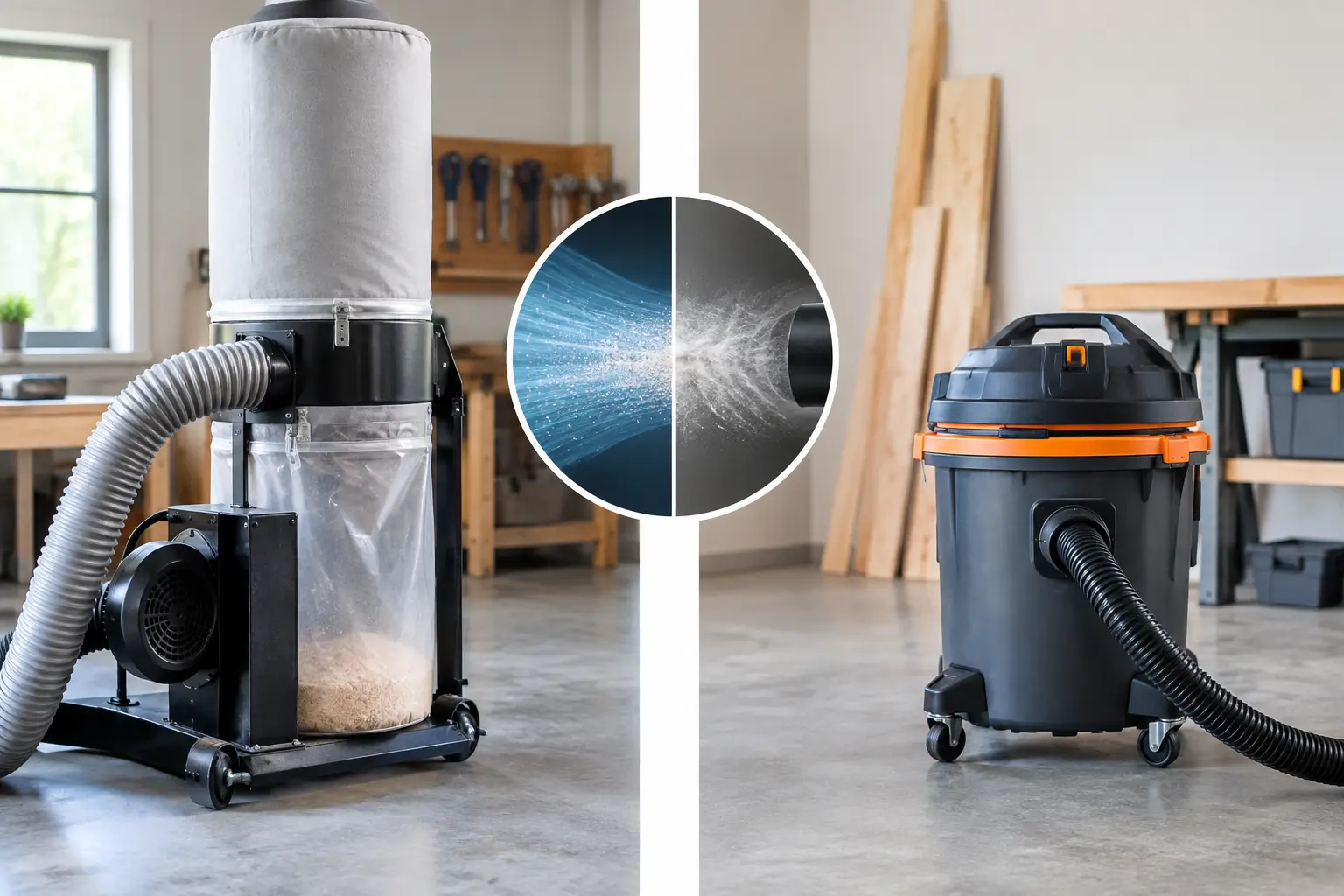
A comparison of dust collection systems shows the basic difference clearly: dust collectors are designed to move a large volume of air through larger ducting, while shop vacuums and extractors are designed to generate stronger pressure through smaller, more restrictive hoses.
CFM vs Static Pressure at a Glance
| Collection task | What matters most | Typical choice |
|---|---|---|
| Random-orbit sander | Static pressure and tight connection | Shop vacuum or dust extractor |
| Track saw | Static pressure | Shop vacuum or extractor |
| Router with small port | Static pressure | Shop vacuum or extractor |
| Miter saw | Airflow plus hood design | Shop vacuum, extractor, or dust collector |
| Table saw with 4-inch port | Useful airflow | Dust collector |
| Planer with 4-inch port | High airflow | Dust collector |
| Jointer with 4-inch port | High airflow | Dust collector |
| Large stationary machines | High-volume airflow | Dust collector |
The important point is that the tool’s dust port and the type of debris it produces should determine the collection system.
Why Published CFM Does Not Equal Airflow at Your Tool
This is where many dust-collection buying decisions go wrong.
A manufacturer may advertise a dust collector’s maximum CFM under conditions that are much less restrictive than your actual workshop. Once you connect a hose and tool, the collector has to work against resistance.
Consider everything between the collector and the machine:
- Flexible hose
- Hose diameter
- Hose length
- 90-degree elbows
- Blast gates
- Reducers
- Tool adapters
- Cyclone separators
- Filters
- Dust ports
- Air leaks
Each restriction affects the system.
A collector advertised at a high free-air CFM number may therefore deliver considerably less airflow once it is connected to a real tool. The meaningful number is the airflow available at the machine rather than simply the maximum number printed on the collector’s box.
This does not mean the manufacturer’s CFM rating is useless. It is still helpful when comparing similar machines. You just need to understand what the number represents.
For a small garage, this distinction is particularly important because you may have a relatively short hose but still introduce substantial restriction through a small reducer, corrugated flex hose, dirty filter, or undersized separator.
A Simple Example
Imagine a dust collector advertised at 1,000 CFM.
That sounds powerful.
Now connect it to:
- 15 feet of flexible hose
- Two tight elbows
- A cyclone separator
- A blast gate
- A 2-1/2-inch reducer
- A table saw with a 4-inch dust port
The collector is no longer operating under the conditions used to produce its maximum airflow number.
The lesson is not to ignore CFM. It is to judge CFM together with the complete air path.
Compare dust collectors by their airflow ratings, inlet sizes, and filter designs before choosing a unit for your workshop.
→ Compare Dust Collectors & Air Cleaners for airflow ratings, inlet sizes, and filtration options before choosing a unit for your small garage workshop.
Hose Diameter Has a Huge Effect on Dust Collection
Hose diameter is one of the most important factors in a small garage dust collection system.
A 4-inch hose has considerably more cross-sectional area than a 2-1/2-inch hose. That allows substantially more air to move through the system without creating the same level of restriction.
This is why forcing a high-CFM dust collector through a small hose can defeat the purpose of buying the larger collector in the first place.
If your machine has a 4-inch dust port, a 4-inch hose is normally the logical starting point.
Your dust collection hose size, length, and fit guide goes into the details, but the basic rule is simple:
Use the largest practical hose diameter that matches the machine and collector.
A reducer is sometimes necessary. For example, a machine may have a 4-inch main port but a smaller secondary connection. The problem comes when the entire system is reduced unnecessarily.
A long 2-1/2-inch hose connected to a collector designed for high-volume airflow can become a major restriction.
Why 4 Inches Is Common for Stationary Tools
Many woodworking machines use 4-inch dust ports because stationary tools such as table saws, planers, and jointers produce a relatively large volume of chips.
A 4-inch duct also has enough cross-sectional area to move considerably more air than a 2-1/2-inch line.
For example, theoretical airflow calculations show that a 4-inch duct carrying air around 4,000 feet per minute corresponds to roughly 350 CFM. A 6-inch duct at the same air velocity can carry more than twice that volume.
That does not mean every garage needs 6-inch ducting. In a compact one-car workshop, 4-inch connections can be a practical compromise when the system is kept short and simple.
Why a Shop Vacuum Can Have Better Suction Than a Dust Collector
This is one of the easiest ways to understand the difference between CFM and static pressure.
A shop vacuum may advertise a much lower CFM number than a dust collector, yet it can feel dramatically more powerful when you put your hand over the hose.
That is because the vacuum is designed to generate stronger pressure through a relatively small hose.
A dust collector has a different job.
It is designed to move a much larger volume of air through a larger opening.
Think about the difference between these two situations:
Sanding a piece of hardwood: The dust comes through a small port. Strong static pressure is useful for pulling the fine particles through the hose.
Planing a board: The machine produces a large volume of chips. You need enough airflow to transport those chips away from the cutterhead.
This is why a shop vacuum can be excellent for a random-orbit sander but a poor choice for a large stationary planer.
Neither machine is automatically better. They are optimized for different airflow conditions.
CFM vs Suction for a Table Saw
A table saw is a good example of why both airflow and system design matter.
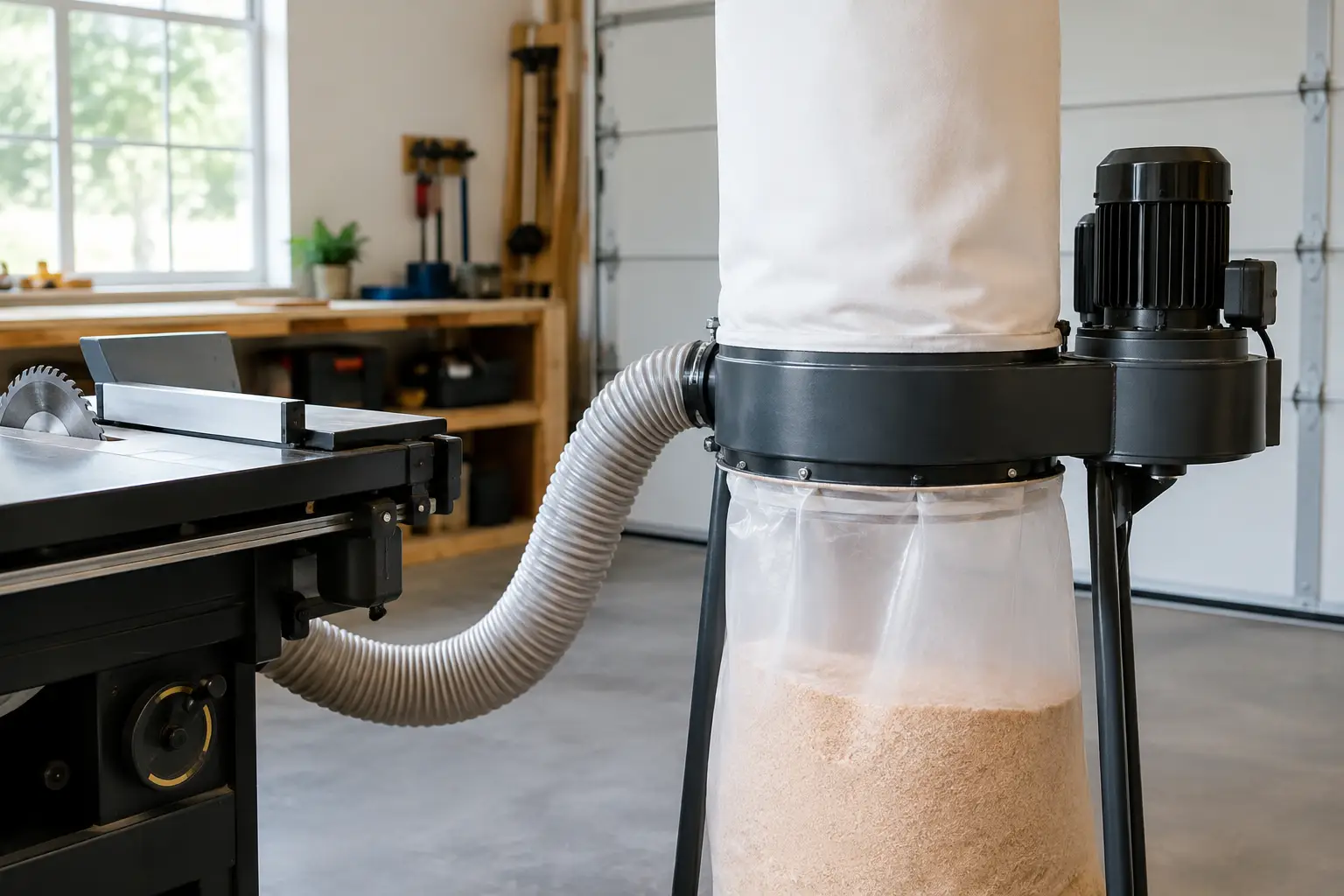
For a cabinet-style table saw with a 4-inch dust port, a dust collector is generally a better match than a standard shop vacuum.
The collector needs enough airflow to move sawdust through the cabinet and out through the port.
However, even a powerful collector will not capture every particle produced by a table saw.
The blade can throw dust above the table, behind the blade, and toward the operator. If the saw is open underneath or has poor internal airflow, the dust can escape before reaching the collection port.
That means CFM alone cannot solve a bad collection design.
A table saw dust collection system for a small garage should focus on the complete path from the blade to the collector.
For a cabinet saw, start with the lower cabinet connection. Then look at whether an overarm guard or upper dust collection would make sense for your setup.
What About a Portable Jobsite Table Saw?
This is different.
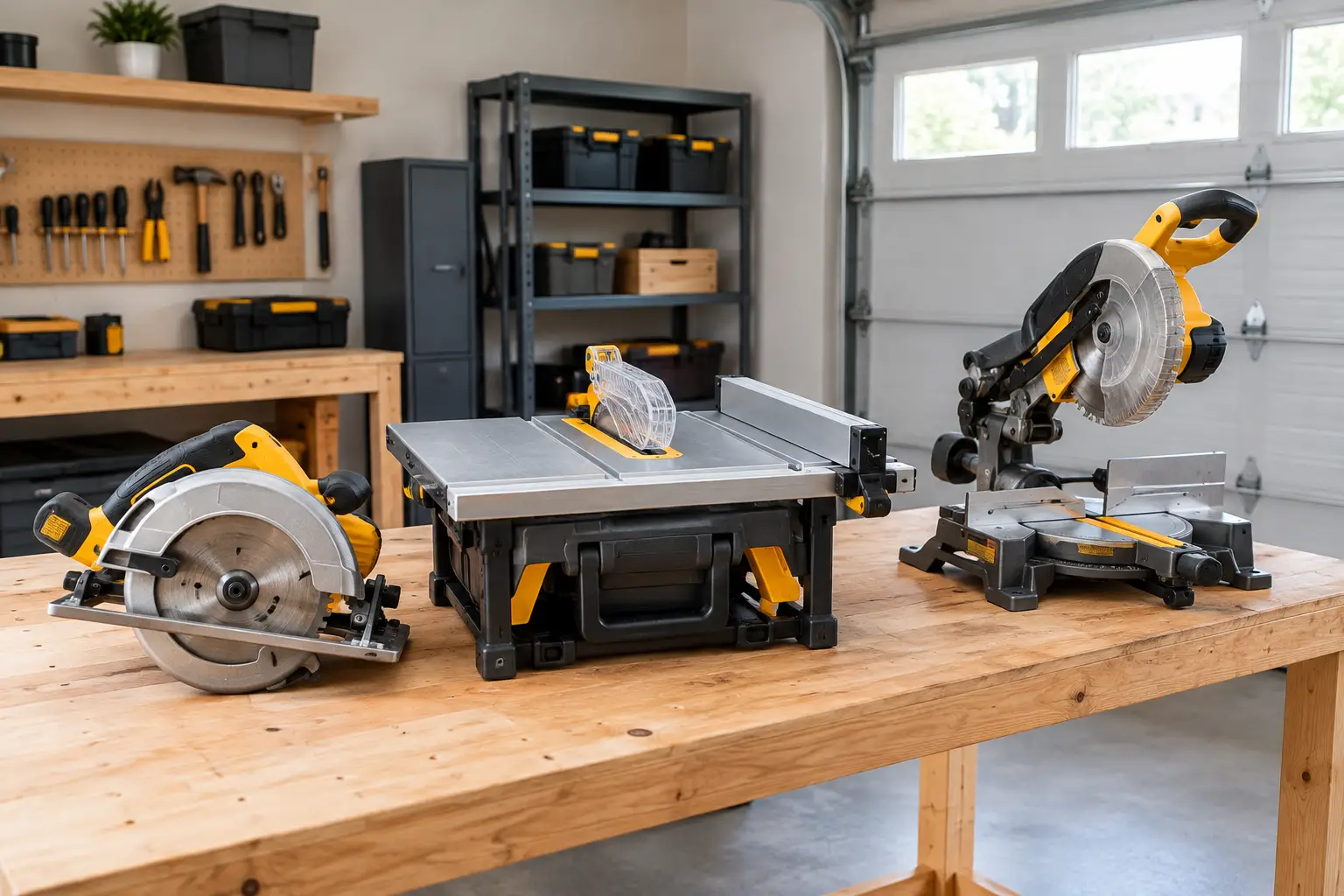
Many portable and jobsite table saws have smaller dust ports and less enclosed cabinets. Some can work reasonably well with a shop vacuum, particularly when the connection is short and sealed properly.
But that does not mean a shop vacuum is automatically the best choice for every jobsite saw.
Look at:
- The saw’s dust-port size
- How enclosed the blade area is
- How much dust escapes above the table
- Hose length
- Hose diameter
- The vacuum’s filtration
- Whether you move the saw frequently
The machine’s design matters as much as the number printed on the collector.
Planers and Jointers Need Airflow, Not Just Strong Suction
Planers and jointers create large chips very quickly.
This is where the difference between a shop vacuum and a dust collector becomes obvious.
A vacuum can have strong suction at the end of a small hose, but it may not move enough air to transport a large stream of chips from a planer.
A dust collector with a suitable 4-inch connection is usually a better choice for these machines.
There are exceptions, especially with some compact benchtop planers that have efficient chip-ejection systems and short hose connections. But these should be treated as machine-specific setups rather than a general rule.
If you regularly mill rough lumber, a dedicated dust collector gives you much more room for the volume of material being produced.
Working with a table saw, planer, or jointer? Compare dust collectors designed for stationary woodworking machines, and check the inlet size and electrical requirements before buying.
→ Explore Dust Collectors & Air Cleaners to compare models designed for stationary woodworking machines, and check inlet size and electrical requirements before buying.
Miter Saws Are More Difficult Than Their Dust Ports Suggest
Miter saws are one of the most frustrating machines for dust collection.
You can connect a large dust collector to the rear port and still find sawdust all over the floor.
The problem is not necessarily a lack of CFM.
The blade is exposed, and the saw throws dust in multiple directions. A small rear port cannot automatically capture the entire dust plume.
That is why the hood design and distance from the blade can matter as much as the collector itself.
A properly sized miter saw dust collection hood can make a substantial difference by giving the airborne dust a larger area to enter the collection stream.
For a small garage, this is important because you may not have room for a large permanent hood. A compact, removable design can be a better compromise.
Static Pressure Becomes More Important as Restrictions Increase
Static pressure matters whenever the collection system has significant resistance.
Imagine two systems.
System A
- 4-inch hose
- Short run
- Few bends
- Large dust port
- Clean filter
System B
- 2-1/2-inch hose
- Long run
- Multiple elbows
- Several adapters
- Cyclone separator
- Dirty filter
Even if both systems use the same collector, they will not deliver the same airflow.
The second system places substantially more demand on the collector.
This is why buying a collector with a larger motor does not automatically fix poor duct design. If the airflow is being choked by the hose and fittings, the additional power may not produce the improvement you expected.
Small ducting, excessive bends, ribbed flex hose, and restrictive fittings are important sources of static-pressure loss.
Does a Cyclone Separator Reduce Suction?
A cyclone separator introduces another stage into the airflow path, so it does add resistance.
But that does not automatically make it a bad choice.
In a small garage, a cyclone can be extremely useful because it separates a large percentage of chips before they reach the collector’s filter.
That means:
- Less material reaches the filter
- The filter can stay cleaner
- Emptying the system can be easier
- Filter performance can remain more consistent
The key is to use a separator that is appropriately sized for the airflow of your system.
A poorly matched separator can create unnecessary restriction. A properly matched one can make maintenance easier and help the system maintain more consistent performance over time.
How Much CFM Does a Small Garage Dust Collector Need?
There is no single CFM number that works for every small garage.
Your target depends on the machine.
For a one-car workshop, a practical way to approach the decision is to identify the largest stationary machine you expect to use and size the collection system around it.
As a general planning range, small-shop dust-collection systems are often discussed in the neighborhood of 350–700 CFM at the tool, although the actual requirement depends on the machine, port configuration, duct diameter, and desired level of fine-dust capture.
The important words are at the tool.
Do not confuse that target with the maximum free-air CFM printed on the collector.
A Practical Small-Garage Approach
If your workshop mainly contains:
- Random-orbit sanders
- Track saws
- Small routers
- Handheld power tools
- Small benchtop machines
A quality shop vacuum or dust extractor may be all you need.
If you regularly use:
- Table saws
- Planers
- Jointers
- Bandsaws
- Router tables with larger ports
A dedicated dust collector makes more sense.
And if you use both types of tools regularly, owning both a shop vacuum and a dust collector may actually be the most practical solution.
You do not have to force one machine to do every job.
How to Choose a Dust Collector for a One-Car Garage
When space is limited, look beyond CFM.
A good small-garage collector should also fit your workflow.
1. Check the Dust Port Size
Start with the tool you use most.
A 4-inch stationary-tool port usually points toward a dust collector. A 1-1/4-inch or 2-1/2-inch handheld-tool connection generally favors a shop vacuum or extractor.
2. Look at Airflow Under Real Conditions
Do not make your decision based entirely on the maximum CFM number.
Look for airflow information associated with a specific inlet or duct configuration when the manufacturer provides it.
The more useful the published test conditions, the easier it is to compare machines.
3. Keep the Hose Short
In a one-car garage, this is one of the easiest improvements you can make.
Position the collector near the machine you are using whenever practical.
A short hose with fewer bends will generally create less resistance than a long, complicated route.
4. Use the Largest Practical Diameter
Do not automatically reduce a 4-inch system to 2-1/2 inches just because a smaller hose is easier to store.
Use the smaller diameter only where the tool requires it.
5. Pay Attention to Filtration
Fine wood dust is not the same as large chips.
A collector that moves plenty of air but allows fine dust to return to the workshop is not a complete solution.
Choose filtration appropriate for the type of woodworking you do and maintain it according to the manufacturer’s instructions.
6. Consider Your Electrical Circuit
Many home garages have limited electrical capacity.
A collector that fits physically but overloads the same circuit used by your saw or planer is not a practical choice.
Before buying a larger machine, check its voltage, amperage, and the electrical requirements for your garage.
7. Consider Footprint and Mobility
In a one-car garage, floor space has real value.
A collector that can roll next to the active machine and then be pushed against a wall can be more useful than a larger stationary unit.
The best dust collector for a small garage is not necessarily the one with the largest motor. It is the one you can actually connect, operate, and store without disrupting the rest of the workshop.
Looking for a dust collector that fits a compact garage workshop? Compare available models, filtration options, inlet sizes, and footprints to find a setup that matches your tools and available space.
→ Compare Dust Collectors & Air Cleaners by footprint, filtration, inlet size, and airflow to find a model that fits your tools and available garage space.
CFM vs Suction: Which One Should You Prioritize?
The answer depends on your tools.
Choose higher static pressure when you are primarily collecting from small ports and restrictive connections.
That usually means:
- Random-orbit sanders
- Track saws
- Small routers
- Handheld tools
- Small-diameter hoses
Prioritize higher useful airflow when you are collecting from large stationary machines.
That usually means:
- Table saws
- Planers
- Jointers
- Bandsaws
- Larger router-table ports
For many small garages, the best solution is not choosing between CFM and suction at all.
It is using the right collector for each class of tool.
Common Dust-Collection Mistakes in Small Garages
Even a good collector can perform poorly if the system is designed around the wrong priorities.
Buying by CFM Alone
A large number on the box does not guarantee strong airflow at your machine.
Using an Undersized Hose
A high-volume collector needs a suitable airflow path.
Making the Hose Too Long
Every additional section of hose adds resistance.
Using Too Many Sharp Bends
A simple route is usually better than a complicated one.
Ignoring the Filter
A loaded filter can restrict airflow and reduce system performance.
Expecting a Shop Vacuum to Replace a Dust Collector
A shop vacuum is excellent at pulling through small ports. It is not designed to move the same volume of air as a conventional dust collector through a large stationary machine.
Expecting a Dust Collector to Solve Poor Hood Design
Miter saws and other open machines can still throw dust outside the collection stream even when the collector is powerful.
Final Verdict: CFM vs Suction for Small-Garage Dust Collection
The CFM vs suction debate becomes much easier once you stop treating the two numbers as competing specifications.
CFM tells you how much air the collector can move. Static pressure tells you how well it can maintain that airflow against resistance.
For small ports and restrictive hoses, static pressure matters more. For large stationary machines producing substantial volumes of chips, useful airflow matters more.
But neither number exists in isolation.
The hose diameter, hose length, fittings, filters, separator, dust port, and machine design all determine how well the system works.
For a one-car garage workshop, the smartest approach is usually to keep the system simple: use a shop vacuum or extractor for small-port handheld tools, use a properly sized dust collector for stationary machines with larger ports, keep hoses short, avoid unnecessary reductions, and maintain the filter.
Most importantly, do not buy a dust collector simply because it has the highest CFM number.
Buy a system that can deliver the airflow your tool needs through the actual setup you have.
That is the difference between impressive specifications on a product page and dust collection that actually works in a small garage.

Leave a Reply