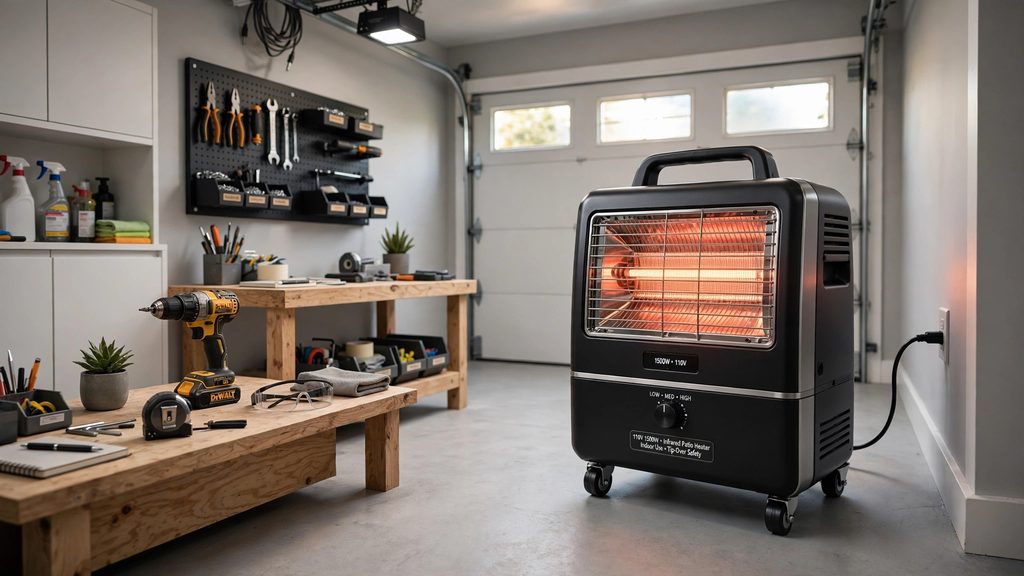
Heating a small garage can be challenging when you only have standard household electrical power and do not want to install a 220V or 240V circuit.
For a one-car garage, workshop, or compact work area, a 110V or 120V garage heater without 220V can be a practical solution. The important part is choosing a heater that matches the limitations of standard household power.
A typical plug-in electric heater in this class is limited to about 1,500 watts, which is roughly 5,100 BTU per hour. That is enough for targeted heating and can work well in a small, reasonably insulated space, but it is not equivalent to a high-output 240V garage heater.
For that reason, the best 120V heater for a small garage is not necessarily the one with the highest marketing claims. You want a model that fits your electrical service, heating needs, available space, and workshop layout.
Best Small Garage Heater Without 220V
Dr. Infrared Heater DR-238 Carbon Infrared Heater
Amazon Category: Home & Kitchen → Heating, Cooling & Air Quality → Space Heaters
The Dr. Infrared Heater DR-238 is a 120V carbon infrared heater designed for targeted radiant heating. Its combination of wall or ceiling mounting, remote control, and multiple power settings makes it particularly interesting for a small garage where floor space is limited.
DR-238 Specifications
| Feature | Specification |
|---|---|
| Model | Dr. Infrared Heater DR-238 |
| Voltage | 110–120V AC |
| Maximum Power | 1,500W |
| Heat Settings | 900W / 1,200W / 1,500W |
| Heating Type | Carbon infrared |
| Mounting | Wall or ceiling |
| Control | Remote control |
| Electrical Load at Maximum | About 12.5 amps |
| Application | Targeted radiant heating |
| Installation | Mounting brackets included |
The published documentation identifies the DR-238 as a 110–120V, 1,500W heater with three power levels: 900W, 1,200W, and 1,500W.
That makes it a good match for the specific search intent behind best small garage heater 110V no 220V, provided your expectations are realistic.
Can a 120V Heater Really Heat a Garage?
Yes, but the size and condition of the garage matter.
A 120V electric heater operating at 1,500W produces approximately 5,100 BTU per hour. That is considerably less than many dedicated 240V garage heaters, which can use several thousand watts more.
This means a 120V heater is better suited to:
- A small one-car garage
- A compact workshop
- A well-insulated garage
- A workbench or project area
- Supplemental heating
- Zone heating around a specific work area
It is much less suitable for trying to rapidly heat a large, poorly insulated garage during extremely cold weather.
The practical question is therefore not simply, “Can a 120V heater heat a garage?”
The better question is:
“Can 1,500W provide enough useful heat for the area where I actually work?”
For a small workshop, the answer can be yes.
Why 120V Is Important
One of the biggest advantages of a 120V garage heater is that it can work with the electrical service already found in many homes.
You do not necessarily need to install a new 240V circuit just to get some heat into a small garage.
However, standard household electrical power has limitations.
A 1,500W heater operating at 120V draws approximately:
1,500W ÷ 120V = 12.5 amps
That is a substantial load.
If your garage circuit is also powering a shop vacuum, miter saw, battery charger, lights, compressor, or other tools, running everything at the same time can overload the circuit or trip the breaker.
This is especially important in a workshop because many garage tools have significant electrical demands.
Before using a 120V garage heater, determine which receptacle and circuit it is connected to and what other equipment is sharing that circuit.
Don’t Assume Every Garage Outlet Can Handle the Heater
Having a standard 120V outlet does not automatically mean that every electrical setup is ideal for a 1,500W heater.
The condition of the outlet, wiring, circuit, breaker, and connections all matter.
A loose, damaged, discolored, or unusually warm receptacle should not be used for a high-load appliance.
If you are unsure about your garage’s electrical setup, have it inspected by a qualified electrician.
And never assume that installing a larger breaker is a solution to a circuit that was not designed for the additional load.
Why Infrared Heating Makes Sense in a Small Garage
The DR-238 uses infrared radiant heating rather than relying on a fan to circulate heated air throughout the garage.
That changes how the heater feels and where it works best.
Infrared heat is directed toward people and objects in its path. Instead of depending entirely on heating the air first, radiant heat can provide noticeable warmth directly to your body and nearby surfaces.
That can be useful in a garage workshop.
Imagine spending two hours working at a bench while the rest of the garage remains relatively cold. Heating the entire garage may require substantially more energy and a much larger heating system.
A radiant heater positioned toward the workbench can instead concentrate warmth where you spend your time.
This is known as zone heating.
Radiant Heater vs. Fan-Forced Heater
Not every 120V garage heater works the same way.
A fan-forced heater heats air and circulates it through the room. A radiant infrared heater directs heat toward objects and people.
| Feature | Infrared/Radiant Heater | Fan-Forced Heater |
|---|---|---|
| Main heating method | Radiant energy | Heated air |
| Best use | Targeted heating | Small enclosed areas |
| Air circulation | Minimal | Yes |
| Noise | Generally very low | Fan noise |
| Workbench heating | Excellent fit | Good |
| Whole-room heating | Limited by wattage | More suitable for air heating |
| Directional heat | Yes | Less directional |
Neither approach is automatically better for every garage.
If your main goal is staying warm while working at one bench, radiant heating can make a lot of sense.
If your goal is raising the temperature throughout an enclosed room, a fan-forced heater may distribute heat more evenly.
DR-238 Heat Settings
One useful feature of the DR-238 is its three power settings.
| Setting | Power |
|---|---|
| Low | 900W |
| Medium | 1,200W |
| High | 1,500W |
Having multiple settings gives you more control over power consumption and heat output.
On a relatively mild day, 900W may provide enough targeted warmth.
When temperatures drop, you can increase the output to 1,200W or 1,500W.
At maximum output, however, the heater still draws approximately 12.5 amps at 120V, so the electrical circuit remains an important consideration.
Wall or Ceiling Mounting Is a Major Advantage
A one-car garage does not have much spare floor space.
Between a vehicle, workbench, tool chest, shelving, storage containers, and power tools, the floor can become crowded quickly.
The DR-238 can be mounted on a wall or ceiling using its mounting hardware.
That allows the heater to stay out of the way while directing radiant heat toward the area where you work.
Before mounting it, carefully consider:
- Heater clearance
- Garage door movement
- Ceiling construction
- Wall construction
- Electrical cord routing
- Nearby combustible materials
- The manufacturer’s required installation distances
Do not simply mount the heater wherever there is an open section of wall.
The position affects both safety and heating performance.
Where Should You Mount a 120V Infrared Heater?
For a small garage workshop, the best location is usually related to the area where you spend the most time.
If your main workspace is a workbench, directing the heater toward that area can provide more useful comfort than mounting it at the opposite end of the garage.
Keep the heater’s radiant path clear.
Do not place shelves, storage bins, hanging materials, or other objects directly in front of the heating element.
Because infrared heating is directional, the position and angle of the heater matter.
A poorly positioned 1,500W heater can feel disappointing even though it is operating normally.
Why a 1,500W Heater Has Real Limitations
This is the most important point to understand before buying a 120V garage heater.
A 1,500W heater cannot produce the same amount of heat as a 5,000W, 7,500W, or larger 240V garage heater.
That is simply a power limitation.
A small 120V heater may struggle if you have:
- A large two-car garage
- Very poor insulation
- High ceilings
- Significant air leakage
- An unsealed garage door
- Very low outdoor temperatures
- Frequent garage-door opening
- A detached garage exposed to cold weather
This does not mean the DR-238 is ineffective.
It means the heater needs to be matched to the job.
Current 120V garage-heater guides similarly emphasize that 1,500W models are better suited to small spaces or spot heating than to heating large, poorly insulated garages.
How Garage Insulation Affects Heating Performance
The heater is only part of the equation.
If your garage loses heat almost as quickly as the heater produces it, increasing the heater’s operating time will not solve the underlying problem.
Before buying a heater, inspect the garage for obvious sources of heat loss.
Check the Garage Door
The garage door is often one of the largest areas where heat can escape.
Check the bottom seal and side seals for gaps or damage.
Look for Air Leaks
Inspect areas around doors, windows, wall penetrations, and other openings.
Even small gaps can make a noticeable difference in a cold garage.
Consider Insulation
If the garage walls and ceiling are uninsulated, adding appropriate insulation can make any heating system more effective.
Avoid Unnecessary Door Opening
Every time the main garage door opens, cold outdoor air enters the space.
If you are trying to maintain a comfortable workspace, minimizing unnecessary door openings can help considerably.
Is the DR-238 Good for a One-Car Garage?
For a small one-car garage, the DR-238 can make sense when the goal is targeted heating rather than turning the entire garage into a warm living space.
It is especially interesting for someone who:
- Has only 120V electrical service available
- Does not want to install a 240V circuit
- Works primarily at a specific bench
- Wants a wall- or ceiling-mounted heater
- Wants radiant rather than fan-forced heat
- Has limited floor space
- Wants multiple power levels
The product becomes less attractive if your primary goal is rapidly heating a large garage from very cold temperatures.
In that situation, a higher-output heating system may be more appropriate.
110V vs. 120V Garage Heater
People often search for “110V garage heater,” but modern household receptacles are generally described as 120V nominal service.
For practical shopping purposes, you will frequently see heaters and listings described as 110V, 115V, or 120V.
The important specification is whether the heater is designed for the electrical supply available in your garage.
The DR-238 documentation specifies 110–120V AC.
120V vs. 240V Garage Heater
The difference is much more than the voltage number.
| Feature | 110/120V Heater | 220/240V Heater |
|---|---|---|
| Typical maximum plug-in heater output | Around 1,500W | Much higher potential |
| Installation | Usually simpler | May require dedicated circuit |
| Electrical capacity | Limited | Higher |
| Small workshop | Often appropriate | May be unnecessary |
| Large garage | Often insufficient | More suitable |
| No 240V circuit | Works within 120V limits | Requires appropriate service |
| Zone heating | Good | Good |
| Whole-garage heating | Limited | Better suited |
If you specifically do not have 220V/240V available, a 120V heater eliminates the need to immediately upgrade the electrical service.
But the tradeoff is lower heating output.
Safety Considerations for a Garage Heater
Garage environments can contain materials that require additional caution.
A typical garage may contain:
- Gasoline
- Motor oil
- Paint
- Solvents
- Cardboard
- Sawdust
- Wood scraps
- Cleaning chemicals
- Aerosols
- Other combustible materials
A heater should never be positioned close to combustible materials.
Keep the heater’s required clearance areas completely unobstructed.
Do not cover the heater.
Do not place objects against the heater.
Do not modify the heater or mounting system.
And always follow the current manufacturer’s installation and operating instructions for the specific model.
The DR-238 documentation also warns about hot surfaces and requires attention to clearance and installation conditions.
Don’t Use an Extension Cord as a Shortcut
This is particularly important with a 1,500W heater.
At maximum output, the DR-238 draws approximately 12.5 amps.
The available documentation for the model specifically instructs users to plug the heater directly into a wall outlet/receptacle and not use an extension cord or relocatable power tap.
That means you should plan the heater’s mounting location around the available receptacle rather than assuming you can simply run an extension cord across the garage.
A cord running across a garage floor can also create a trip hazard and may be damaged by vehicles or tools.
What to Look for in a 120V Garage Heater
If the DR-238 is not the exact style of heater you want, use these criteria when comparing alternatives.
1. Maximum Wattage
For a standard 120V plug-in electric heater, 1,500W is a common upper limit.
Do not assume that a higher advertised wattage is automatically compatible with your existing circuit.
2. Heating Type
Choose radiant infrared if you primarily want targeted heat around a workbench or workstation.
Choose fan-forced heating if you want more air circulation throughout a small enclosed area.
3. Mounting
Wall and ceiling mounting can be particularly valuable in small garages.
4. Circuit Requirements
Check the voltage, amperage, plug configuration, and manufacturer’s electrical requirements before purchasing.
5. Safety Features
Look for appropriate safety certifications and manufacturer-documented protection features.
6. Installation Requirements
Always check required clearances and mounting instructions before installing a heater.
7. Garage Conditions
Consider insulation, ceiling height, air leakage, climate, and how often the garage door is opened.
Best Heating Strategy for a Small Garage Without 220V
If you only have 120V available, the heater should be part of a larger strategy.
Start by reducing heat loss.
Seal obvious gaps.
Improve garage-door weather stripping.
Insulate where practical.
Then position the heater near the area where you actually work.
If you spend most of your time at a workbench, concentrate the heat there instead of trying to heat unused storage space.
This is one reason infrared heating can be appealing for a small workshop.
You are not necessarily trying to make every cubic foot of the garage warm.
You are trying to make your working area comfortable.
Who Should Consider the DR-238?
The DR-238 is worth considering if you want a compact 120V garage heater without 220V and your primary goal is targeted radiant heating.
It makes the most sense for someone with a small workshop or one-car garage who wants to keep the heater off the floor and direct warmth toward a specific work area.
The three power settings also give you more flexibility than a heater that operates at only one output level.
Who Should Choose a Different Heater?
Consider another heating solution if you need to heat a large garage evenly and quickly.
A 1,500W 120V heater simply does not have the same heating capacity as a dedicated high-output 240V garage heater.
You may also want a different type of heater if you specifically need:
- Whole-garage heating
- Higher BTU output
- A built-in thermostat
- Strong air circulation
- Heating for a large detached workshop
- Heating during extremely cold weather
In those cases, increasing the electrical capacity or choosing another heating technology may make more sense than trying to make a 120V heater do a job it was not designed to handle.
Final Verdict
For homeowners searching for the best small garage heater 110V no 220V, the Dr. Infrared Heater DR-238 is a strong product to consider when the goal is compact, targeted radiant heating.
Its 110–120V electrical requirement, 1,500W maximum output, 900W/1,200W/1,500W settings, remote control, and wall- or ceiling-mount design make it well suited to a small workshop where floor space is limited.
The most important limitation is also its biggest defining characteristic: 1,500W is not a substitute for a high-output 240V garage heater.
For a one-car garage, especially when you primarily work at a bench or in one particular area, targeted infrared heating can be a practical way to add warmth without installing a new 220V/240V circuit.
Just make sure the electrical circuit can safely handle the load, connect the heater according to the manufacturer’s instructions, maintain the required clearances, and keep combustible materials away from the heater.
If your garage is small and your goal is to make your work area warmer rather than rapidly heat an entire large garage, a 120V infrared heater can be a much more practical solution than its wattage number might initially suggest.
Leave a Reply