
As an Amazon Associate I earn from qualifying purchases.
A table saw needs enough outfeed support to keep a workpiece stable as it passes the blade, plus enough clear space for the entire board to travel without hitting a wall, cabinet, vehicle, or other obstacle. In a small garage workshop, getting that balance right matters just as much as choosing the saw itself.
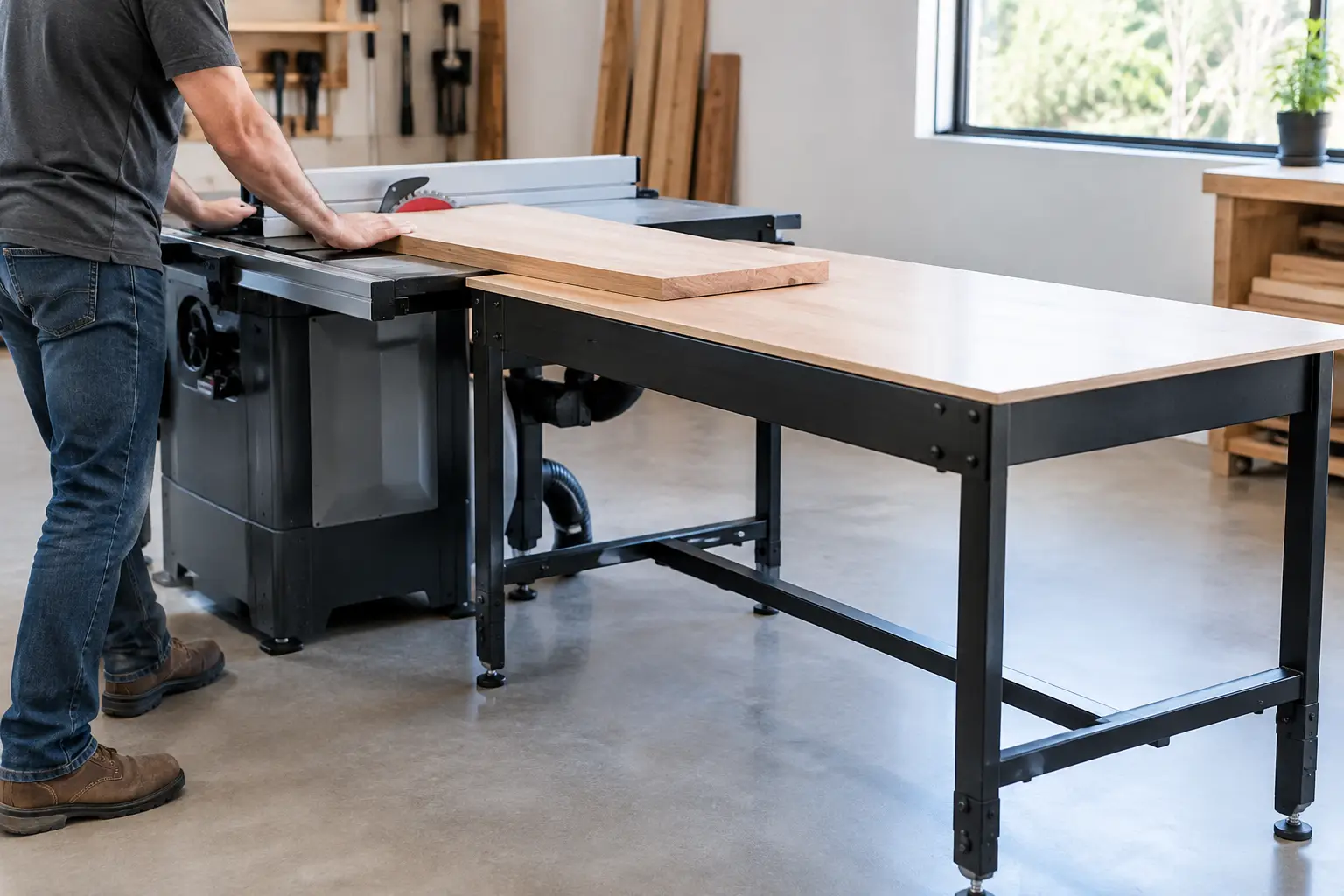
For many hobbyist woodworkers, a folding or mobile outfeed table with roughly 24 to 36 inches of support is a practical starting point for common projects involving shorter boards and plywood panels. Longer workpieces may require more support, additional assistance, or a different cutting method.
The key is to distinguish outfeed table size from outfeed clearance. A relatively short support table can work for some cuts, but it cannot compensate for a blocked path or an unstable workpiece. If you are planning a table saw setup for a one-car garage, measure the material you actually cut and design the workspace around those dimensions.
Outfeed Support vs. Outfeed Clearance
Outfeed support is the surface behind the table saw that helps support material as it exits the cut. It can be a fixed table, a folding extension, a mobile work surface, or a compatible built-in support.
Outfeed clearance is the unobstructed space required for the workpiece to move through the entire cut. It includes the area behind the blade where the board travels and enough room for the operator to maintain a stable position.
These are two separate requirements.
For example, a 48-inch board does not automatically require a 48-inch-deep outfeed table. Depending on the board’s stiffness, width, weight, and the saw’s layout, a shorter, properly positioned support may be sufficient. However, the board still needs enough room to travel through the cut without striking an obstacle or losing control.
A useful way to plan your layout is to measure from the blade toward the nearest obstruction. Then consider the full length of the workpiece, the saw’s table depth, and the space needed to stand and operate the machine safely.
Do not assume that a particular table depth makes every cut safe. The support must suit the material and the cutting operation.
How Much Outfeed Space Do You Need?
The right amount of outfeed space depends on your workpieces and the type of cuts you make. Short shelf components require a different setup from long solid-wood boards or full sheets of plywood.
The following figures are planning estimates, not manufacturer specifications or universal safety minimums.
| Typical workpiece length | Initial outfeed support to consider | Main planning concern |
|---|---|---|
| Up to 36 inches | 18–24 inches | Stable support without taking up unnecessary floor space |
| 48 inches | 24–36 inches | Keeping the board level and controlled as it exits |
| 72 inches | 36–48 inches | Supporting longer stock and maintaining a clear travel path |
| 96 inches | 48 inches or more, if appropriate for the cut | Managing long stock without relying on a short or unstable support |
These dimensions are starting points for evaluating a setup, not proof that a cut will be safe. A wide, flexible panel may need a broader support surface than a narrow, rigid board of the same length. Some operations also require more extensive support than others.
Calculate the Required Clearance From the Blade
For a straightforward rip cut, the workpiece must be able to travel far enough for the cut to finish without its trailing end hitting an obstruction.
A practical first calculation is:
Required rear clearance = workpiece length + additional room for the actual setup.
Measure from the blade toward the rear obstruction, then account for the saw’s position, the way the material will be handled, and any additional space needed to maintain control. Check the manufacturer’s instructions and evaluate the entire cutting path before operating the saw.
For an 8-foot board, approximately 8 feet of unobstructed travel behind the blade is a useful starting point for the layout calculation. The saw table’s depth affects the overall footprint of the machine, but it should not be added twice when measuring from the blade.
This distinction matters in a one-car garage. A short outfeed table may provide adequate local support for certain workpieces, yet an 8-foot board can still require substantially more open space than the garage provides.
If the material cannot move through the cut safely, do not force the operation. Reposition the saw, choose a shorter workpiece, arrange suitable support, or use a different cutting method.
Choose an Outfeed Table for Your Small Garage
The best outfeed table is one that supports your typical workpieces reliably without occupying more space than your workshop can spare.
Fixed Outfeed Tables
A fixed outfeed table provides a broad, stable surface behind the saw. It can be useful for repetitive woodworking, cabinet components, and projects that involve frequent rip cuts.
A properly designed table may also serve as an assembly or work surface when the saw is not running. However, it takes up permanent floor space and can interfere with parking a vehicle or moving other equipment.
Before building one, check the saw’s height, the location of its rear supports, and the space needed for the fence, blade guard, riving knife, and other accessories. The table must not interfere with any moving parts or safety equipment.
Folding Outfeed Tables
A folding outfeed table is often a better fit for a garage that serves more than one purpose.
It can be lowered or folded away when woodworking is finished, freeing space for a vehicle or other tools. A wall-mounted design or a compatible folding extension can be particularly useful when the saw must be stored against a wall between projects.
The important consideration is rigidity. Hinges, brackets, legs, and locking mechanisms must be suitable for the table’s load and intended use. Once deployed, the surface must remain stable throughout the cut.
Never use a folding table if its legs or locking mechanism are not fully secured.
Mobile Outfeed Tables
A mobile outfeed table can be moved into position when needed and stored elsewhere afterward. It is a useful option for woodworkers who regularly rearrange their workshop.
Choose a model with a rigid top and appropriately rated locking casters. Check that the wheels lock securely and that the table cannot roll, twist, or tip under the load of the workpiece.
The top must also align correctly with the saw. A mobile table that moves or sits at an unsuitable height can cause a workpiece to catch, shift, or become difficult to control.
Roller Stands
Roller stands are compact and easy to store. They can help support certain long, narrow boards when adjusted correctly.
However, a roller stand does not provide the same broad support as a flat tabletop. A board can drift sideways, and uneven or twisted stock may be difficult to control. Rollers can also introduce unwanted movement if they are not positioned and adjusted properly.
For wide plywood panels, cabinet parts, and repeated precision cuts, a stable flat-top support is generally easier to manage.
Whichever system you choose, follow the manufacturer’s instructions and make sure the support is suitable for the material, cut, and load.
| Product | Best Use | Check on Amazon |
|---|---|---|
| Table Saw Outfeed Table | Supporting boards as they exit the saw | View Options → |
| Folding Outfeed Table | Saving floor space in a small garage workshop | View Options → |
| Track Saw or Circular Saw | Breaking down large plywood sheets before table-saw use | View Options → |
How High Should an Outfeed Table Be?
The outfeed surface should be level with or slightly below the table saw’s surface, as specified by the saw or outfeed-support manufacturer. It must never sit higher than the saw table.
A surface that is too high can catch the workpiece, lift it, or interfere with its movement. A surface that is too low may allow the material to dip or lose support, depending on the workpiece and the size of the gap.
Do not assume that one exact offset works for every saw. Some manufacturers specify a particular relationship between the two surfaces, and some extensions have their own adjustment requirements.
To check the alignment:
- Disconnect the saw from its power source before making adjustments.
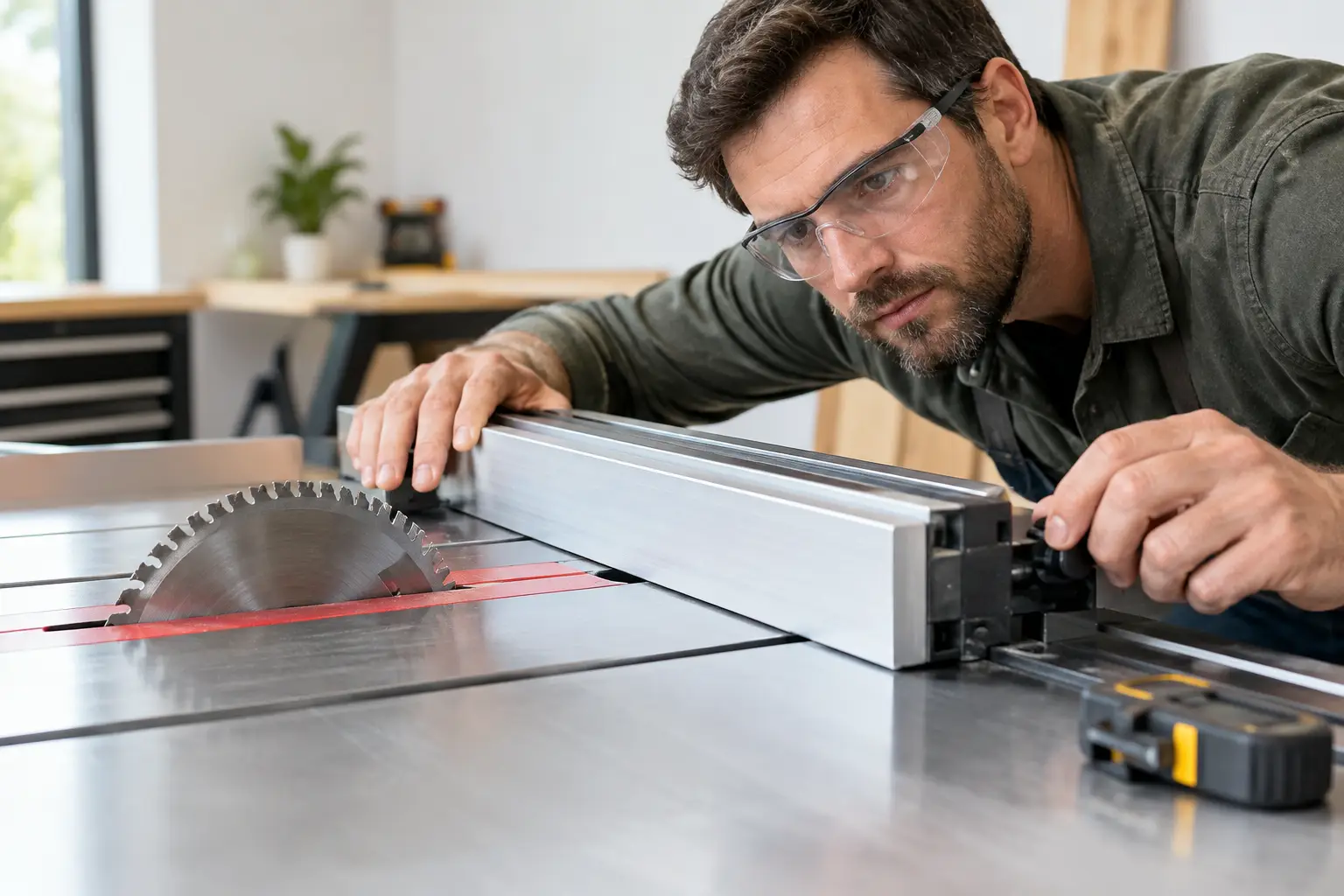
- Use a suitable straightedge to compare the saw table with the outfeed surface.
- Check that the surfaces are aligned across the width and that the outfeed table is not higher.
- Confirm that the gap and surface edges will not catch the material or interfere with the saw’s accessories.
- Secure the support and recheck the alignment after moving the saw or folding and redeploying the table.
A portable saw on an uneven garage floor may need its position or support adjusted before each session. Never rely on a visual estimate alone when the surfaces appear misaligned.
Cutting Plywood in a Small Garage
Full 4-by-8-foot plywood sheets create a particular challenge for compact workshops. They are large, flexible, and awkward to maneuver, especially when one person is trying to guide the sheet through a small table saw.
An outfeed table alone does not solve the problem. The sheet may also require substantial infeed support, lateral support, and enough room for the operator to maintain control throughout the cut.
For many garage woodworkers, breaking down the sheet before bringing it to the table saw is a more practical approach.
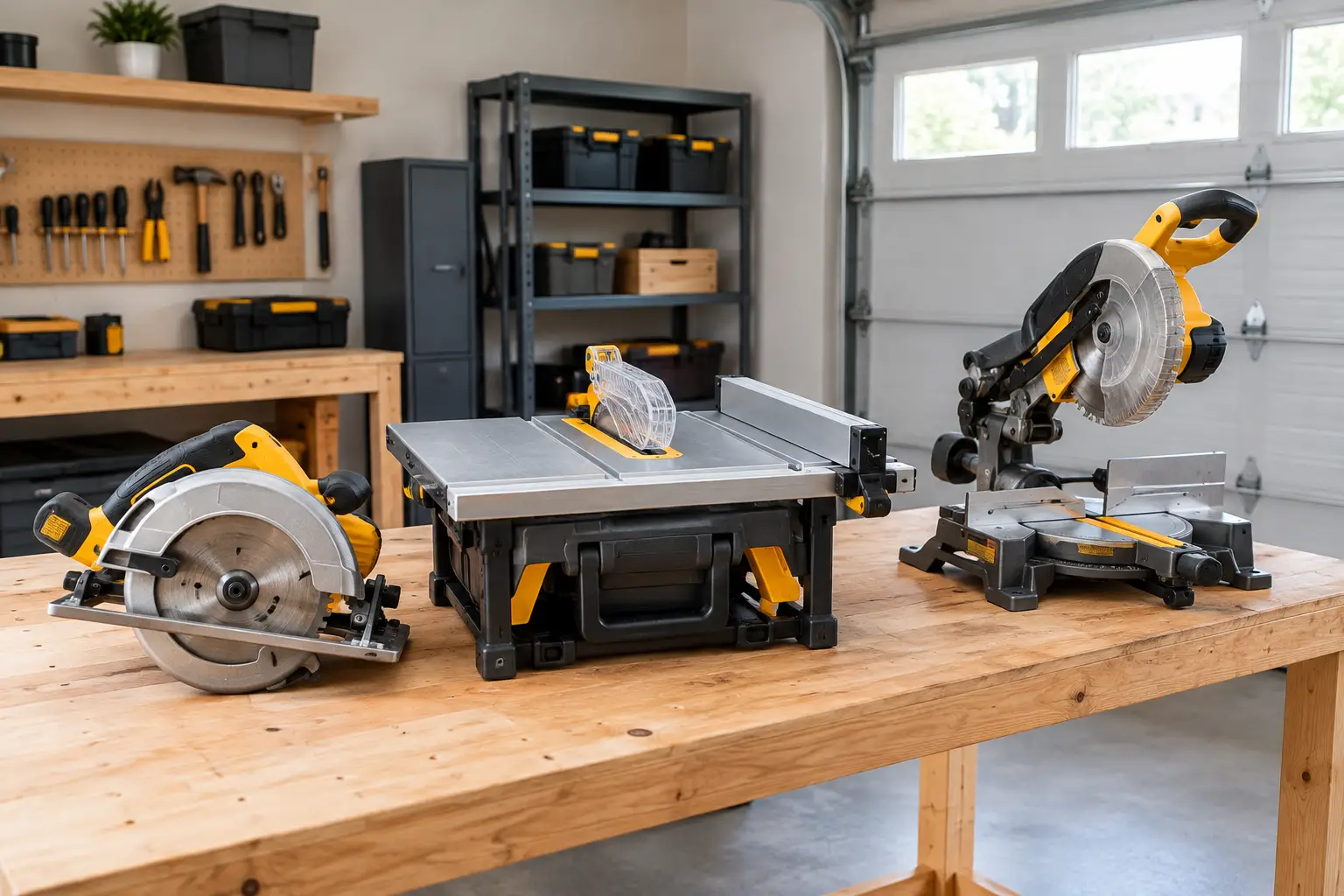
A track saw, circular saw with a suitable straightedge, or properly supported cutting station can help reduce a full sheet into manageable sections. Those smaller pieces can then be brought to the table saw for final sizing when appropriate.
Whatever method you choose, the panel must be supported against sagging or shifting, and the cutting area must be clear. Follow the tool manufacturer’s safety instructions and use the required guards and other protective equipment.
Do not attempt to control an oversized sheet on a small saw simply because you have installed a larger outfeed table. If the workpiece is difficult to handle safely, use a different setup or get appropriate assistance.
Account for Dust Collection, Walls, and Storage
A garage may look spacious when the saw is not in use, but the real workspace changes once the dust collector, shop vacuum, lumber rack, extension cords, and other equipment are in position.
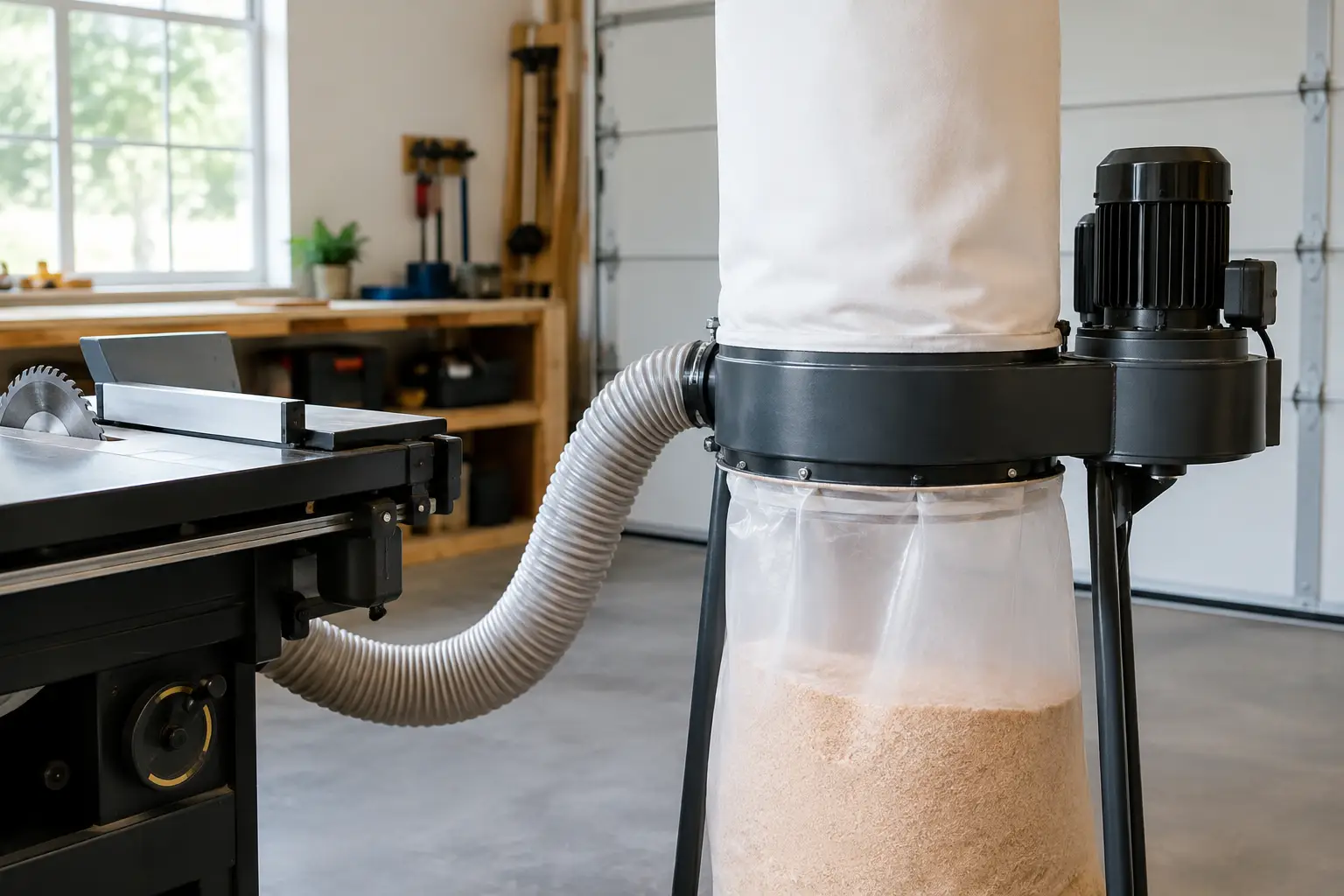
A dust collector for a small one-car garage can occupy valuable floor space. Its location should not obstruct the workpiece’s path or force you to stand in an awkward position.
Pay particular attention to dust collection hose size and length. A hose that stretches across the work area or catches on a support can interfere with your movement. Route hoses and cables away from the cutting path, and make sure they cannot snag the board or create a trip hazard.
Also check the space beside the saw. The fence and workpiece must have enough room to operate as intended, and the operator should not be forced against a wall or vehicle while feeding stock.
If opening the garage door provides additional clearance, that may help with certain layouts. However, the driveway should not be treated as a substitute for stable support or a controlled work area. Uneven pavement, weather, vehicles, and other hazards can make the setup unsuitable.
Finally, think about where the finished workpiece will go. The outfeed area should allow the material to remain supported without requiring you to reach over the blade or make sudden movements to catch a falling piece.
Plan a Flexible Table Saw Zone
For many one-car garages, a movable saw paired with a folding or mobile outfeed table provides a useful balance between workspace and storage.
The goal is to create a repeatable cutting zone. When the saw, support table, dust hose, and nearby equipment return to predictable positions, it becomes easier to check the setup before starting a project.
A few practical steps can help:
- Measure the length and width of the boards and panels you cut most often.
- Mark the saw’s working position and measure the unobstructed path behind the blade.
- Choose an outfeed support that remains stable and suits those workpieces.
- Check the height, alignment, locking mechanisms, and clearance before each session.
- Keep hoses, cables, offcuts, and stored materials out of the work area.
- Use another cutting method when a workpiece exceeds the safe handling limits of the available space.
If your setup frequently changes, consider how easily the outfeed table can be stored without damaging its alignment or locking components. A folding surface is only helpful if it can be redeployed securely and consistently.
For additional ideas on managing the saw’s footprint, see this guide to table saw dust collection for a small garage.
Common Outfeed Space Mistakes to Avoid
Buying a longer table without measuring the cutting path. A larger surface does not eliminate a wall, vehicle, or storage cabinet at the end of the workpiece’s travel.
Treating a sizing guideline as a safety guarantee. The right amount of support depends on the workpiece, the cut, the saw, and the stability of the setup.
Setting the outfeed surface too high. A high edge can catch the workpiece. Follow the manufacturer’s alignment requirements and verify the height before use.
Using an unstable roller stand for a difficult panel. A narrow support may not control a wide or flexible sheet adequately.
Ignoring hoses and cables. An otherwise suitable layout can become hazardous when dust collection equipment or cords interfere with feeding the material.
Trying to cut every piece on the table saw. A track saw or circular saw may be a better option for breaking down large sheet goods in a compact shop.
Reaching over the blade to catch a board. Plan the support and workpiece path so you do not need to make sudden movements or reach into a dangerous area.
Frequently Asked Questions
How much outfeed space does a table saw need?
There is no single dimension that suits every table saw or workpiece. Start by evaluating the length and width of the material you cut, the support required as it exits the blade, and the unobstructed travel path. A short support table may work for some cuts, while longer stock or sheet goods may require additional support or another cutting method.
Is a 24-inch outfeed table enough?
A 24-inch outfeed table can be a practical starting point for some shorter boards and manageable panels. Whether it is sufficient depends on the workpiece’s weight, stiffness, dimensions, and the way the cut is performed. It should not be treated as a universal minimum, and the remaining cutting path must still be clear.
Can I use a folding table as a table saw outfeed?
A folding table can work if it is designed or adapted for the task, remains rigid under load, and is secured against movement. Its surface must align correctly with the saw table, and its legs and locking mechanisms must be fully engaged. An ordinary folding table that wobbles or shifts should not be used as outfeed support.
Should an outfeed table be higher or lower than the saw?
The outfeed surface should be level with or slightly below the saw table, following the manufacturer’s instructions. It should never be higher. A high surface can catch the workpiece and interfere with safe feeding. Check the height and alignment with a straightedge, and recheck them whenever the saw or support is moved.
How do you cut 8-foot boards in a small garage?
First determine whether the full board can travel through the cut without striking an obstruction and whether it can be supported and controlled throughout the operation. If the garage cannot accommodate the required setup, consider cutting the board to a manageable length with a suitable alternative tool or arranging an appropriate cutting location. Never force long stock through a restricted workspace.
Do I need an outfeed table to use a table saw?
Not every cut requires a separate full-size outfeed table, but the workpiece must remain adequately supported and controlled. A built-in extension or another suitable support system may be sufficient for some operations. Follow the saw manufacturer’s instructions and do not proceed when the material cannot be handled safely.
Final Recommendation
For a small garage workshop, the best outfeed setup is not necessarily the largest one. It is the arrangement that supports your typical workpieces, keeps the material’s path clear, and can be stored without compromising stability or alignment.
Start with the boards and panels you cut most frequently. Measure the actual space available behind the blade, choose a support suited to those materials, and verify the setup before each cut. For oversized plywood sheets or long stock that cannot be controlled safely in your garage, use a more appropriate cutting method.
A well-planned outfeed zone helps make a compact workshop more practical without sacrificing control, accuracy, or safety.

Leave a Reply