As an Amazon Associate I earn from qualifying purchases.
How Much CFM Does an Air Compressor Need for a Nail Gun?
A small pancake compressor can handle an 18-gauge brad nailer without much trouble. The situation changes when you switch to a framing nailer and start driving nails into studs, sheathing, or deck boards at a steady pace. Suddenly, the compressor runs more often, tank pressure drops faster, and you spend more time waiting for it to recover.
Choosing the right air compressor CFM for nail gun work comes down to three things: the nailer’s air consumption, how frequently you fire it, and how quickly the compressor can replenish the air you use. Tank size matters, too, but a larger tank cannot make up for a pump that delivers too little airflow.
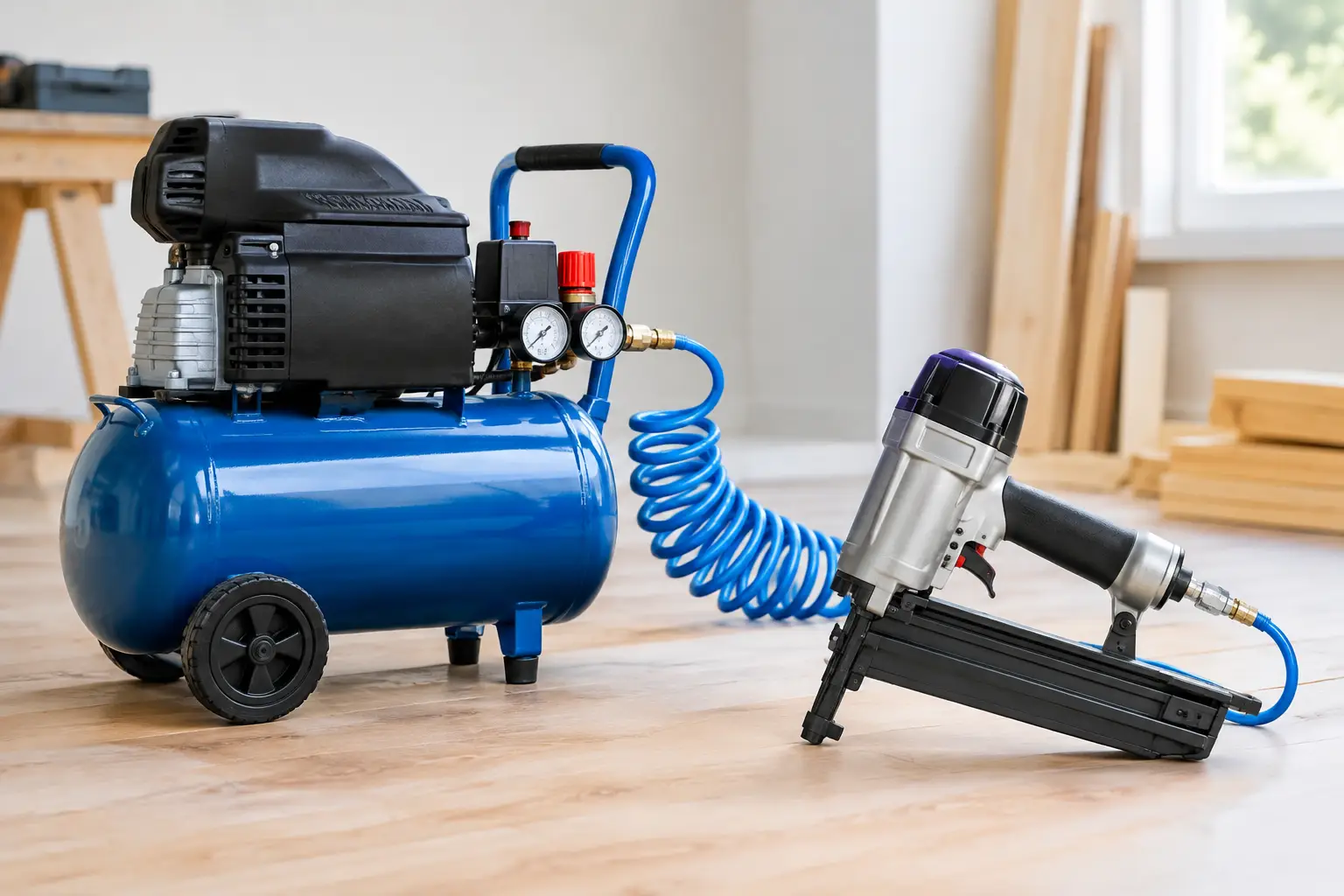
For most home woodworking and trim projects, a compact portable air compressor for a small garage shop is a practical choice. If you regularly use a framing, roofing, or siding nailer, however, checking the compressor’s delivered CFM at the right pressure becomes much more important.
What Does CFM Mean for a Nail Gun?
CFM stands for cubic feet per minute. It measures airflow, or how much air a compressor can deliver over time. When comparing compressors for pneumatic nailers, look for the manufacturer’s airflow rating at 90 PSI rather than relying on the maximum pressure printed on the tank.
A nail gun uses compressed air each time it drives a fastener. The tank provides a reserve of stored air, while the compressor pump replenishes that supply. If the pump cannot keep up with your average air consumption, tank pressure eventually falls and the motor has to work harder to catch up.
This explains why two compressors with the same tank size can perform differently. One may deliver enough air to support a steady pace of nailing, while the other needs frequent recovery pauses.
CFM vs. SCFM: Which Number Should You Check?
CFM and SCFM are closely related, but they are not automatically interchangeable. SCFM stands for standard cubic feet per minute and refers to airflow expressed under defined standard conditions.
Nailer manufacturers may specify air consumption per cycle, per 100 fasteners, or at a particular firing rate. Compressor manufacturers commonly list delivered airflow at a stated pressure.
For an accurate comparison, check the compressor’s output at the operating pressure you intend to use and the nailer’s published air consumption. If the figures use different measurement conditions, do not assume they match perfectly.
The practical rule: compare the compressor’s delivered airflow with the nailer’s air demand at the intended operating pressure and firing rate.
| Equipment | What to Compare | Explore Options |
|---|---|---|
| Portable Air Compressors | Delivered CFM, PSI and tank capacity | View Options → |
| Pneumatic Nail Guns | Air consumption and operating pressure | Compare Nailers → |
| Air Hoses and Fittings | Inside diameter, length and connections | Check Options → |
How Much CFM Does Each Type of Nail Gun Need?
The amount of air required varies by nailer design and model. A brad nailer used for occasional trim work has a different demand from a framing nailer firing repeatedly during a construction project.
The following table provides general shopping guidance rather than guaranteed manufacturer specifications. Always check the manual for your particular nailer before buying a compressor.
| Nail gun type | General air-demand level | What to prioritize |
|---|---|---|
| 23-gauge pin nailer | Low for occasional use | Compact size and adequate recovery |
| 18-gauge brad nailer | Low for intermittent work | Modest airflow and portability |
| 15- or 16-gauge finish nailer | Low to moderate | Airflow matched to the firing rate |
| Narrow-crown stapler | Low to moderate | Manufacturer’s consumption rating |
| Framing nailer | Moderate to high during rapid use | Higher delivered CFM and recovery capacity |
| Roofing or siding nailer | Moderate to high during sustained use | Airflow suited to repetitive firing |
These categories are useful for narrowing your options, but the nailer’s specifications should determine the final choice. Even tools in the same gauge category can have different air requirements.
How to Calculate the CFM You Actually Need
If your nailer manual provides air consumption per fastener, you can estimate the compressor output required for your work.
Use this formula:
Required CFM = air consumption per fastener × fasteners per minute × safety factor
Make sure the air-consumption figure is expressed in cubic feet per fastener and that the pressure conditions are appropriate for the calculation.
For example, suppose a nailer uses 0.04 cubic feet of air per fastener and you expect to drive 30 fasteners per minute. Using a 1.2 safety factor gives:
0.04 × 30 × 1.2 = 1.44 CFM
That is an illustrative calculation, not a specification for every nailer. If the manufacturer provides a compressor-sizing formula, follow that guidance first. You should also allow for leaks, pressure losses, and any other tools that will share the air supply.
This approach is more reliable than choosing a compressor based on the nailer’s gauge alone.
Match the Compressor to Your Work Pace
A compressor that works well for occasional home repairs may struggle during repetitive construction work. The difference is how quickly you use the stored air and how much time the pump has to replenish it.
If you install a few pieces of baseboard, you might fire several nails and then pause to measure, cut, or reposition the material. During those pauses, even a relatively small compressor can recover.
Framing a storage wall is different. You may fire nails repeatedly while assembling studs and attaching sheathing. In that situation, a compressor with limited airflow can run almost continuously and still fall behind.
Before choosing a model, ask yourself three questions:
- How many fasteners do you expect to drive per minute?
- Will you work in short bursts or fire continuously?
- Will another pneumatic tool operate at the same time?
If you use one nailer intermittently, a compact compressor may be all you need. For frequent framing or roofing, prioritize higher delivered CFM and sufficient recovery capacity over a small footprint alone.
Is a Small Pancake Compressor Enough?
For brad nailing, light finish work, and occasional repairs, a small pancake or hot-dog compressor can be a sensible choice. These models are relatively easy to carry and store, making them convenient for a one-car garage.
Do not assume that every pancake compressor has the same performance, though. Check the airflow rating at 90 PSI, the tank capacity, and the manufacturer’s recommended applications.
For example, Metabo HPT lists its EC710S six-gallon compressor at 2.8 CFM at 90 PSI and describes it as suitable for finish work and multiple nailers depending on the application. Its EC914S six-gallon model delivers 4.0 CFM at 90 PSI, giving it more airflow for demanding nailing tasks.
Those specifications illustrate why the actual output matters more than the tank style or gallon rating alone.
→ Compare portable air compressors for nail gun projects
When Should You Choose a Larger Compressor?
A higher-output compressor makes sense if you frequently use a framing nailer, fire fasteners rapidly, or need to support more than one pneumatic tool.
Look at delivered CFM first, then consider tank size, recovery behavior, weight, noise, and electrical requirements. A larger compressor is not automatically the best choice if you only install trim a few times a year.
For a garage that also serves as a parking space, portability and storage are part of the decision. Choose a machine that meets your air requirements without permanently blocking access to your workbench or other equipment.
Does Tank Size Matter More Than CFM?
No. Tank capacity and CFM solve different problems.
The tank stores compressed air that is available when you pull the trigger. The pump’s delivered CFM determines how quickly the compressor can replenish that supply at a given pressure.
A larger tank can provide a useful reserve for a burst of fasteners, but it cannot compensate indefinitely for insufficient airflow. Once the stored air is depleted, the compressor still needs to catch up.
For occasional brad and finish work, a small tank may be perfectly adequate. For more demanding work, a larger tank can help smooth out pressure changes, provided the pump also delivers enough air.
When comparing two compressors, check these specifications together:
- Delivered CFM at 90 PSI: How much air the compressor can supply at a useful working pressure.
- Tank capacity: How much compressed air the receiver can store.
- Maximum tank pressure: The upper pressure limit, which is not the same as airflow.
- Recovery performance: How effectively the compressor replenishes the air supply during your actual work.
A high maximum PSI number does not automatically mean a compressor can keep a nailer running at a faster pace.
Choose the Right Air Hose and Fittings
Your compressor may have sufficient airflow on paper, yet the nailer can still perform poorly if the air line is restrictive or leaking.
Hose diameter, hose length, couplers, and fittings all affect the air available at the tool. A long hose with a small inside diameter can create more pressure loss than a shorter, wider hose, especially when air demand is high.
For general garage use, choose a hose and fittings compatible with your nailer’s connection and the compressor’s output. A quality 3/8-inch inside-diameter hose can be useful when a longer run or higher airflow is needed, but it is not mandatory for every brad or finish nailer.
Before upgrading your compressor, check for:
- Leaks around couplers and hose connections.
- Damaged or restrictive quick-connect fittings.
- A hose that is too long or too narrow for the application.
- A regulator setting below the nailer’s specified operating range.
Set the regulator according to the nailer manual. Do not exceed the tool’s maximum rated pressure in an attempt to compensate for inadequate airflow.
→ Check air compressor hoses and fittings for your nail gun setup
Electrical Requirements and Noise in a Small Garage
Many portable electric compressors are designed for standard 120-volt household power in the United States. However, current requirements vary by model, and the compressor may draw additional current when starting.
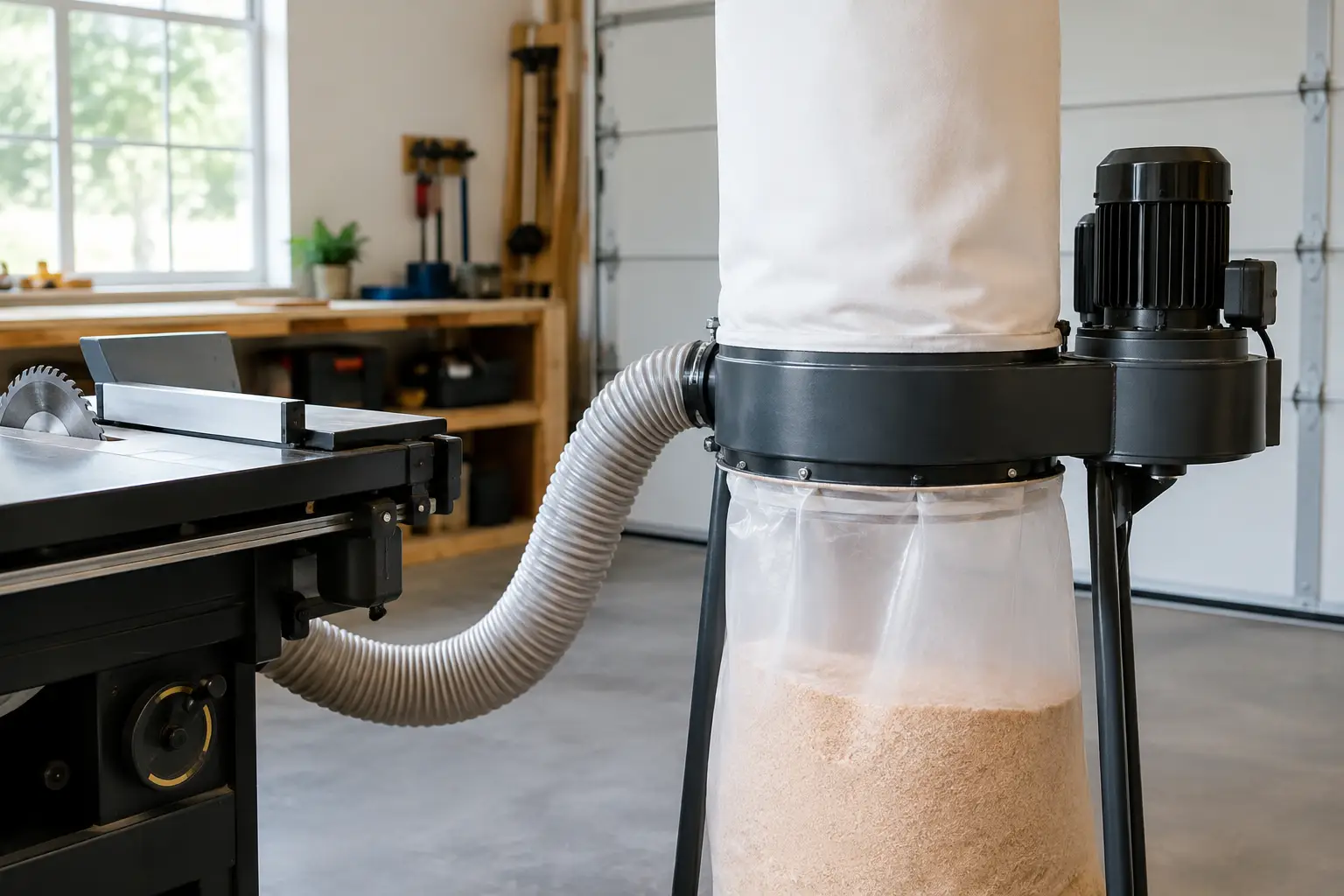
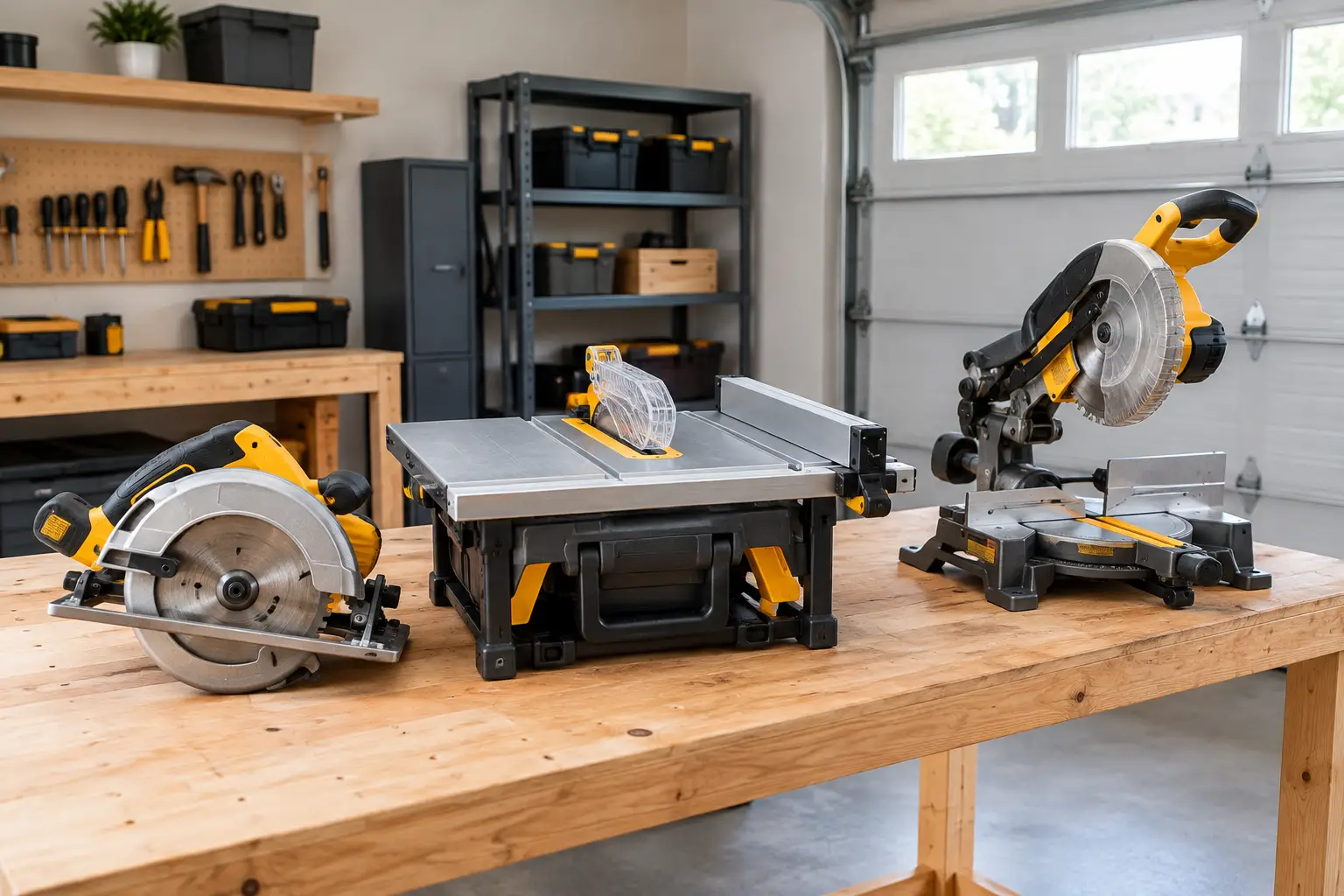
Check the nameplate and owner’s manual before plugging the compressor into a circuit shared with a table saw, dust collector, heater, or other high-draw equipment. Follow the manufacturer’s electrical instructions, and have a qualified electrician evaluate the circuit if you are unsure whether it can safely support the load.
Avoid using an extension cord unless the manufacturer permits it and the cord meets the specified requirements.
Noise also deserves attention in a compact workshop. Some oil-free pancake compressors are loud enough to make extended indoor use uncomfortable. A quieter model can be worth considering if you work near living areas or frequently use the compressor for longer sessions.
Compare published noise ratings where available, but remember that the distance from the machine and the room’s acoustics affect how loud it sounds.
If your garage needs heating during colder months, consider how the compressor will fit into the overall layout. A small garage heater designed for 110V outlets may suit some setups, but the electrical load of both appliances must be considered before operating them on the same circuit.
A Simple Buying Guide for Nail Gun Work at Home
The best compressor depends on the work you actually do, not the largest number advertised on the packaging.
For occasional brad nailing and small repairs: Look for a compact portable compressor whose delivered airflow meets the nailer’s requirements. Portability, storage, and noise may matter more than a large tank.
For regular finish carpentry: Compare the nailer’s published air consumption with compressors that provide adequate airflow at the working pressure. Choose enough capacity to support your expected firing rate without excessive recovery pauses.
For occasional framing projects: Check the specific framing nailer’s consumption figures and calculate the expected demand from your firing rate. A six-gallon compressor with higher delivered CFM may be a practical option, but tank size alone is not a guarantee.
For frequent framing, roofing, or siding: Prioritize sustained airflow and recovery performance. If several nailers will run simultaneously, add their air demands together before choosing a compressor.
For a small, multipurpose garage: Balance airflow against noise, portability, electrical requirements, and available storage. A compressor that fits your routine and your workspace is more useful than an oversized machine you rarely need.
Frequently Asked Questions
Is 2.5 CFM enough for a nail gun?
It can be enough for many finish-nailing applications and some intermittent framing work, depending on the nailer’s air consumption and firing rate. Check the tool’s manual and compare its demand with the compressor’s delivered airflow at the required pressure. For sustained framing, more airflow may be necessary.
Can I use a 6-gallon compressor for a framing nailer?
Yes, some six-gallon compressors can operate framing nailers. The important distinction is the compressor’s delivered CFM and the pace of work. A six-gallon tank with higher airflow may keep up better than a similar-sized unit with a lower-output pump. Always verify the nailer and compressor specifications.
Does higher PSI mean a better compressor for nail guns?
Not necessarily. PSI measures pressure, while CFM measures airflow. Most pneumatic nailers have a specified operating-pressure range, and exceeding it can damage the tool or create a safety hazard. Choose a compressor that supplies enough air at the pressure your nailer requires.
Do I need a large tank for a brad nailer?
Usually not for occasional trim work. A compact compressor can be sufficient if its airflow and pressure meet the brad nailer’s requirements. A larger tank provides more stored air, but it also adds bulk and weight that may not be worthwhile for light-duty projects.
What matters more for a framing nailer: tank size or CFM?
Both matter, but they do different jobs. Tank capacity provides a reserve of compressed air, while delivered CFM determines how quickly that air is replenished. For frequent framing, start with the nailer’s air-consumption requirements and prioritize sufficient delivered airflow. Then choose a tank size that suits your pace and portability needs.
Final Verdict
The right air compressor CFM for nail gun work at home depends on your nailer, your firing pace, and how often you need the compressor to recover.
For occasional brad and finish work, a compact portable model can be a sensible choice. For framing, roofing, and other repetitive applications, compare the tool’s actual air demand with the compressor’s delivered CFM at the appropriate pressure. Consider tank capacity, hose restrictions, electrical requirements, and noise before making your final decision.
Start with the nailer’s manual, calculate the airflow your work requires, and choose a compressor that fits both your workload and your garage. That approach will help you avoid paying for capacity you do not need—or buying a small unit that cannot keep up when a project gets moving.


Leave a Reply