
As an Amazon Associate I earn from qualifying purchases.
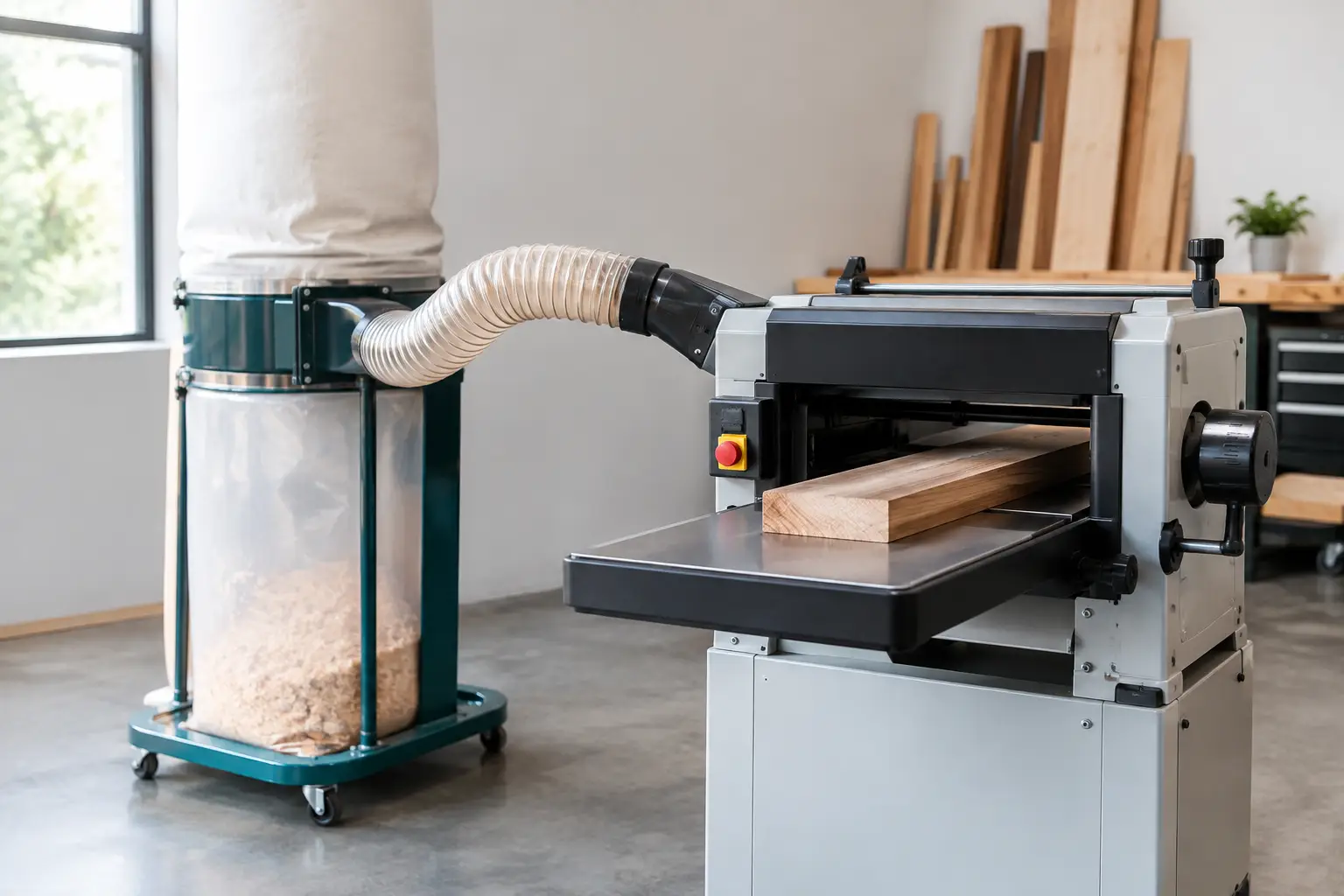
A thickness planer can turn a few rough boards into a pile of parts in an afternoon. It can also cover a one-car garage in curled chips before the first board is finished. Choosing a dust collector for planer use is less about buying the biggest machine you can afford and more about moving a high volume of chips through a short, properly sized path without giving up the floor space your shop needs.
Planers are among the easiest stationary tools to collect from when the system is matched correctly. They have an enclosed cutterhead area and a dedicated dust hood, so the chips have a defined exit route. But their output is heavy, fast, and relentless. A collector that handles occasional table saw dust may still clog, spray chips at the connection, or lose capture when connected to a planer through a long flexible hose.
Why a planer needs real airflow
A planer produces shavings rather than the fine dust associated with sanding. Those shavings take up a surprising amount of volume. A 13-inch benchtop planer taking even a light pass can fill a small collection bag quickly, and a wide or deep pass can overwhelm a marginal system in minutes.
The goal is not merely suction at the dust port. The system needs enough air velocity to keep chips suspended all the way from the planer hood to the collector. Once velocity drops, chips settle at low spots in the hose, especially in corrugated flexible hose. A blockage then reduces airflow further, creating the familiar result of chips backing up into the planer hood or blowing onto the floor.
For a typical 12- to 13-inch benchtop planer with a 4-inch dust port, a single-stage collector rated around 1,000 to 1,200 CFM is a practical starting point. That rating is not the airflow you will get at the planer. Actual airflow falls as the hose gets longer, bends are added, filters load up, and reducers restrict the path. Still, a collector in this class, used with a short 4-inch hose, has enough capacity for reliable single-machine planer collection in most compact garages.
A shop vacuum is usually the wrong primary choice for a planer. Vacuums create high static pressure but move comparatively little air. They work well for small ports on track saws, routers, and sanders. A planer needs volume. Some benchtop models can be run with a large wet/dry vacuum for light work, but expect frequent bin emptying, louder operation, and a greater chance of chips packing in the hose.
Match the dust collector for a planer to the port
Start with the planer itself. Many benchtop models have a 4-inch port, while some use a 2-1/2-inch connection or include an optional hood. A 4-inch port is a strong sign that the manufacturer expects a dust collector rather than a shop vacuum.
Do not reduce a 4-inch planer port to 2-1/2 inches just because that is the hose you already own. The smaller hose sharply restricts airflow and makes chip transport harder. In a small shop, reusing accessories is sensible, but an undersized hose is one compromise that regularly creates more cleanup and frustration than it saves.
Keep the connection at 4 inches from the planer to the collector whenever possible. Use a smooth-wall hose or rigid duct for fixed runs. Flexible hose is useful at a mobile planer because it bends and stores easily, but it has more internal resistance than smooth pipe. The practical approach is to use only enough flex hose to let the planer roll out from its storage position, then keep the remainder of the run straight and short.
A secure connection matters just as much as diameter. Planer vibration can loosen a friction-fit hose, and a hose that pops off under a blast of chips makes a serious mess. A hose clamp, a properly sized coupler, and a short check before each session are simple safeguards.
The small-garage setup that works best
For most one-car garages, a mobile single-stage collector is the best fit for a planer. It can park against a wall or in a corner, then roll into position when the planer comes out. This avoids dedicating valuable floor space to permanent ductwork while keeping the hose run short enough for useful airflow.
Place the collector on the discharge side of the planer if your layout allows it. That often creates the cleanest hose route because the collection hood is already at the outfeed end on many machines. Do not let the hose cross the board path, though. Long stock needs clear infeed and outfeed support, and a hose underfoot is a trip hazard when you are feeding heavy lumber.
If the planer is on a rolling stand, consider storing its hose and fittings directly on that stand. A wall-mounted hook, a capped port, and a dedicated 4-inch hose keep the setup from becoming a scavenger hunt every time you need to mill lumber. In a garage that must still hold a vehicle, reducing setup friction is often what determines whether a dust-control system gets used.
Avoid treating a central collector as a reason to run a 25-foot hose across the garage. Long hose runs can work when the collector has sufficient power and the duct is properly designed, but they are not ideal for a compact, budget-conscious shop. For a planer, moving the collector closer is usually more effective than chasing a higher advertised CFM number.
→ Check Price on Amazon for portable dust collectors that may fit a compact planer setup. Check the inlet size, actual airflow specifications, electrical requirements, and filter arrangement before choosing a model.
Filtration affects the air you breathe, not chip pickup
A standard woven collection bag is generally adequate for catching planer shavings. It is not adequate for capturing the finest airborne dust that escapes the machine and becomes a breathing concern. Planer chips are visible, but the smallest particles produced by the cutterhead are the ones that remain suspended in a closed garage.
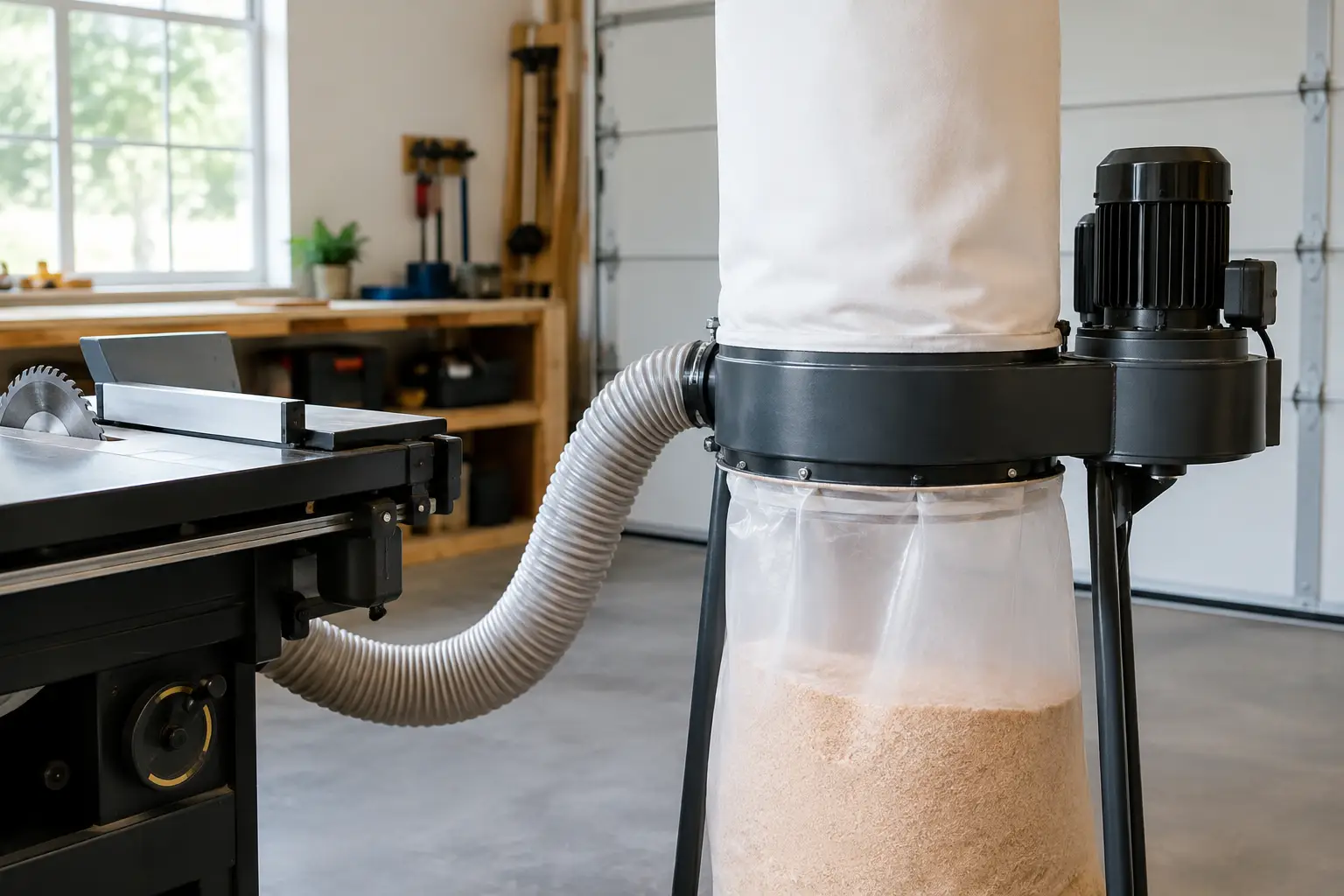
A canister filter rated to capture fine dust is a meaningful upgrade on a single-stage collector. It usually provides more filtration surface area than a basic bag and may improve airflow when kept clean. A cartridge or canister filter with a listed efficiency around 1 micron or better is a reasonable baseline for hobby-shop use. Models with finer published filtration ratings offer further protection, but no collector eliminates the need for sensible shop practices such as opening the garage door when conditions permit and cleaning settled dust with a vacuum rather than compressed air.
Collection bags and bins also deserve attention. Planer shavings fill them much faster than sawdust. If the bag overfills, chips can rise into the impeller area or restrict the system, depending on the collector design. Check the level before a long milling session, not after airflow has already dropped.
→ Check Price on Amazon for compatible canister filters and fine-dust filtration upgrades. Verify the model compatibility and published filtration rating before ordering.
Static pressure, hose length, and the CFM number on the box
Manufacturer CFM ratings are useful only as a rough comparison point. They are often measured with little or no restriction, which does not resemble a real setup with a hood, hose, elbows, filters, and a partially full bag. What matters at the planer is the airflow remaining after those restrictions.
A collector with a stronger motor and impeller can maintain airflow against resistance, but even a good unit can be handicapped by poor hose choices. For a dedicated planer connection, aim for a run of roughly 10 feet or less when possible. Every extra length of flex hose, tight bend, blast gate, or reducer adds resistance.
Do not assume a blast gate is mandatory on a one-tool setup. If the collector is rolled to the planer and serves only that machine during the session, a direct hose connection is simpler and leaks less. Blast gates make more sense when several machines share fixed ductwork. If you use one, place it where you can reach it without leaning across the planer or blocking the board path.
| Product | What to Look For | Check Price |
|---|---|---|
| Portable Dust Collector | A mobile unit with a 4-inch inlet for collecting planer chips in a small garage. | → Check Price |
| 4-Inch Dust Collection Hose | A properly sized hose with a short, direct route between the planer and collector. | → Check Price |
| Canister Dust Collector Filter | A compatible replacement filter with a published fine-dust filtration rating. | → Check Price |
When a larger collector is worth the space
A 1.5- to 2-horsepower collector can be worthwhile if you own a larger 15-inch planer, regularly take heavy passes in hardwood, or intend to build a short fixed duct system serving several machines. It also gives more margin when the collector cannot sit close to the planer.
The trade-off is physical size. Larger collectors have a wider footprint, taller filter assemblies, and bulkier bags or drums. They may be technically better at moving air but practically worse if they force you to store lumber outside, block a garage door track, or make it difficult to park a vehicle. For a benchtop planer used as a single machine, a compact 1-horsepower class collector with a 4-inch hose is often the more useful purchase.
If floor space is extremely tight, a wall-mounted dust collector can be a good compromise. Verify that its real inlet size, filtration arrangement, and collection capacity suit planer chips before committing. A small wall unit with a narrow hose and tiny bag may save space while creating constant emptying and clogging problems.
Set up for clean milling sessions
Before running the planer, inspect the hood for packed chips, make sure the bag or bin has room, and confirm that the hose is fully seated. Turn on the collector first, then start the planer. Feed boards at a steady rate and avoid taking an unnecessarily deep cut, particularly in wide hardwood stock. Lighter passes improve surface quality and reduce the sudden chip volume that can challenge a small collection system.
After the session, let the collector run briefly to clear the hose before shutting it down. Then empty the chips before moving the planer back into storage. A dust collector for planer work earns its space when it makes milling cleaner without turning a compact garage into a permanent industrial installation. Keep the hose large, the run short, and the collector close to the machine, and you will spend more time making boards flat and less time sweeping curls out from under every tool.

Leave a Reply