
As an Amazon Associate I earn from qualifying purchases.
A table saw can produce a surprising amount of sawdust in a small garage workshop. Even when the saw has a dust port, chips and fine particles can escape around the blade, through the stand, or onto the floor. A properly sized dust collector can make a major difference, especially when you are working in a one-car garage where there is little room for dust to spread.
The POWERTEC DC5372 is a portable 1 HP dust collector designed to connect directly to woodworking machines through a 4-inch dust port. It provides up to 560 CFM of advertised airflow and includes a reusable 1-micron filter bag. That makes it a much different machine from a shop vacuum and a potentially useful option for table saw dust collection in a small workshop.
The key is using it with the right saw, hose, and dust-collection setup. The DC5372 can improve table saw dust control, but it is not a complete solution for every type of airborne dust.
POWERTEC DC5372 Specifications
Before deciding whether the DC5372 is right for your table saw, it helps to understand exactly what you are buying.
| Feature | POWERTEC DC5372 |
|---|---|
| Motor | 1 HP induction motor |
| Voltage | 120V / 240V |
| Motor speed | 3,450 RPM |
| Advertised airflow | 560 CFM |
| Main inlet | 4 inches |
| Filter bag | 1 micron |
| Static pressure | 7.2 inches at 0 CFM |
| Impeller | 10-inch radial fan |
| Mobility | Casters |
| Weight | About 38 lb |
| Dimensions without bag | 16-5/8 × 15-7/8 × 17 inches |
POWERTEC specifies a 1 HP motor, 560 CFM airflow capacity, a 4-inch inlet, and a reusable 1-micron filter bag. The motor is designed for either 120V or 240V operation, although the unit is pre-wired for 120V.
Those specifications put the DC5372 in a useful middle ground for a small woodworking shop. It moves considerably more air than many shop-vac-style dust extractors while remaining compact enough to move around a garage.
Is the POWERTEC DC5372 Good for a Table Saw?
Yes, the DC5372 can be a good match for a table saw, particularly when the saw has a 4-inch dust port or an effective adapter to a 4-inch collection system.
The important distinction is that the DC5372 is the dust collector itself. It is not an under-table dust collection accessory or a replacement dust shroud.
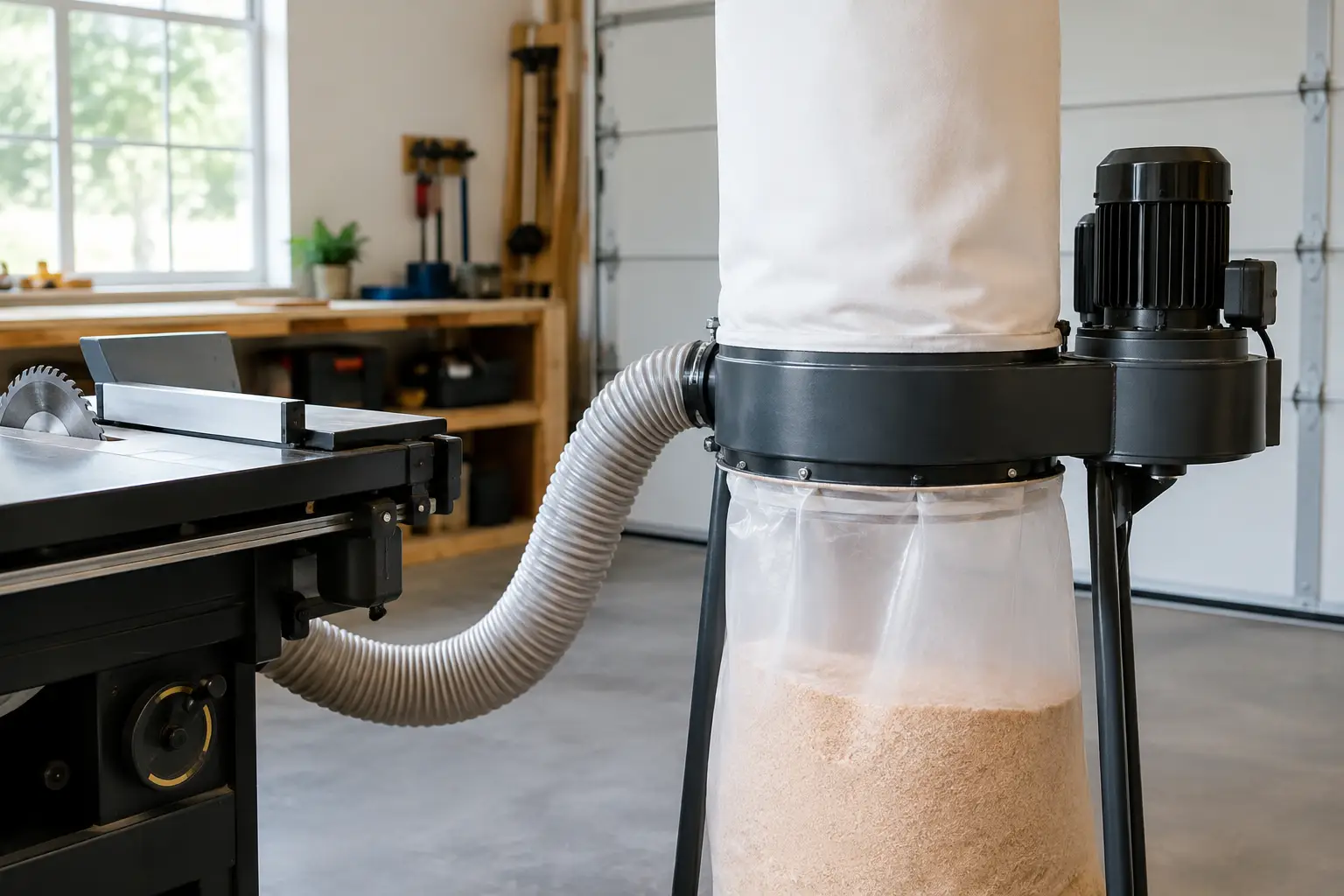
Its job is to create airflow through the dust port on your table saw and transport sawdust and chips through the hose into the collection bag.
That means the performance you get depends on the entire system:
- The table saw’s dust port and internal shroud
- The hose diameter
- Hose length
- Number of bends and adapters
- Condition of the filter and collection bag
- How well the saw contains dust around the blade
- How close the collector is to the saw
For a one-car garage, this system approach matters more than simply looking at the collector’s 560 CFM rating.
What the DC5372 Can and Cannot Capture
A table saw produces two basic types of dust and debris.
Larger chips and sawdust are generated below and around the blade. A properly connected dust collector can capture much of this material through the saw’s lower dust port.
Fine airborne dust is more difficult.
Some of it can travel above the table with the blade’s rotation. Other particles can escape through gaps around the throat plate, fence, blade guard, or rear of the saw. An open contractor-style saw can also allow dust to fall directly through the stand.
This is why even a powerful dust collector does not make a table saw completely dust-free.
The DC5372 is best thought of as the main source-capture component. It removes dust where the saw provides an appropriate collection point, while other improvements may be necessary for airborne dust.
If your saw has poor lower dust containment, improving that area can make the DC5372 much more effective.
For a more detailed look at the complete system, see our guide to table saw dust collection.
→ Compare woodworking dust collectors to find a setup that matches your table saw’s dust port, available space, and workshop needs.
DC5372 vs. a Shop Vacuum for Table Saw Dust
One of the most important decisions for a small garage shop is choosing between a dust collector and a shop vacuum.
They are not interchangeable.
A shop vacuum typically produces strong suction through a relatively small hose. That makes it useful for tools with smaller dust ports and applications where static pressure is important.
A dust collector such as the DC5372 is designed to move a larger volume of air through a larger 4-inch dust-collection system.
For a table saw with a 4-inch dust port, that larger airflow can be a better match.
The DC5372 provides a 4-inch main inlet and 560 CFM of advertised airflow.
That does not mean 560 CFM will necessarily reach the blade. Real-world airflow decreases as the air moves through the hose, adapters, bends, the saw’s internal passages, and the collection system.
Still, the basic architecture is appropriate for a full-size woodworking machine.
When a Shop Vacuum May Be Better
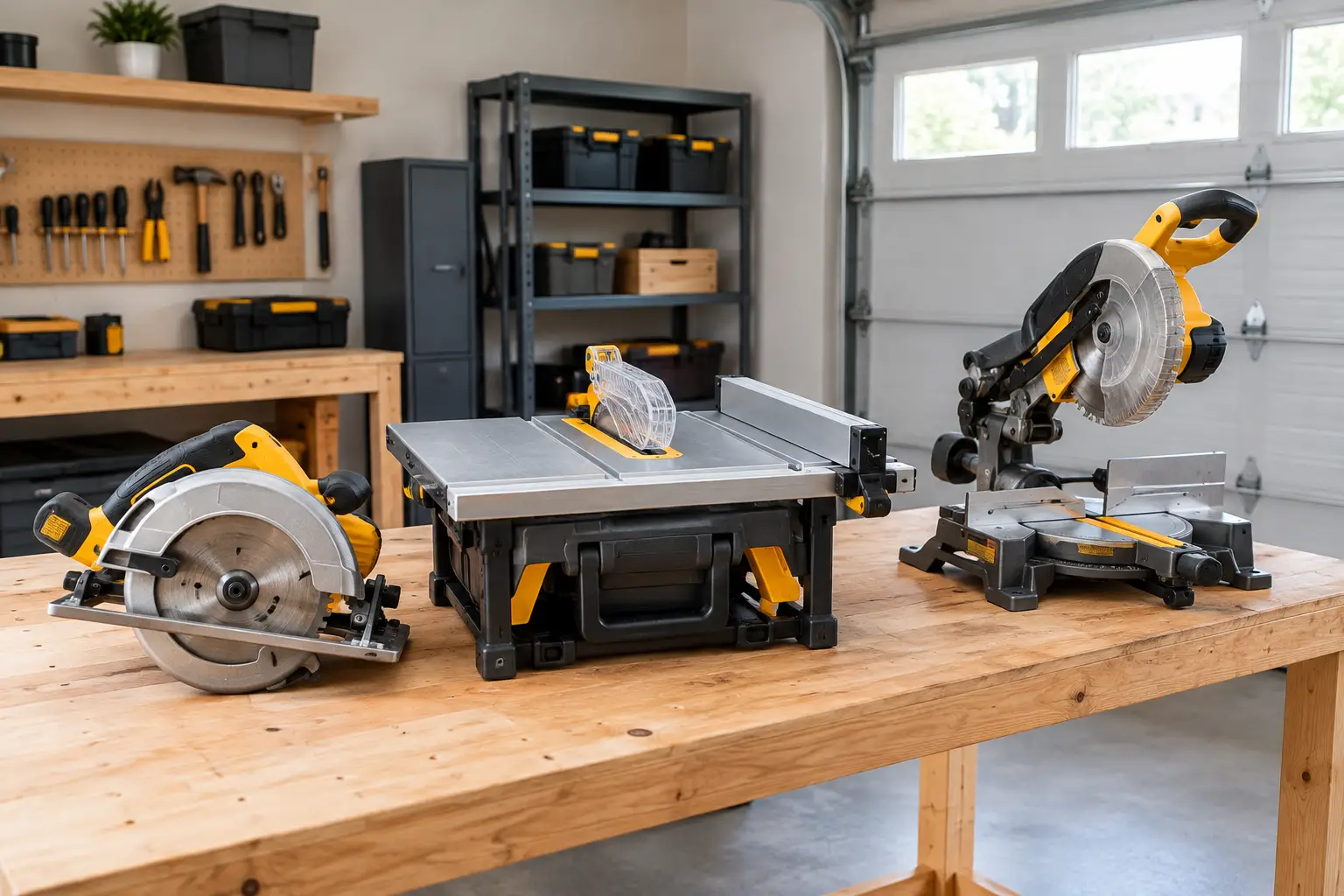
A shop vacuum can make more sense if you have a compact jobsite table saw with a small dust port.
It can also be preferable when portability is your highest priority.
For example, if you routinely fold your saw, carry it outside, or store it against a wall after every project, connecting a large 4-inch hose to a separate dust collector may be more trouble than it is worth.
The DC5372 makes more sense when the table saw is part of a dedicated workshop setup.
Use a 4-Inch Hose Whenever the Saw Allows It
The DC5372 has a 4-inch inlet, so the natural setup is a 4-inch dust-collection hose from the collector to the table saw.
Avoid reducing the hose diameter earlier than necessary.
A long run of smaller hose can restrict airflow and reduce the advantage of using a dedicated dust collector in the first place.
For example, a short adapter at the table saw may be reasonable if the saw has a smaller dust port. Running the entire distance with a narrow hose is less desirable.
Keep the hose as short and direct as your garage layout allows.
Our guide to dust collection hose size, length, and fit explains why hose diameter and routing have such a noticeable effect on dust-collection performance.
→ Check dust-collection hoses and adapters that fit your machine’s port size before setting up the DC5372.
How to Set Up the DC5372 in a One-Car Garage
The biggest advantage of the DC5372 for a small garage is its relatively compact footprint and mobile design.
The unit has casters, allowing you to move it closer to the machine you are using instead of permanently dedicating an entire corner of the garage to one collector. POWERTEC specifically positions the DC5372 as a portable dust collector for small professional and hobby workshops.
A practical table saw setup looks like this:
Table saw → 4-inch hose → DC5372
Keep the collector as close to the saw as practical.
This reduces hose length and makes it easier to keep the hose routing out of your walking path.
If your garage also contains a workbench, miter saw, planer, or router, mobility becomes even more useful. You can move the collector to the machine being used rather than installing a permanent ductwork system.
That can be a significant advantage when your garage still needs to function as a parking space.
Hose Routing Matters in a Small Garage
A good dust collector can become inconvenient if the hose is poorly routed.
Do not allow the hose to run across the main walkway where you stand while feeding lumber through the table saw. A long loop of flexible hose can become a trip hazard and may also interfere with long boards.
Whenever possible:
- Position the DC5372 behind or beside the saw.
- Use the shortest practical hose.
- Avoid unnecessary elbows.
- Keep the hose away from the operator’s feet.
- Leave enough slack for normal saw movement.
- Disconnect the hose before moving a portable saw.
If the saw is on a mobile stand, the hose should not be used as a handle or towing point.
The goal is not simply maximum airflow. It is a dust-collection setup that you will actually use every time you turn on the saw.
Contractor Saws and Open-Base Table Saws
The DC5372 can be particularly useful with contractor-style table saws and other saws that have a functional lower dust port but do not have the completely enclosed cabinet found on many cabinet saws.
An open base gives dust more opportunities to escape.
If the saw already has an effective lower shroud, connect the collector directly to that system and check for obvious leaks.
If the underside of the saw is largely open, the collector may still remove some of the material through the available port, but you should not expect the same containment as a fully enclosed cabinet.
In that situation, improving the saw’s dust shroud can be just as important as buying a stronger collector.
Cabinet Saws Have Different Needs
A cabinet saw generally provides better built-in dust containment.
The cabinet encloses much of the area around the blade and directs debris toward the dust port. Because of that, the DC5372 can often work more efficiently with the saw’s existing collection system than it would with a completely open stand.
However, more airflow is not always the answer.
Check the saw’s manufacturer’s recommended dust-port configuration first. If the saw has a poorly designed internal path, leaks or blockages may limit performance regardless of the collector you connect.
The same principle applies to a clogged filter or an overfilled collection bag.
Keep the DC5372 Filter and Bag Clean
Dust collection performance declines when the collection system becomes restricted.
POWERTEC’s manual recommends regularly checking and emptying the collection bag, and notes that the machine operates more efficiently when the bag is empty.
The DC5372’s 1-micron reusable bag also has a viewing window and bottom zipper, which makes it easier to see when the bag needs attention and empty it without completely removing the bag.
There is another maintenance point worth knowing.
POWERTEC states that the 4-inch inlet has a protective grate designed to keep large debris away from the impeller. Debris can accumulate around this grate over time and restrict airflow, so the company recommends removing the hose periodically and checking the inlet for blockage.
That is an easy maintenance step to overlook.
Is a 1-Micron Filter Good Enough for a Table Saw?
The included 1-micron filter bag is a useful feature for a small woodworking shop because it is designed to filter finer dust than a basic coarse collection bag.
However, filtration at the collector does not mean every airborne particle generated by the table saw is captured.
The dust that never enters the hose cannot be filtered by the collector.
That is why table saw dust control should be approached in layers:
- Capture dust at the saw’s dust port.
- Use an appropriately sized hose.
- Keep the collection system free of restrictions.
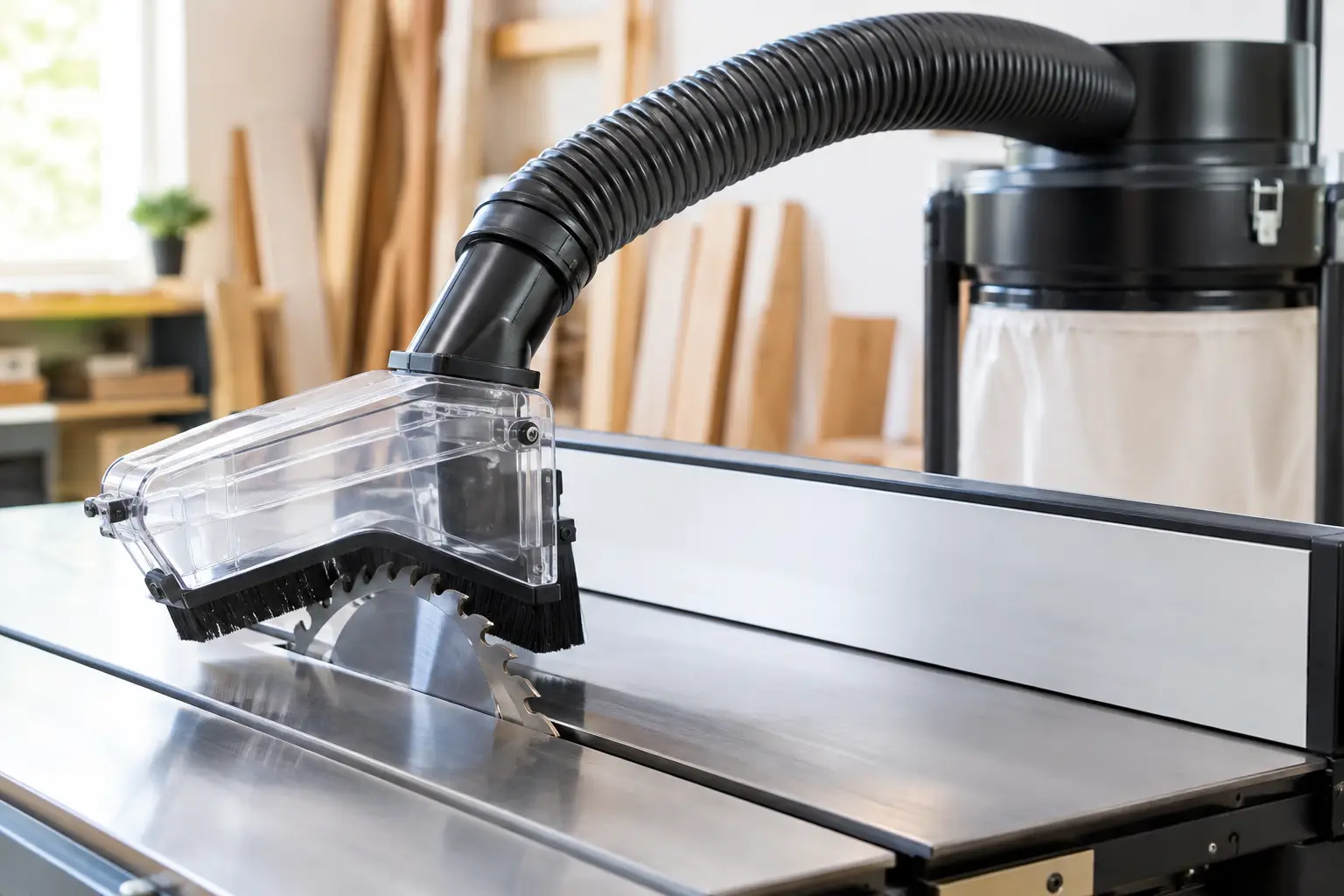
- Improve blade-guard or overhead collection where practical.
- Keep the work area clean.
- Wear appropriate respiratory protection when conditions require it.
The DC5372 can reduce the amount of dust entering the garage air, but it should not be treated as a guarantee of dust-free air.
What About MDF and Fine Sheet Goods?
MDF and similar sheet materials can produce a large amount of fine dust.
This is one situation where the difference between collecting chips and controlling airborne dust becomes especially important.
The DC5372 can collect material that successfully enters the saw’s dust-collection system, but fine particles escaping around the blade can still enter the air.
If you frequently cut MDF, plywood, or other dusty sheet goods, consider improving the blade guard and upper collection system in addition to the lower dust port.
An air cleaner can also be useful as a secondary layer for particles that remain suspended in the workshop, but it should not replace source collection at the saw.
DC5372 Pros and Cons for Table Saw Use
Pros
- 1 HP induction motor
- 560 CFM advertised airflow
- 4-inch dust inlet
- Reusable 1-micron filter bag
- 120V/240V motor
- Compact footprint
- Caster-mounted portable design
- Suitable for small professional and hobby workshops
- More appropriate for larger dust ports than many shop vacuums
Cons
- Requires a dedicated dust hose
- Takes up more space than a shop vacuum
- Not ideal for every portable jobsite saw
- Does not capture dust that escapes above the table
- Performance depends heavily on hose diameter and routing
- A 4-inch system may require an adapter for smaller saw ports
- The collector still needs regular bag and inlet maintenance
Is the POWERTEC DC5372 Worth It for a Small Garage?
The POWERTEC DC5372 makes the most sense for a woodworker who has moved beyond occasional DIY cutting and wants a dedicated dust collector for a small workshop.
Its combination of a 1 HP motor, 560 CFM advertised airflow, 4-inch inlet, 1-micron filter bag, and mobile design fits the needs of many one-car garage shops.
It is particularly attractive if you use several woodworking machines and want one collector that can move between them.
For a table saw, the best results come from keeping the collector reasonably close, using a 4-inch hose whenever the saw supports it, minimizing restrictions, and making sure the saw itself provides a reasonably enclosed path for the dust.
It is less compelling if you have a tiny folding jobsite saw, only use the saw occasionally, or already have a highly effective dust-collection system built into the machine.
For those users, a quality shop vacuum may be simpler.
For a dedicated one-car garage workshop with a full-size table saw, however, the DC5372 offers a practical balance between airflow, filtration, portability, and size.
→ Compare dust collectors for woodworking machines to find an option that suits your garage layout, power supply, and dust-control requirements.
Final Verdict
The POWERTEC DC5372 is not a table saw attachment. It is a portable 1 HP dust collector designed to provide source collection for woodworking machines through its 4-inch inlet.
Used with an appropriately configured table saw, it can substantially reduce the amount of sawdust and chips that end up on the floor and around the lower part of the machine.
The biggest mistake would be to judge it only by the 560 CFM specification. Your actual results depend on the saw’s dust port, hose diameter, hose length, internal dust path, and how much dust escapes before it reaches the collection point.
For a one-car garage workshop, that makes the DC5372 a practical choice when you want dedicated dust collection without installing a large permanent system.
It will not make a table saw completely dust-free, but paired with good source capture and sensible hose routing, it can be a meaningful upgrade over letting sawdust accumulate around the saw or relying entirely on a small shop vacuum.

Leave a Reply