
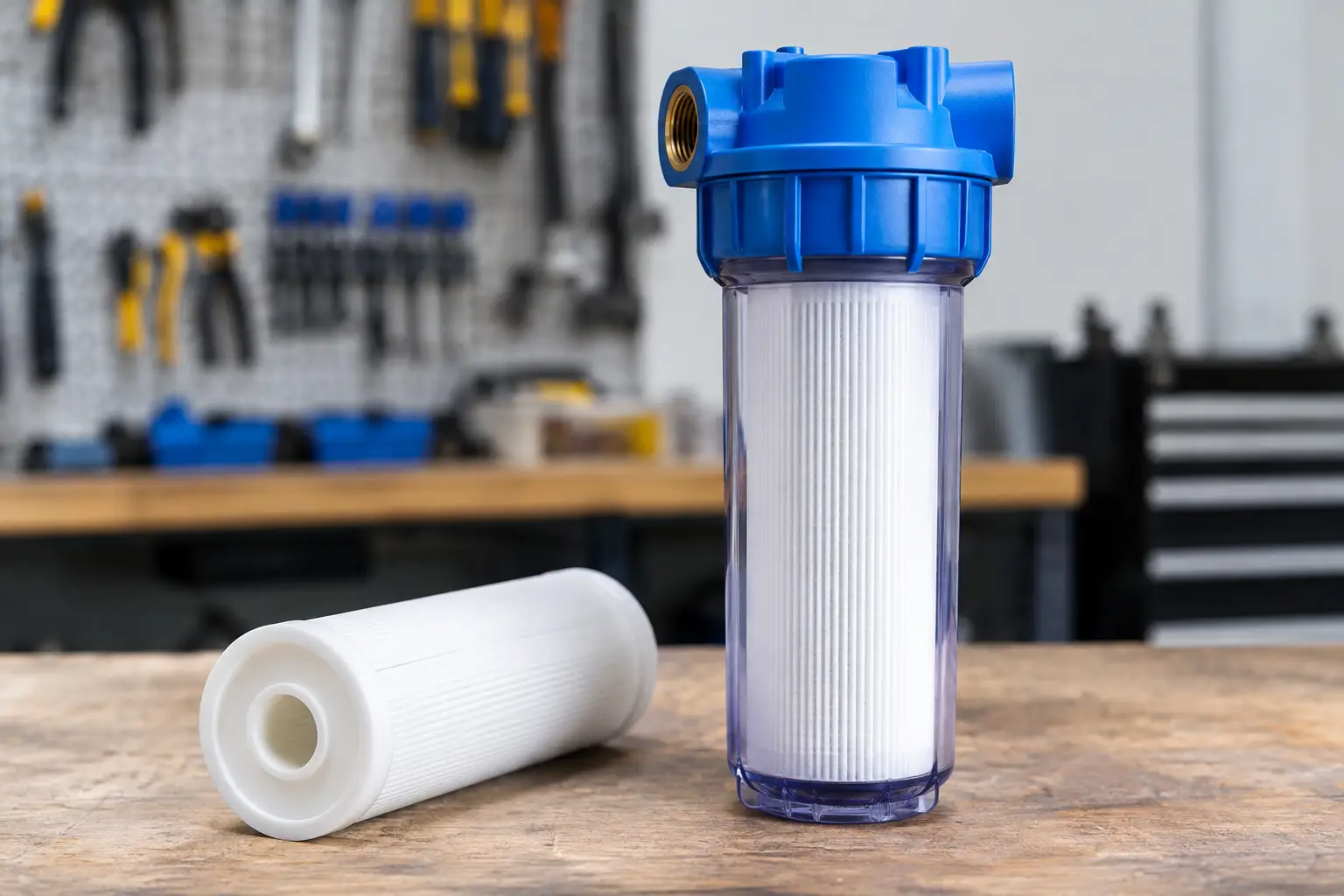
As an Amazon Associate I earn from qualifying purchases.
A dust collector can look like it is working perfectly while fine dust is still circulating through your workshop. Large wood chips may end up in the collection bag or drum, but much smaller particles can remain airborne or pass through a poorly designed filter.
So, what does 1-micron filtration mean?
In simple terms, a 1-micron filter is designed to address particles around 1 micrometer in size. But the number alone does not tell you how efficiently the filter captures those particles.
That distinction matters.
A dust collector advertised with a 1-micron filter is not automatically capturing 100% of 1-micron particles. You also need to look at the filter’s stated efficiency, filter design, available filter area, airflow, and how the system performs once dust begins building up on the media.
For a one-car garage workshop, those details matter because there is limited air volume, limited floor space, and often less powerful electrical service than you would find in a large professional shop.
What Is a Micron?
A micron, or micrometer, is one millionth of a meter.
That is extremely small compared with the dust and chips you can see around a woodworking shop.
A human hair is commonly tens of microns wide, while a 1-micron particle is far too small to see with the naked eye. Woodworking dust also exists across a wide range of particle sizes. Planer chips and larger sawdust are relatively easy for a dust collector to capture, while the finest dust is much harder to control.
This is why a workshop can look clean immediately after using a table saw or sander while still having fine dust suspended in the air.
A filter’s micron rating is intended to tell you something about the particle size the filter is designed to capture. However, it should not be treated as a complete measurement of filtration performance.
What Does a 1-Micron Filter Actually Capture?
When a manufacturer says a dust collector has 1-micron filtration, the statement generally means the filter is designed to capture particles down to approximately 1 micron.
The important word is designed.
A micron rating by itself does not tell you the percentage of particles captured at that size. Two filters can both be marketed as 1-micron filters while providing different levels of filtration efficiency.
For example:
- Filter A may be advertised as filtering particles down to 1 micron.
- Filter B may specify a particular capture efficiency at 1 micron.
- Filter C may publish efficiency across a range of particle sizes.
Those specifications give you different amounts of useful information.
This is why you should not compare dust collector filters by the micron number alone.
When possible, look for a manufacturer that provides both the particle-size rating and an efficiency percentage or test specification.
→ Compare dust collectors with published filtration-efficiency specifications.
1 Micron Does Not Mean 100% Filtration at 1 Micron
This is one of the most common misunderstandings about dust collector filters.
If a filter says 1 micron, it does not automatically mean that every particle larger than 1 micron will be captured or that every 1-micron particle will be removed from the airstream.
The actual performance depends on the filter media, construction, airflow, testing method, and other characteristics of the dust collection system.
Some manufacturers provide detailed efficiency specifications. For example, current dust collection products can publish figures such as 99% efficiency or even efficiency over a specific particle-size range rather than relying only on a rounded micron rating.
That is a much more useful specification when comparing filters.
Nominal vs. absolute filtration ratings
You may also encounter the terms nominal and absolute when researching filtration.
A nominal rating generally indicates that the filter removes a stated portion of particles at the specified size under the manufacturer’s testing conditions. The exact efficiency associated with a nominal rating can vary.
An absolute rating is intended to represent a much more stringent, defined level of particle retention under a specified test method.
The important point for a woodworker is simple:
Do not assume that two filters with the same micron number have identical performance.
Always check what the manufacturer means by the rating and whether an efficiency percentage or test method is provided. The testing details are what give the micron number useful context.
Is a 1-Micron Filter Better Than a 5-Micron Filter?
Generally, a filter designed to capture smaller particles provides finer filtration than one designed only for larger particles.
So, all else being equal, a 1-micron filter provides finer filtration than a 5-micron filter.
But “finer” does not automatically mean “better for every dust collector.”
A filter with very fine media can create additional resistance to airflow. If the collector does not have enough airflow capacity, installing a more restrictive filter can reduce the amount of air reaching the tool.
That can create another problem: poor source capture.
A dust collector that filters extremely well but cannot move enough air through a long hose may perform worse at the table saw than a properly sized system with adequate airflow and appropriate filtration.
For that reason, filtration and airflow need to be considered together.
Why Filter Design Matters
A 1-micron rating tells you about particle size, but filter construction also matters.
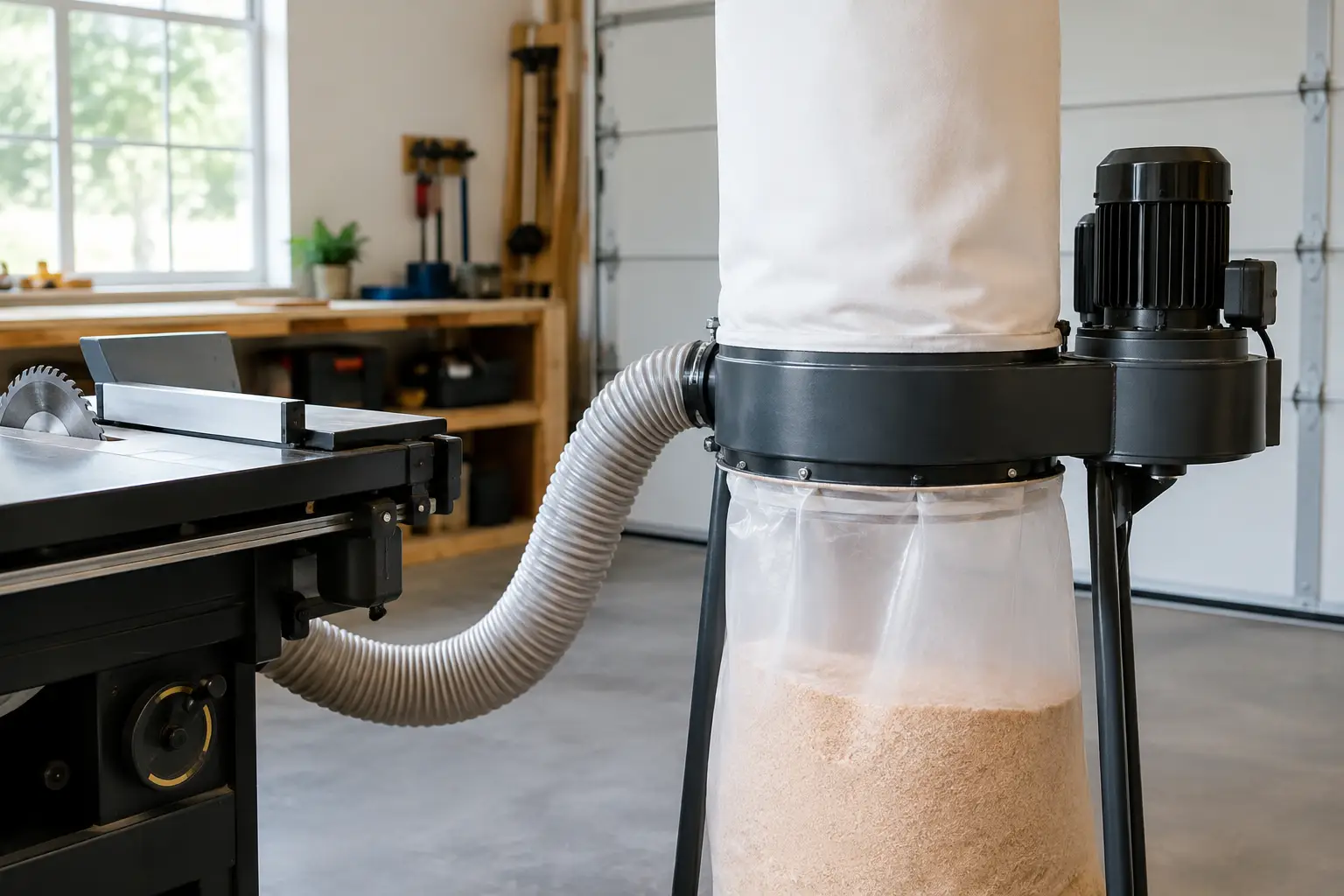
A pleated cartridge filter can provide a large amount of filter media in a relatively compact space. That increased surface area can help the system maintain airflow while filtering fine dust.
For example, current woodworking dust collectors commonly use pleated cartridge filters specifically to provide more filtration surface in a compact design.
This is particularly useful in a small garage workshop, where you may not have room for a large dust collection system.
A compact collector with a well-designed cartridge filter can be easier to fit beside a workbench, table saw, or wall while still providing substantially finer filtration than a basic cloth bag.
If you are comparing filter options for a small shop, our guide to pleated cartridge filters explains what to look for and how filter design affects dust collector performance.
Does a 1-Micron Filter Make a Dust Collector HEPA?
No.
A 1-micron filter is not automatically a HEPA filter.
HEPA is a specific high-efficiency filtration classification with its own performance requirements and testing. A filter simply labeled “1 micron” has not earned a HEPA designation unless the manufacturer specifically identifies it as HEPA and provides the applicable specifications.
This distinction is important because HEPA filtration is designed for substantially finer particulate capture than a basic 1-micron specification.
That does not mean a 1-micron dust collector filter is ineffective. It can be a significant improvement over a coarse filter, particularly when combined with good source capture.
It simply means you should not use the terms 1 micron and HEPA interchangeably.
Why Airflow Still Matters With a 1-Micron Filter
One of the biggest mistakes when choosing a dust collector is focusing entirely on the filter rating.
Dust collection is a system.
The filter, motor, impeller, hose, ductwork, fittings, blast gates, tool port, and collection container all affect performance.
A filter creates resistance as air passes through the media. As dust accumulates, that resistance can increase further.
This is why a dust collector’s advertised CFM should not be treated as the airflow you will automatically get at the tool.
A long flexible hose, sharp bends, undersized ducting, reducers, clogged filters, and restrictive tool ports can all reduce real-world airflow.
Our guide to dust collection hose size and length covers this issue in more detail.
For a small one-car garage, this is especially important. You may have a compact collector sitting 10 or 15 feet away from the table saw simply because of the available floor space. That extra hose length and the bends required to route it around your workspace can affect pickup.
What Happens When a 1-Micron Filter Gets Dirty?
A filter does not remain in the same condition forever.
As dust accumulates on the filter media, airflow resistance can increase. Depending on the filter design, some dust buildup can also change filtration behavior.
The result is a trade-off between filtration and airflow.
A completely clean filter may allow excellent airflow, while an overloaded filter can restrict the system enough to reduce dust pickup at the machine.
This is why filter maintenance matters.
Some manufacturers design filters with cleaning systems that help remove accumulated dust from the media. Pleated filters may also provide more surface area, which can help maintain airflow for longer periods between cleanings.
Do not wait until the collector is obviously struggling before checking the filter.
If you notice that:
- The table saw leaves more dust behind
- The planer hood is no longer clearing chips effectively
- Fine dust is appearing around the machine
- Airflow feels weaker
- The collection drum is unusually full
- The filter looks heavily loaded
check the entire dust collection system.
The filter may be part of the problem, but it may not be the only problem.
Is a 1-Micron Filter Good Enough for a Small Garage Workshop?
For many hobby woodworkers, a properly designed 1-micron dust collector filter is a useful baseline.
It can be especially worthwhile if your shop includes:
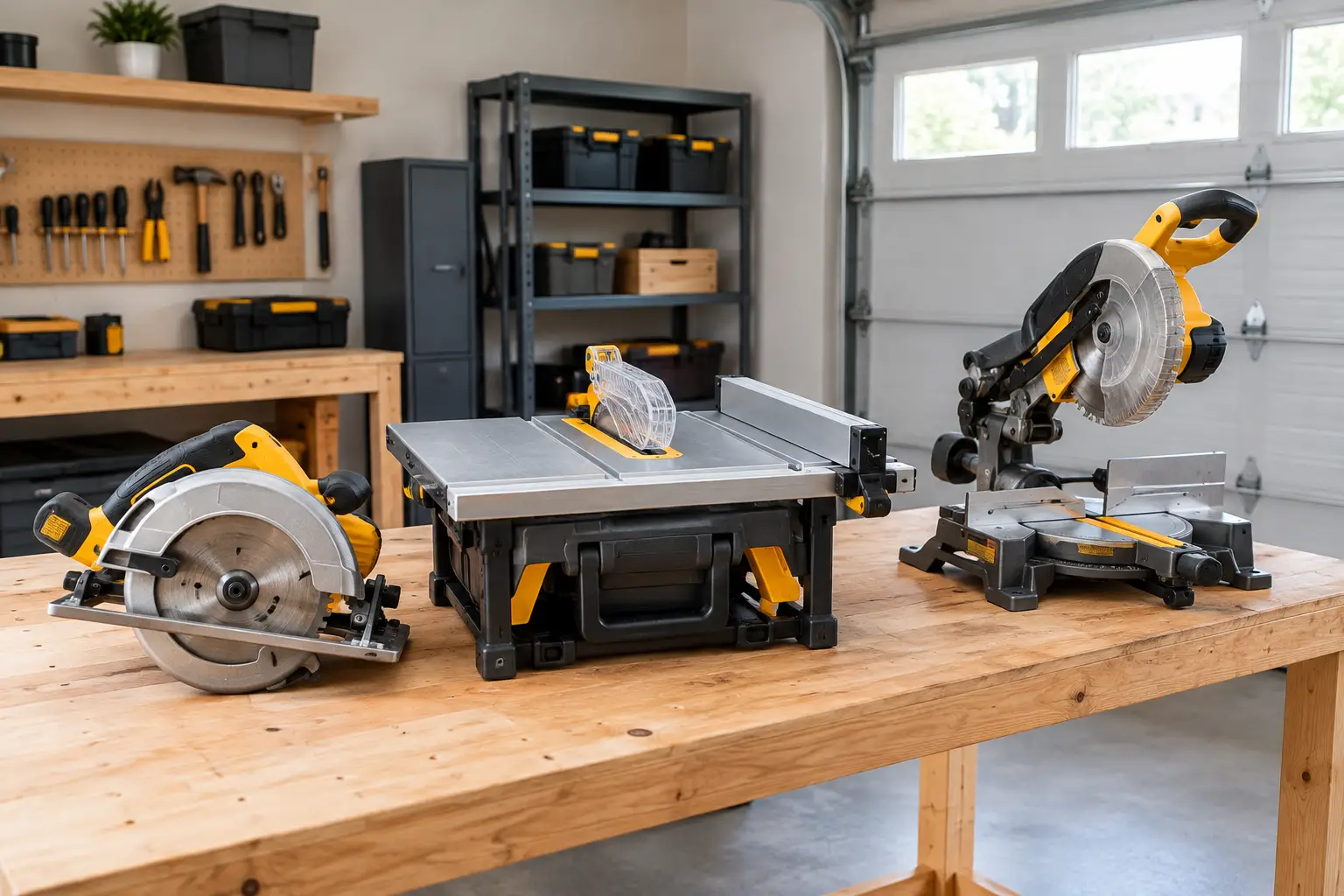
- Table saws
- Miter saws
- Routers
- Planers
- Jointers
- Sanding equipment
- Benchtop woodworking machines
- MDF and particleboard projects
However, the filter should not be considered your only line of defense.
The most effective strategy is to capture dust at the source before it becomes airborne.
That means using an appropriate dust port, keeping connections sealed, using the correct hose diameter, and positioning the collector so the hose run is as short and direct as practical.
For table saw work, improving table saw dust collection can make a bigger difference than simply installing a finer filter on an undersized collector.
What About MDF and Plywood Dust?
Sheet goods deserve special attention because cutting MDF, particleboard, and some plywood products can produce substantial amounts of fine dust.
If you regularly work with these materials, do not rely on the filter rating alone.
Use effective source extraction whenever possible, keep the dust collector maintained, and use appropriate personal protective equipment for the task.
A 1-micron filter can help reduce the amount of fine particulate returned to the workshop, but it does not eliminate dust at the cutting point.
The goal is to prevent as much dust as possible from becoming airborne in the first place.
Dust Collector vs. Shop Vacuum: Does 1 Micron Mean the Same Thing?
Not necessarily.
A traditional dust collector and a shop vacuum are designed around different airflow characteristics.
A dust collector generally moves a larger volume of air through larger ports. That makes it better suited to machines such as table saws, planers, and jointers that produce larger quantities of chips and dust.
A shop vacuum typically produces higher static pressure through a smaller hose. That makes it useful for sanders, handheld routers, track saws, and other tools with small dust ports.
A shop vacuum can also have a highly efficient filter, including a HEPA filter, but that does not automatically make it a substitute for a high-volume dust collector on a machine with a 4-inch dust port.
Choose the collection system based on the tool and the type of dust it produces, not simply the micron number printed on the filter.
How to Maintain a 1-Micron Filter
A good filter only performs well when it is maintained properly.
Follow the manufacturer’s cleaning instructions for your specific filter. Some cartridge filters have built-in cleaning mechanisms, while others may require manual cleaning.
Avoid aggressive cleaning methods unless the manufacturer specifically recommends them. Excessive pressure or improper handling can damage filter media.
Also check the rest of the system.
Inspect:
- Filter condition
- Collection bag or drum
- Lid seals
- Hose connections
- Blast gates
- Tool dust ports
- Flexible hose for crushing or kinking
- Duct transitions and reducers
An air leak can reduce collection performance even when the filter itself is in excellent condition.
Keep the collection container from becoming excessively full, too. A collector that is overloaded with debris may have reduced airflow and become harder to clean.
1-Micron Filtration: What Should You Look For?
When comparing dust collectors or replacement filters, look beyond the phrase “1 micron.”
A useful checklist is:
1. Filtration efficiency
Does the manufacturer provide an efficiency percentage?
A statement such as “99% at a specified particle size” provides more information than simply saying “1-micron filtration.”
2. Filter surface area
A larger pleated filter can provide more media within a relatively compact footprint.
3. Airflow
Look at the collector’s airflow specifications, but remember that advertised CFM may not represent the airflow you actually get at the tool.
4. Filter cleaning
A filter that is easy to clean is more likely to remain useful over time.
5. Hose compatibility
Make sure the collector, hose, and tool port are appropriately matched.
6. Shop size
In a one-car garage, physical dimensions and hose routing matter. A technically powerful collector that consumes too much floor space may be impractical for everyday use.
7. The type of woodworking you do
Someone who mainly cuts solid lumber has different dust collection requirements from someone who spends several hours sanding MDF every week.
→ Check dust collector options and compare airflow, filter design, and shop size before choosing.
Common Mistakes With 1-Micron Dust Collectors
There are several easy mistakes to avoid.
Mistake #1: Assuming 1 micron means 100% capture.
It does not. Check the manufacturer’s efficiency specification.
Mistake #2: Assuming 1 micron means HEPA.
It does not. HEPA is a separate filtration classification.
Mistake #3: Ignoring airflow.
A fine filter cannot compensate for inadequate airflow at the machine.
Mistake #4: Using a small shop vacuum for every machine.
A vacuum can be excellent for small dust ports but may not provide the airflow needed for large machine ports.
Mistake #5: Ignoring the hose.
A crushed, excessively long, or undersized hose can significantly reduce collection performance.
Mistake #6: Waiting until the filter is completely clogged before cleaning it.
Excessive filter loading can restrict airflow and reduce dust pickup.
Mistake #7: Focusing only on cleanup.
The best dust collection strategy captures dust at the tool before it spreads through the workshop.
So, What Does 1-Micron Filtration Really Mean?
1-micron filtration means the filter is designed to address particles around 1 micron in size, but the micron number alone does not tell you how efficiently those particles are captured.
That is the key distinction.
For a small garage workshop, a good dust collection system should combine appropriate filtration with sufficient airflow, a properly sized hose, good seals, effective source capture, and regular filter maintenance.
A 1-micron cartridge filter can be a very useful upgrade over a coarse collection bag, particularly when you are working with fine sawdust, sanding dust, MDF, or other dusty materials. Pleated cartridge filters are widely used because they can provide substantial filter surface area in a compact package.
But do not choose a dust collector simply because the box says “1 micron.”
Look at the complete system.
The best dust collection setup is not the one with the smallest micron number. It is the one that combines effective filtration with enough real-world airflow to capture dust where it is created.


Leave a Reply