
As an Amazon Associate I earn from qualifying purchases.
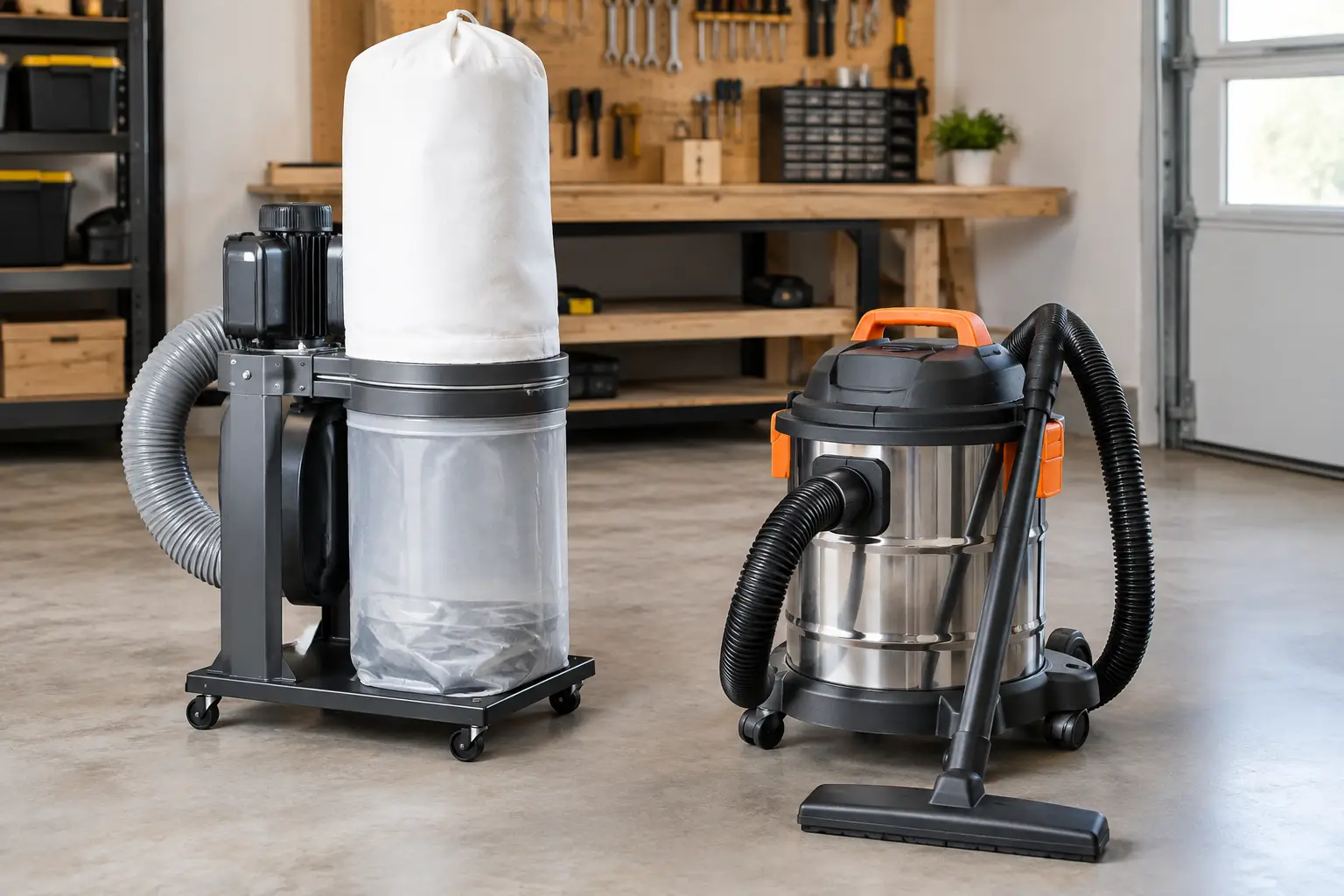
A benchtop planer can produce a surprising amount of wood chips in just a few minutes, while a random-orbit sander creates fine dust that can spread across a small garage and remain suspended in the air. That is why choosing between a portable dust collector vs shop vac is less about buying the machine with the biggest motor and more about matching the collection system to the tool.
For most small and one-car garages, a shop vac is the better choice for sanders, routers, track saws, small dust ports, and general cleanup. A portable dust collector makes more sense for machines that produce large volumes of chips, such as planers, jointers, and some table saws with larger dust ports.
If you use both types of tools, owning both machines can actually be the most practical solution. The shop vac handles small-port and portable tools, while the dust collector takes care of high-volume chip-producing machines.
The important thing is to match the airflow, suction, hose diameter, filtration, and collection capacity to the work you actually do.
Portable Dust Collector vs Shop Vac: The Core Difference
The easiest way to understand the difference is to think about two different airflow problems.
A shop vac is designed to create strong suction through a relatively small hose. That makes it useful when a tool has a small dust port or restrictive internal passages. Sanders, routers, track saws, and handheld tools generally benefit from this type of system.
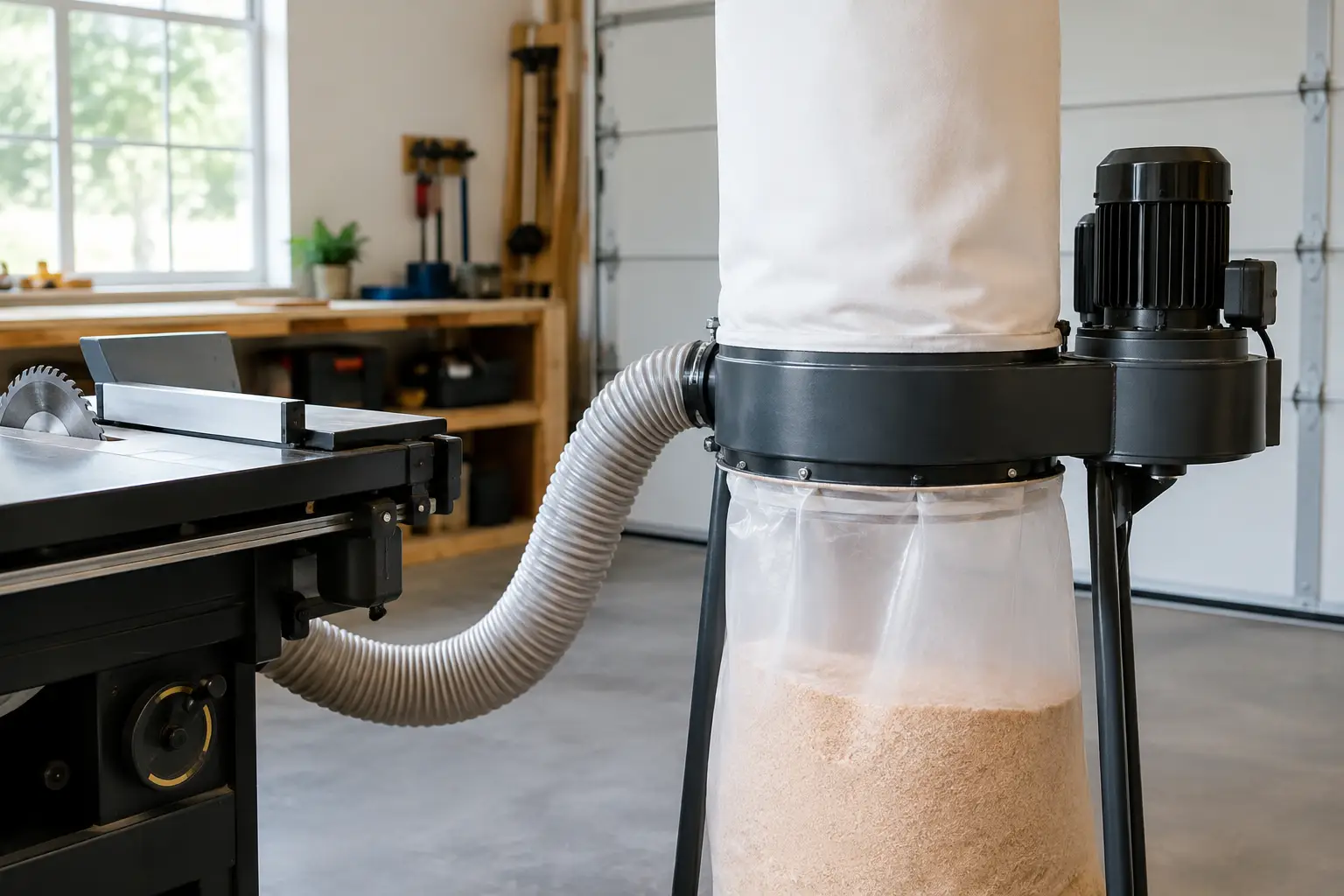
A portable dust collector moves a much larger volume of air through a larger hose, commonly around 4 inches in woodworking applications. That higher airflow is important when a machine produces a large stream of chips that needs to be transported away from the cutting area.
In simple terms:
Shop vac = stronger suction through a smaller hose.
Dust collector = higher airflow through a larger hose.
Neither is automatically better. They are designed for different jobs.
This distinction is also why simply comparing the advertised CFM numbers can be misleading. Manufacturers may measure airflow under conditions that are very different from real-world use. Once you add a hose, elbows, reducers, fittings, a tool port, and a filter, the airflow available at the tool can be significantly lower.
For a small garage workshop, the entire airflow path matters.
| Workshop task or tool | Better choice | Why |
|---|---|---|
| Random-orbit sander | Shop vac | Small port and restrictive airflow favor higher suction. |
| Track saw | Shop vac or dust extractor | Portable setup and small dust port make a vacuum practical. |
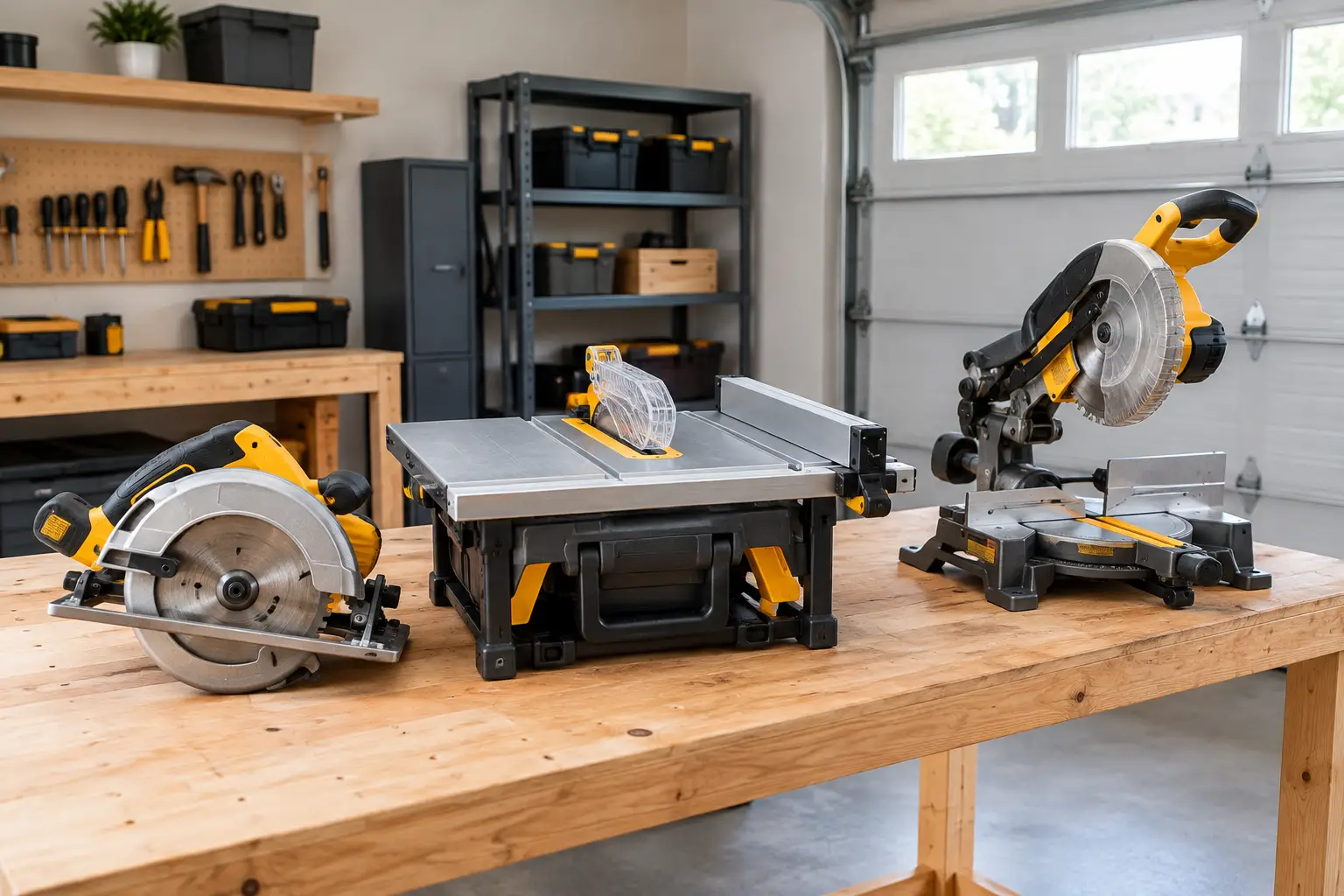
| Circular saw | Shop vac or dust extractor | Small connection and portability are important. |
| Miter saw | Shop vac | A vacuum works well with the factory port and a rear collection hood. |
| Benchtop planer | Portable dust collector | Produces a high volume of chips that requires more airflow. |
| Jointer | Portable dust collector | Large dust ports and continuous chip production favor higher airflow. |
| Table saw with a large dust port | Portable dust collector | Better suited to moving larger quantities of chips and sawdust. |
| Router table | Depends on setup | A shop vac can work well with a small port; larger enclosed systems may benefit from a collector. |
| General garage cleanup | Shop vac | Easier to move and better suited to floors, benches, and miscellaneous debris. |
→ Compare shop vacs and portable dust collectors to find a setup that fits your garage, tools, and available storage space.
When a Shop Vac Is the Better Choice
For many small garage workshops, a good shop vac is the most useful first purchase.
If your tools include a random-orbit sander, drill press, router, track saw, circular saw, miter saw, or other portable tools with relatively small dust ports, a shop vac is usually easier to connect and easier to move around the garage.
It also takes up less space.
That matters when your workshop shares space with a vehicle, lawn equipment, storage shelves, or other household items. A shop vac can usually be rolled underneath a workbench or parked against a wall when you are finished.
Another advantage is versatility. A shop vac can collect sawdust and chips, clean a workbench, pick up debris from the garage floor, and in many models handle wet spills as well.
A portable dust collector does not provide the same flexibility.
Shop Vac Filtration Matters
One mistake is to judge a shop vac only by its motor power.
For woodworking, filtration is extremely important. A vacuum that collects visible sawdust but allows a large amount of fine dust to pass through its filter is not an ideal solution for sanding or other fine-dust work.
Use a filter designed for fine dust and, when compatible with the vacuum, a collection bag. A bag can keep a substantial amount of debris away from the main filter, helping maintain airflow and making emptying the vacuum cleaner.
A cyclone separator can be another useful upgrade.
Instead of sending all the chips and sawdust directly into the shop vac, the separator captures much of the material in a separate container before it reaches the vacuum. This is particularly useful when using a shop vac for woodworking because it reduces how quickly the filter and vacuum container become loaded.
The separator does add another connection to the airflow path, so it should be installed with appropriately sized hoses and fittings.
When a Portable Dust Collector Makes More Sense
A portable dust collector becomes much more useful when your garage contains a machine that produces a large volume of chips.
A thickness planer is the classic example.
A planer can produce a surprisingly large amount of waste in a short period. A shop vac may have enough suction to pull some material from the port, but the combination of limited airflow and a small collection container can become frustrating quickly.
The same basic problem appears with jointers and some stationary saws.
A portable dust collector is designed to move a larger volume of air through a larger hose. That makes it better suited to transporting chips away from machines with larger dust ports.
If a planer or jointer is the machine you use most often, the additional floor space occupied by a portable dust collector can be worthwhile.
You may also spend less time stopping to empty the collection container.
Do Not Assume Every Dust Collector Handles Fine Dust Well
A dust collector’s ability to move a lot of air does not automatically mean it provides excellent fine-dust filtration.
Some entry-level collectors use fabric filter bags that are primarily intended for collecting larger particles. Fine dust can pass through less-efficient filtration and return to the garage.
For woodworking, look for a collector with an appropriate fine-filtration system, such as a pleated cartridge filter, when available for that model.
The filter is only one part of the system, though. The condition of the filter also affects airflow. As the filter becomes loaded with dust, the system can lose performance.
This is another reason regular filter maintenance matters.
→ Explore portable dust collectors designed for woodworking machines that produce large amounts of chips, including planers and jointers.
Shop Vac vs Portable Dust Collector: Airflow, Suction, and Hose Size
The hose is one of the easiest ways to understand why these machines behave differently.
A shop vac commonly uses a hose in the smaller-diameter range, while woodworking dust collectors frequently use 4-inch hoses for stationary machines.
That difference is significant.
A small hose can provide strong suction at a small opening, which is useful for pulling fine dust from a sander or handheld router.
A larger hose allows considerably more air volume to move through the system, which is what you need when transporting a large stream of chips.
This is why putting a small hose on a large dust collector does not magically make the collector ideal for a random-orbit sander.
The smaller opening becomes a restriction.
The opposite is also true. Connecting an oversized hose to a small tool port does not automatically improve dust collection. The tool’s port and internal passages can still restrict the system.
Keep the Hose as Short and Straight as Practical
Once you have selected the right machine, the next step is reducing unnecessary airflow resistance.
Avoid excessive hose length when possible.
Minimize sharp bends.
Use appropriately sized fittings.
Avoid unnecessary reducers.
Keep the hose interior as smooth as practical for the application.
These details become especially important in a small garage because the temptation is often to run one long hose around the entire workshop.
A shorter connection to the machine that produces the most dust is often a better solution.
For more information on hose sizing and fit, see our guide to dust collection hose size, length, and fit.
What About a Miter Saw?
Miter saws deserve special attention because they are often messy even when connected to a vacuum.
The problem is not always the vacuum.
A miter saw can throw dust backward and sideways, and the factory dust port may capture only part of the material generated by the blade.
That is why a shop vac combined with a properly designed rear hood or enclosure can work better than simply connecting a larger hose to the factory port.
For a small garage, this approach can also be easier to manage because the shop vac remains portable.
Our guide to miter saw dust collection in small garages covers this setup in more detail.
Filtration and Dust Collection Are Not the Same Thing
One of the most important points in this comparison is that collecting visible chips is only part of dust control.
A machine can appear clean while fine particles remain in the air.
Sanding is a good example. The amount of material produced may not look impressive compared with a planer, but the particles can be much finer.
That means a dust-control setup should be evaluated on two separate questions:
How much material does the system capture at the tool?
How effectively does the filtration system retain the particles it collects?
These are related but different issues.
For a shop vac, use a compatible fine-dust filter and collection bag when appropriate.
For a portable dust collector, consider the quality of the filter or filter bag rather than looking only at the advertised CFM.
And remember that neither machine replaces sensible respiratory protection when the work produces significant airborne dust.
Source collection is one layer of protection. Good housekeeping, appropriate filtration, ventilation, and respiratory protection can all play a role depending on the work being performed.
Can a Shop Vac Run a Planer?
Sometimes, but it is usually not the best long-term solution for a planer that produces a large volume of chips.
A shop vac can provide useful suction at the planer port, but the limiting factor is often airflow and collection capacity.
If you are planing a small number of boards occasionally, a shop vac with a suitable separator may be workable.
If you regularly thickness large amounts of lumber, a portable dust collector is generally the more appropriate tool for the job.
The difference becomes especially obvious when the collection container starts filling rapidly or the filter becomes loaded with chips and dust.
Can You Use a Dust Collector With a Sander?
Technically, you can connect a dust collector to many tools with adapters, but that does not automatically make it the best setup.
A sander typically has a small dust port and needs effective suction close to the point where the dust is generated.
A shop vac or dust extractor is usually a more natural match for that type of tool.
A large dust collector connected through a small reducer may also lose much of the airflow advantage that makes the collector useful in the first place.
The better approach is to match the extraction system to the tool rather than trying to make one machine handle every application.
Do You Need Both a Shop Vac and a Dust Collector?
For some small garages, yes.
That does not mean you need an elaborate permanent dust collection system.
A practical setup can be surprisingly simple:
- Keep the shop vac near the workbench for handheld tools.
- Use it for sanding, routing, cutting, and general cleanup.
- Add a cyclone separator if you frequently collect large amounts of debris.
- Keep the portable dust collector near the planer, jointer, or other high-chip machine.
- Use the appropriate hose diameter for each machine.
- Keep hose runs as short as practical.
- Maintain the filters regularly.
This division of labor can be more efficient than trying to force one machine to perform every job.
It also works particularly well in a one-car garage because each machine has a specific purpose rather than requiring a complicated permanent duct system.
What Is the Best Choice for a One-Car Garage?
The answer depends on the machine that produces the most dust and chips.
If your garage workshop is mostly built around handheld tools, sanding, small benchtop equipment, and general DIY work, start with a quality shop vac.
If your main woodworking machines include a planer or jointer with a large dust port, a portable dust collector deserves priority.
If you use both categories regularly, keep both machines.
That may sound less economical initially, but it prevents you from compromising every tool’s dust collection just to use one machine everywhere.
Space is another important consideration.
A portable collector needs somewhere to live when it is not being used. Before buying one, measure the available floor and storage space, including the collector’s height with its filter installed.
In a one-car garage, a machine that performs well but is difficult to store can quickly become an obstacle.
The best dust collection system is ultimately the one that fits your tools and your workspace well enough that you will actually use it every time you work.
→ Compare dust collection options for a small garage workshop and choose a system that matches your tools, available space, and filtration needs.
Portable Dust Collector vs Shop Vac: Final Verdict
For most small garage workshops, there is no universal winner.
A shop vac is the better choice for small dust ports, handheld tools, sanding, portable equipment, and general cleanup.
A portable dust collector is the better choice for high-volume chip-producing machines such as planers and jointers, particularly when they use larger dust ports.
If you are building a workshop from scratch, a shop vac is usually the more versatile first purchase. Once you add a machine that produces a large volume of chips, a portable dust collector becomes a logical next step.
If you already own both types of equipment, use them according to their strengths rather than trying to make one machine replace the other.
The goal is not simply to buy the machine with the highest CFM or the strongest motor. The goal is to create an airflow path that matches the tool, hose, filter, and collection container.
For a small garage, that usually means shop vac for small-port tools and cleanup, dust collector for high-volume stationary machines, and good filtration for the fine dust that neither system should be allowed to put back into the room.
Frequently Asked Questions
Is a dust collector better than a shop vac?
Neither is universally better. A dust collector is generally better for moving large volumes of chips from stationary woodworking machines, while a shop vac is better suited to small dust ports, handheld tools, sanding, and cleanup. The correct choice depends primarily on the tools you use and the size of their dust ports.
Can I use a shop vac instead of a dust collector?
You can use a shop vac for some woodworking machines, especially when the machine produces a modest amount of debris. However, planers and jointers can produce chips faster than many shop vacs can handle efficiently. For frequent high-volume chip collection, a portable dust collector is generally the better match.
Is a 4-inch hose better than a 2.5-inch hose for dust collection?
A 4-inch hose can move substantially more air, which is useful for transporting chips from larger woodworking machines. A 2.5-inch hose can be more practical for a shop vac and smaller tool ports. The right diameter depends on the machine, port, extractor, and complete airflow path.
Do I need a cyclone separator with a shop vac?
You do not always need one, but a cyclone separator can be very useful for woodworking. It removes much of the larger debris before it reaches the shop vac, reducing the load on the filter and allowing the vacuum container to stay cleaner. It is especially useful when collecting large amounts of chips.
Can a dust collector collect fine dust?
Yes, but the quality of the filtration system matters. A dust collector can move a large volume of air while still using a filtration system that is not ideal for very fine particles. If fine-dust control is important, pay attention to the filter or cartridge rather than judging the machine only by its CFM rating.
Should a small garage have both machines?
If you use both handheld tools and high-chip stationary machines, having both can be the most practical setup. The shop vac can remain mobile for sanders, routers, saws, and cleanup, while the dust collector handles machines such as planers and jointers. This division of work avoids forcing one machine to perform outside its strengths.

Leave a Reply