
As an Amazon Associate I earn from qualifying purchases.
A dust collector can look powerful on paper and still leave chips around your table saw, planer, or jointer. In a small garage shop, the problem is often not simply the motor size. The connection between the collector and the machine can become a major restriction.
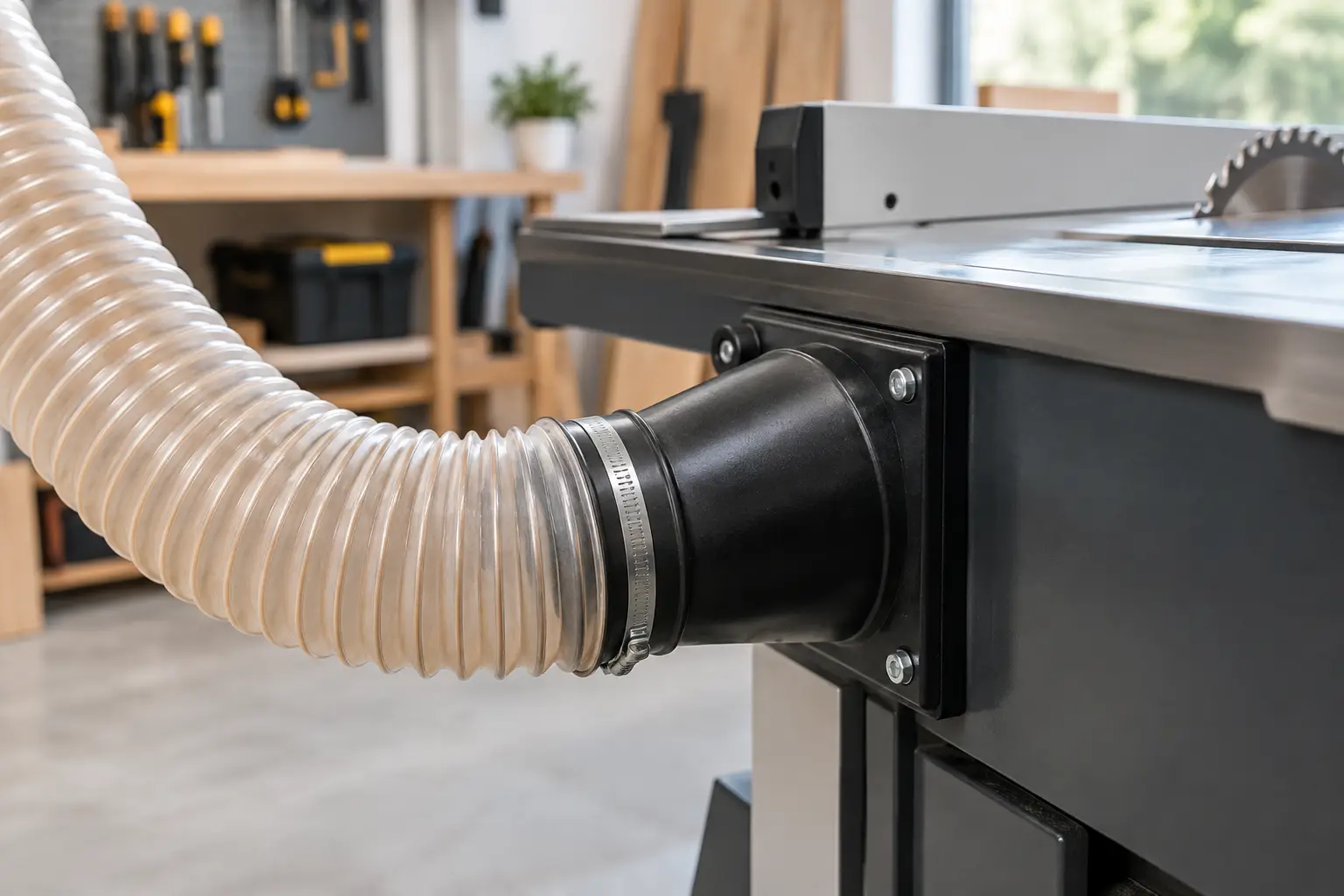
That is why a 4-inch dust inlet matters in a small shop. A 4-inch connection gives a portable dust collector a practical path for moving the volume of air needed by many stationary woodworking machines. It also matches the dust ports found on a wide range of table saws, planers, jointers, band saws, and other shop equipment.
For a one-car garage, this matters because every part of the dust collection system has to work efficiently without taking over the available floor space.
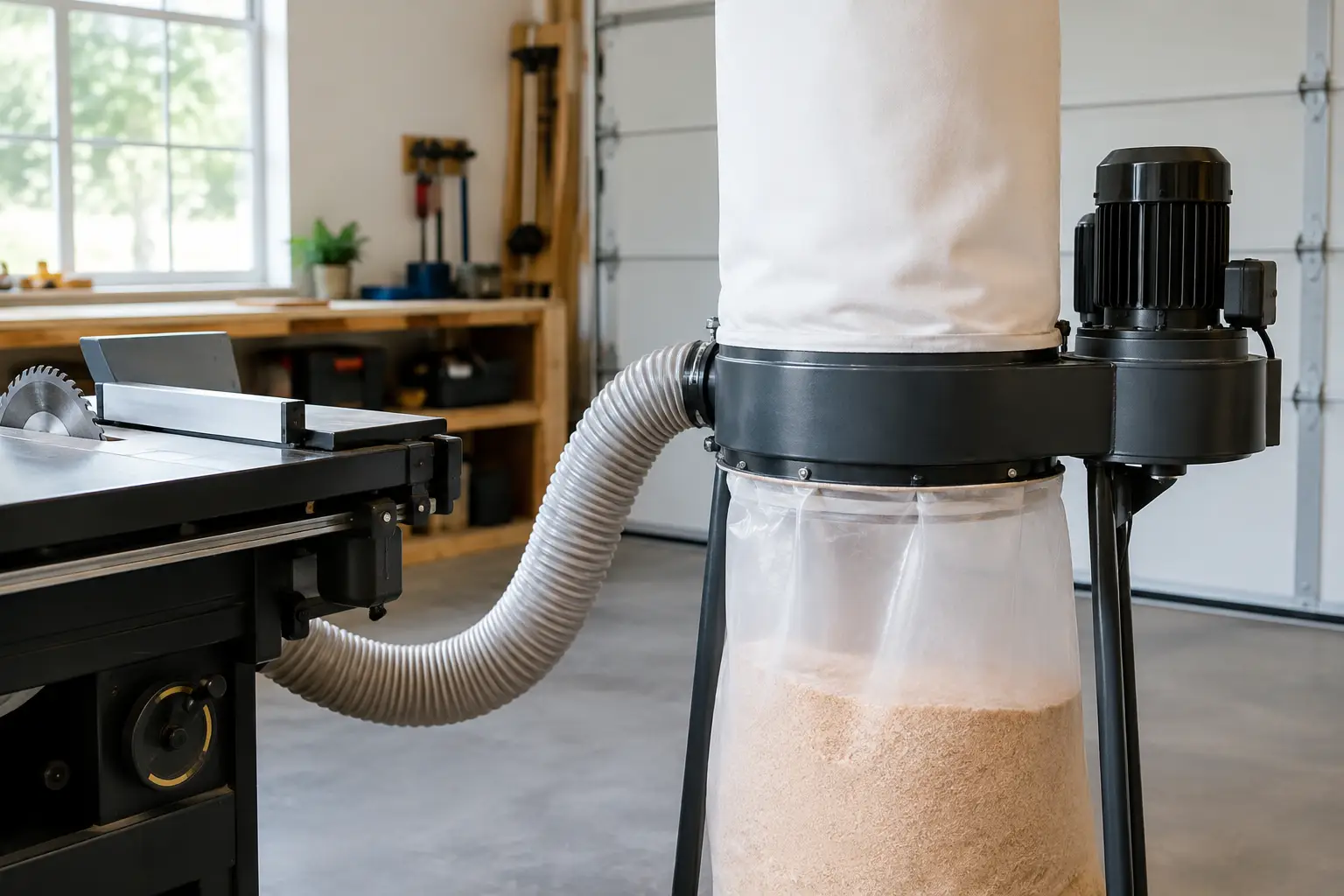
A compact dust collector with a 4-inch inlet can be a practical choice when you use one stationary machine at a time and keep the hose run short. However, a 4-inch inlet is not a guarantee of strong dust collection. The blower, filter, hose, fittings, machine port, and overall system design all determine how much airflow actually reaches the tool.
→ Compare portable dust collectors with 4-inch inlets for a small garage workshop.
Why Is a 4-Inch Dust Inlet Important?
The main reason is simple: larger stationary woodworking machines generally need more airflow than small handheld tools.
A 4-inch round opening has approximately 12.6 square inches of cross-sectional area. A 2-1/2-inch opening has approximately 4.9 square inches.
That means a 4-inch opening has about 2.5 times the cross-sectional area of a 2-1/2-inch opening.
This does not mean a 4-inch hose automatically produces 2.5 times the CFM. Airflow depends on the blower, static pressure, hose construction, fittings, filter, and machine connection.
Still, the larger diameter gives the system a much better starting point for moving the relatively large volume of air needed to transport wood chips and sawdust from stationary machines.
This is where dust collectors differ from typical shop vacuums.
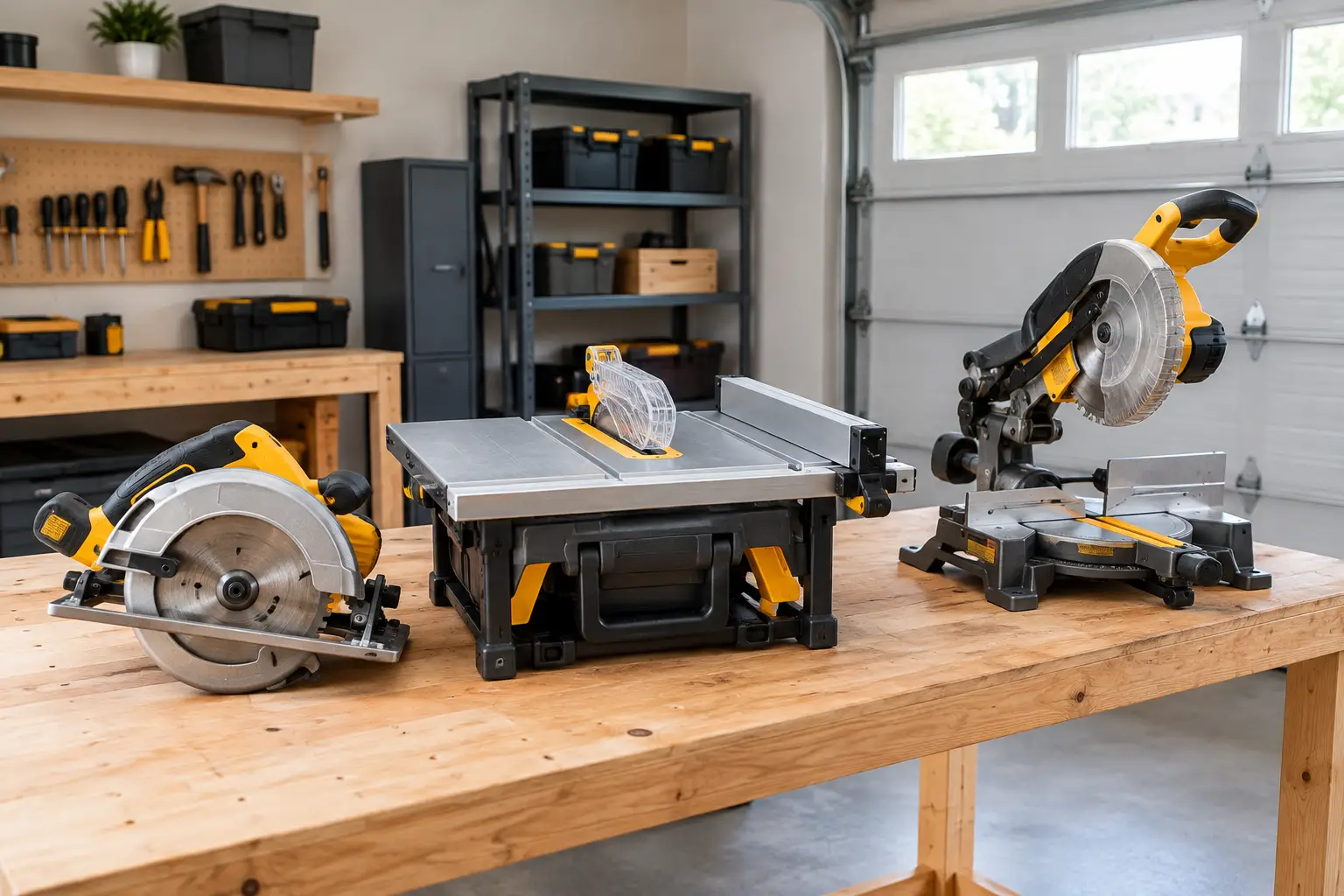
A shop vacuum is designed to generate relatively high suction through a smaller hose. That makes it useful for sanders, routers, track saws, circular saws, and other portable tools with smaller dust ports.
A dedicated dust collector is designed to move a much larger volume of air through a larger hose at lower static pressure.
Neither system is automatically better. They are designed for different jobs.
4 Inches vs. 2-1/2 Inches for Dust Collection
The difference becomes obvious when you compare the physical opening sizes.
| Hose Size | Approx. Cross-Sectional Area | Typical Use |
|---|---|---|
| 1-1/4 inch | 1.2 sq. in. | Small sanders and specialized extractors |
| 2-1/2 inch | 4.9 sq. in. | Shop vacs, sanders, routers, portable tools |
| 4 inch | 12.6 sq. in. | Dust collectors and stationary woodworking machines |
| 5 inch | 19.6 sq. in. | Higher-airflow systems and larger duct runs |
A 2-1/2-inch hose can work very well when the tool is designed around that size. The problem comes when you try to use a small hose for a machine that needs significantly more airflow.
For example, connecting a table saw with a 4-inch dust port to a 2-1/2-inch hose creates substantially more restriction than using a properly sized 4-inch connection.
That does not mean a 2-1/2-inch connection will collect nothing. It means the smaller hose may become the limiting factor, particularly when the system also has a long flexible hose, several bends, a restrictive fitting, or a loaded filter.
For a small garage shop, the practical rule is straightforward:
Use the largest practical hose diameter that matches the collector and the machine, then reduce only where the tool requires it.
Does a 4-Inch Inlet Mean More CFM?
Not necessarily.
This is one of the most important points to understand before buying a dust collector.
A 4-inch inlet is a connection size, not an airflow rating.
Two dust collectors can both have 4-inch inlets and deliver very different real-world performance. One may have a stronger blower, a better impeller, a cleaner filter design, or less internal restriction.
The opposite can also happen. A collector can advertise an impressive maximum CFM figure but lose a substantial amount of airflow once a hose, fittings, filter, and woodworking machine are connected.
That is why free-air CFM should not be treated as the same thing as airflow delivered at the machine.
For a typical 4-inch dust collection connection, airflow in the neighborhood of several hundred CFM is commonly discussed for stationary woodworking applications. Some table-saw guidance places the practical range around 350 to 400 CFM at the 4-inch port, but actual requirements vary with the machine and collection hood.
The important lesson is not to chase a single CFM number.
Instead, look at the complete system.
What Actually Reduces Airflow?
A 4-inch hose can still perform poorly if the rest of the system is restrictive.
Common restrictions include:
- Long flexible hose runs
- Sharp 90-degree bends
- Crushed or kinked hose
- Undersized reducers
- Poorly sealed fittings
- Clogged filters
- Overfilled collection bags or drums
- Poorly designed machine dust ports
- Too many blast gates or unnecessary fittings
- Multiple open branches on a small collector
Flexible hose is especially important because its internal ribbing creates more resistance than a smooth-walled duct.
That does not mean you should eliminate flexible hose completely. In a one-car garage, flexibility is valuable because machines may need to move.
The goal is to use short, practical hose runs and avoid unnecessary bends and loops.
For a deeper look at choosing the correct diameter and length, see our guide to dust collection hose size, length, and fit.
→ Explore dust collection hoses and fittings to build a properly sized 4-inch setup for your shop.
Why a Short 4-Inch Hose Works Better in a Small Garage
A 4-inch connection becomes much more useful when the hose is short.
Imagine a portable dust collector sitting several feet from a table saw. If the hose is only long enough to make that connection comfortably, there is less resistance and less excess material taking up space.
Now compare that with a 20-foot hose stretched across a garage, running around a workbench and through several bends.
The collector may have the same motor, but the system now has more resistance.
This is one reason portable dust collectors make sense in small workshops. Instead of building a permanent duct network, you can move the collector to the machine you are actually using.
For many one-car garages, that is a better compromise than trying to create a full central dust collection system.
What Tools Benefit Most From a 4-Inch Connection?
A 4-inch dust connection makes the most sense for stationary tools that generate a significant amount of chips or dust.
Table Saw
A table saw is one of the most common reasons to choose a 4-inch dust collector.
The blade produces a mixture of fine dust and larger chips, while the cabinet or lower enclosure can accumulate debris quickly.
A 4-inch hose connected to the lower dust port provides substantially more airflow potential than a small shop-vac hose.
However, the lower port is only part of the solution. Some table saws throw dust above the table as well, so an effective setup may require both cabinet collection and an overhead blade guard or other upper dust collection.
A larger hose cannot compensate for a table saw enclosure that allows dust to escape from every opening.
Planer
Planers produce a large volume of wood chips in a short period of time.
This makes airflow particularly important.
A 4-inch connection is common on many woodworking planers, and it provides a practical path for moving chips away from the cutterhead.
However, a 4-inch connection should not automatically be interpreted as meaning that every planer will perform perfectly with every 4-inch collector.
The machine’s recommended airflow, dust-port design, hose length, and collector performance still matter.
For high-volume chip production, some systems benefit from larger ducting upstream of the machine. Woodcraft, for example, describes using 5-inch main ducting to serve larger machines even when those machines have 4-inch dust ports.
Jointer
Jointers are another strong application for a 4-inch dust collection system.
A jointer can produce a surprising amount of chips, especially when removing substantial material from rough lumber.
Some manufacturer documentation recommends a minimum of 400 CFM for certain jointers with a 4-inch dust port, illustrating why simply matching hose diameter is not enough.
If your jointer produces heavy chip loads, pay attention to the collector’s actual airflow capability rather than buying solely because the inlet happens to be 4 inches.
Band Saw
Band saws commonly use 4-inch dust ports, but collection effectiveness varies significantly by machine design.
The blade area is partially exposed, and some dust escapes before it ever reaches the collection port.
A 4-inch hose can provide useful airflow, but enclosure design and the location of the dust port matter just as much.
Miter Saw
Miter saws are particularly difficult because the cutting area is open.
Even a strong dust collector may leave some dust behind if the saw has poor source capture.
A larger hose can help when used with an effective hood or rear collection enclosure, but simply attaching a 4-inch hose to a poorly designed port will not solve the problem.
Our guide to miter saw dust collection in small garages covers the space and capture challenges in more detail.
What About Routers, Sanders, and Handheld Tools?
This is where a 4-inch dust collector can become the wrong tool for the job.
A random-orbit sander typically has a much smaller dust port and generates fine dust close to the sanding surface.
A shop vacuum or dust extractor is usually better suited to that type of tool because it can generate stronger suction through a smaller hose.
The same general idea applies to many handheld routers, track saws, circular saws, and portable sanders.
Do not connect a huge hose simply because your collector has a 4-inch inlet.
The hose should match the tool’s dust port and the type of dust being generated.
A small tool with a small, enclosed dust port can actually perform better with a smaller hose and higher-static-pressure extractor.
4-Inch vs. 5-Inch Dust Collection
If 4 inches is good, should you automatically move to 5 inches?
No.
The answer depends on the collector, machine, and system layout.
A 5-inch duct has approximately 19.6 square inches of cross-sectional area, compared with approximately 12.6 square inches for a 4-inch duct.
That larger diameter can reduce resistance in a properly designed higher-airflow system.
But putting a 5-inch hose on a collector that was designed around a 4-inch outlet does not automatically make the collector perform better.
The blower must be capable of moving enough air to take advantage of the larger duct.
For a typical portable collector in a one-car garage, a properly designed 4-inch connection is often a sensible balance between airflow, portability, storage, and cost.
For a larger central system, a larger main duct can make more sense, with 4-inch branches connecting individual machines.
Avoid the Reducer-at-the-Collector Mistake
One of the easiest ways to create unnecessary restriction is to reduce the hose diameter immediately at the collector.
For example, imagine a collector with a 4-inch inlet connected to a 2-1/2-inch hose for most of the run, followed by a 4-inch machine port.
The collector may have a 4-inch inlet, but most of the system is still restricted by the smaller hose.
A better arrangement is generally to keep the main hose or duct at 4 inches for as much of the run as practical and make the reduction near the tool when the machine requires a smaller connection.
This does not magically increase the airflow through the small machine port. It simply avoids making the entire system smaller than necessary.
The same principle applies in the opposite direction.
If the machine has a larger dust port or the system is designed around larger ductwork, do not assume that every section needs to be reduced to 4 inches simply because 4 inches is a common woodworking connection.
Should You Run Two Machines at Once?
Usually, not with a small portable collector.
A splitter or Y-fitting makes it possible to connect multiple machines, but opening two branches divides the available airflow.
If the collector is only capable of delivering a few hundred CFM under real operating conditions, splitting that airflow between two machines can result in weak collection at both.
This is why many small-shop systems work better as one-machine-at-a-time systems.
Some larger collectors are specifically designed to handle multiple connections. Manufacturers may even provide a way to cap an unused port so that available suction is directed toward the machine being used.
For a compact one-car garage, simplicity is often the better approach.
Connect the collector to the machine you are using, close unused branches, and keep the hose run as short and straight as practical.
The Filter Matters as Much as the Hose
It is easy to focus on the 4-inch inlet and forget what happens after the air enters the collector.
A loaded filter can significantly reduce airflow.
As fine dust accumulates on the filter surface, the collector has to work against greater resistance. The result can be noticeably weaker collection even though the hose and machine connection have not changed.
That is why filter maintenance should be part of your normal workshop routine.
Check the filter regularly, clean it according to the manufacturer’s instructions, and empty the collection bag or drum before it becomes excessively full.
A 4-inch hose connected to a neglected collector is still a poor dust collection system.
What to Look for in a Small-Shop Dust Collector
If you are shopping for a dust collector for a one-car garage, do not stop at the inlet diameter.
Look at these specifications together:
| Feature | What to Look For |
|---|---|
| Inlet size | 4 inches for many stationary woodworking machines |
| Real-world airflow | Look for airflow information beyond free-air CFM when available |
| Motor/blower | Adequate capacity for your largest dust-producing machine |
| Filter | Appropriate filtration with enough surface area |
| Hose compatibility | Standard 4-inch connections if your tools use them |
| Port design | Avoid unnecessary internal restrictions |
| Mobility | Casters or a compact design can be valuable in a small garage |
| Collection capacity | Large enough that you are not constantly stopping to empty it |
| Power requirements | Make sure the collector fits your available electrical circuit |
| Noise | Important when the collector operates close to your work area |
The ideal specification depends on your tools.
A woodworker who primarily uses a table saw and planer has different requirements from someone who spends most of the day sanding small parts.
→ Compare dust collectors, filtration options, and collection capacities before choosing a model for your small garage shop.
The Best 4-Inch Setup for a One-Car Garage
For many small garages, a practical setup looks something like this:
Dust collector → short 4-inch hose → machine dust port
Keep the collector close to the active machine.
Use the shortest hose that allows comfortable movement.
Avoid unnecessary elbows and reducers.
Close unused ports.
Keep the filter clean.
And when the machine has poor built-in dust capture, improve the hood or enclosure rather than assuming a larger collector will solve everything.
This approach keeps the system simple and makes the most of limited garage space.
It also avoids one of the most common mistakes in small workshops: building an elaborate duct system before understanding where the dust is actually escaping.
So, Is a 4-Inch Dust Inlet Worth It?
For a small woodworking shop, a 4-inch dust inlet is often a very useful feature because it matches the connection size used by many stationary woodworking machines and provides a much larger airflow path than a typical 2-1/2-inch shop-vac hose.
But the inlet diameter is only one piece of the system.
A 4-inch inlet cannot compensate for an undersized blower, a clogged filter, a long restrictive hose, poor machine sealing, or an ineffective dust hood.
The best results come when the collector, hose, fittings, machine port, and filter are all working together.
For a one-car garage, that usually means using a portable dust collector with a 4-inch connection, keeping the hose short, running one major machine at a time, and matching smaller tools with a shop vacuum or dust extractor when appropriate.
The goal is not to have the biggest dust inlet possible.
The goal is to move enough air, through the right-sized path, to capture the dust before it spreads throughout your shop.
That is what makes a 4-inch dust inlet valuable in a small shop.

Leave a Reply