
As an Amazon Associate I earn from qualifying purchases.
Choosing between a contractor saw and a jobsite saw for a small garage comes down to more than motor power or rip capacity. You need a machine that fits your available floor space, works with your electrical setup, handles the lumber you actually cut, and leaves enough room to move safely around the blade.
For most one-car garages that still need to park a vehicle, a jobsite table saw is the practical starting point. It can be rolled into position for a project and stored against a wall afterward. A traditional contractor saw makes more sense when woodworking takes priority over parking and you want a heavier table, a more substantial fence, and a stable setup for frequent furniture or cabinet work.
Neither option is automatically more accurate or better for every project. The right choice depends on how often you work, what you cut, and whether your garage needs to function as a workshop, a parking space, or both.
Contractor Saw vs. Jobsite Saw: What’s the Difference?
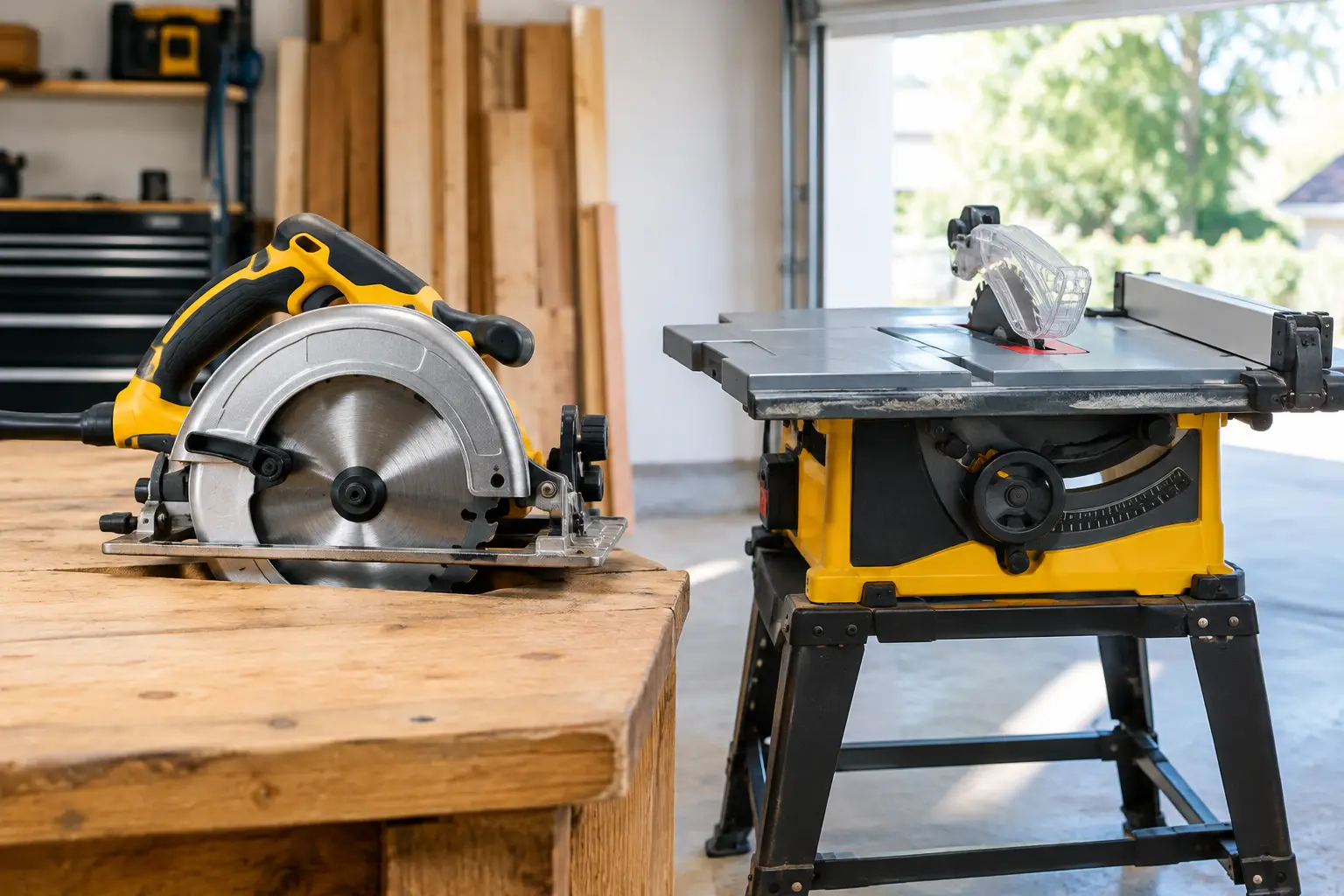
A jobsite table saw is designed to be portable. Most use a compact motor, a lightweight table, and a folding or wheeled stand. Many current models have rack-and-pinion fences that make it easier to set a repeatable cut width without constantly fighting the adjustment.
A traditional contractor table saw is designed primarily for stationary workshop use. It typically has a heavier table, a belt-driven induction motor, and a larger support structure. Many traditional models have cast-iron tables, although the exact design varies by manufacturer.
The terminology can be confusing. Some manufacturers use the contractor label for saws that are lighter or more portable than the traditional design. Hybrid saws also blur the distinction. Before comparing two machines, check their actual construction, weight, motor specifications, and table dimensions rather than relying on the category name alone.
| Workshop factor | Jobsite table saw | Traditional contractor saw | |—|—|—| | Main advantage | Portability and compact storage | Stability and a more substantial work surface | | Typical construction | Lightweight table and portable stand | Heavier table and workshop-oriented base | | Motor design | Commonly a compact universal motor | Traditionally a belt-driven induction motor | | Moving the saw | Usually easier for one person, depending on the model | Often requires a suitable mobile base and careful handling | | Small-garage storage | Easier to fold or park against a wall | Requires a dedicated parking location | | Frequent furniture work | Can work well with proper support and setup | Often more comfortable for repeated, demanding cuts | | Electrical requirements | Many models use standard 120V power | Requirements vary; some models need a different circuit or 240V | | Main compromise | Less mass and a smaller work surface | More floor space, weight, and setup effort |
These are general design differences, not guarantees about every model. A well-adjusted jobsite saw can produce accurate cuts, while a poorly aligned contractor saw can produce disappointing results.
How Much Space Does Each Saw Need in a One-Car Garage?
A portable saw can save storage space, but it does not eliminate the space required to operate a table saw.
You need room to feed material toward the blade, support the workpiece as it exits, stand in a stable position, and move without being forced against a wall or vehicle. Long boards and full plywood sheets can require more room than the saw’s footprint suggests.
When a jobsite saw makes more sense
A jobsite saw is usually the better fit when your garage has to return to parking duty after a woodworking session.
Look for a model with a folding or wheeled stand that can be secured in its operating position and stored without blocking doors, electrical panels, or walking paths. Before buying, measure the saw with its fence rails extended, not just its folded dimensions.
A practical small-garage arrangement might include:
- A designated storage spot along one wall.
- A clear area where the saw can be positioned for cutting.
- A folding outfeed table or properly rated support stand.
- Wall-mounted storage for frequently used tools.
- A separate location for lumber and sheet goods.
The goal is to make setup predictable. If moving the saw takes half the time you have available for woodworking, even a good machine can become frustrating to use.
When a contractor saw makes sense
A traditional contractor saw is easier to justify when your garage is primarily a workshop or when you can dedicate a permanent section of the space to woodworking.
Its additional mass and larger work surface can make repeated cutting operations more comfortable. A suitable mobile base can help you reposition the saw for cleanup or storage, but the machine still needs a clear route and enough room for safe operation.
Do not assume that a mobile base solves every space problem. A heavy saw can be difficult to move over uneven concrete, thresholds, or cluttered floors. Check the base’s load rating and the manufacturer’s instructions before moving the machine.
Do not forget infeed and outfeed clearance
An eight-foot board needs support before and after it passes the blade. Full sheets of plywood are even more difficult to control because they are large, flexible, and awkward to maneuver.
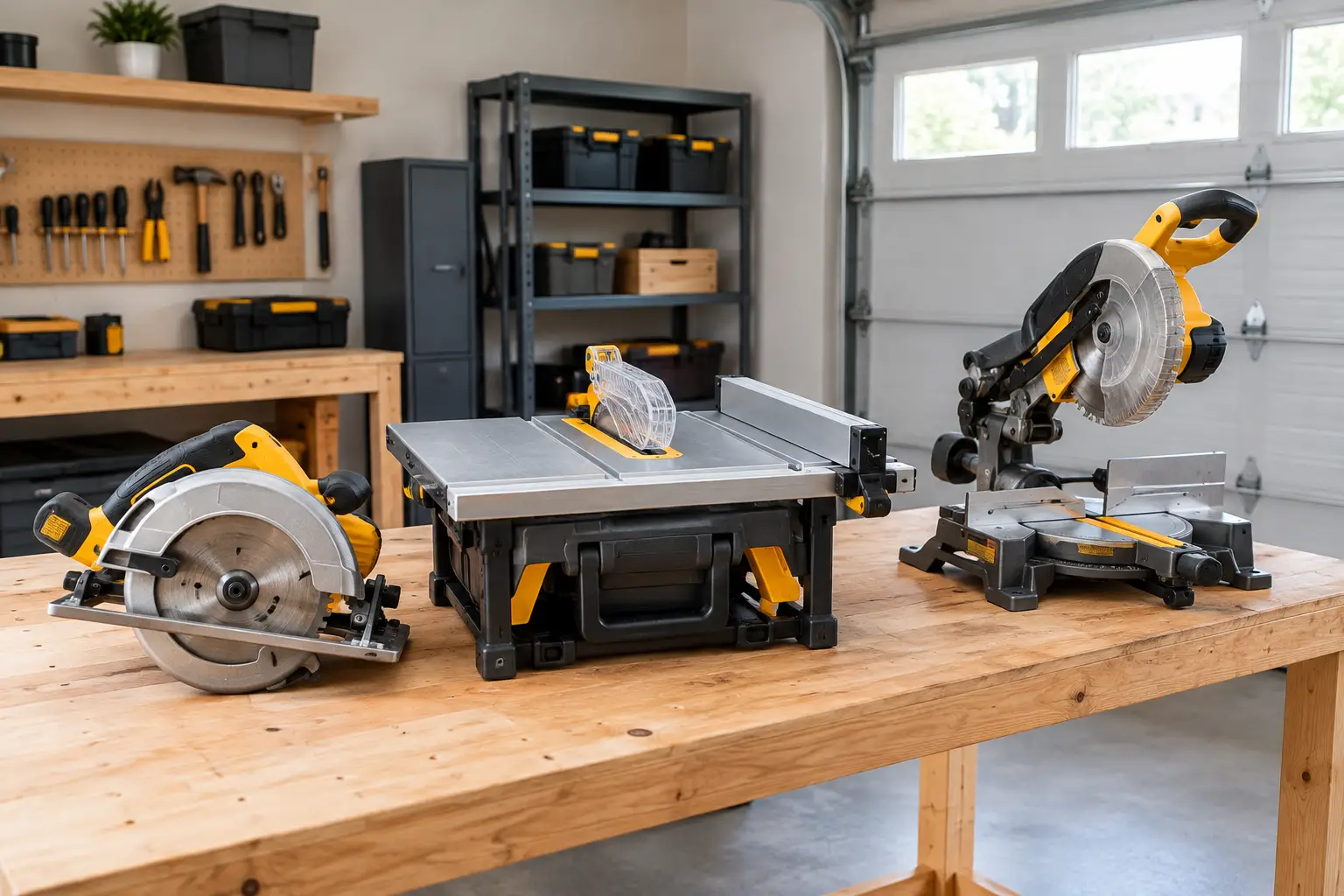
For many small shops, a track saw or circular saw with a suitable guide is a more practical way to break down full sheets before making final cuts on the table saw. Use a stable cutting surface and follow the tool manufacturer’s safety instructions.
This approach reduces the amount of awkward material handling around a compact table saw. It also means you do not have to buy a larger saw simply because you occasionally work with sheet goods.
| Table Saw | Best For | Amazon USA |
|---|---|---|
| DEWALT DWE7491RS | Portable workshop and small garages | Check Price → |
| SKIL TS6307-00 | Budget-friendly portable woodworking | Check Price → |
| SawStop Contractor Saw | Dedicated woodworking shops | Check Price → |
Does a Contractor Saw Make Cleaner and More Accurate Cuts?
A heavier contractor saw can offer advantages, but weight alone does not guarantee accuracy.
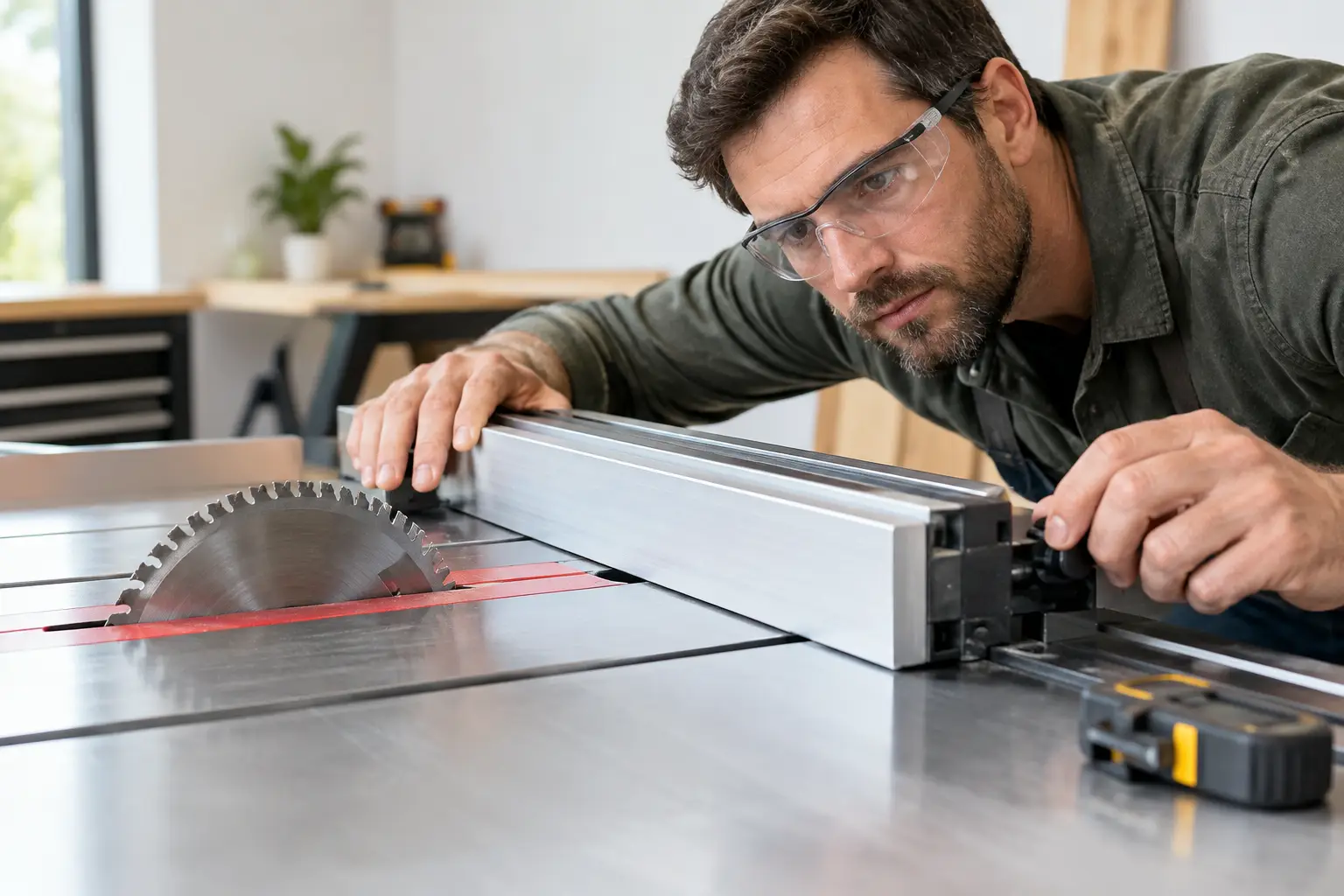
The table, arbor, blade alignment, fence, and workpiece support all affect the result. A good fence that locks securely and stays parallel to the blade is especially important when making repeated rip cuts.
Jobsite saw cut quality
A quality jobsite saw can handle shelving, trim, built-ins, small furniture projects, and many general woodworking tasks. Some models have excellent fence systems and useful rip capacity despite their compact construction.
The limitations become more noticeable when you work with thick hardwood, make long cuts repeatedly, or need to support wide and heavy stock. The smaller table may also require more auxiliary support for jigs and fixtures.
For a small garage, that does not automatically make a jobsite saw the wrong choice. A properly aligned machine with a sharp blade and adequate workpiece support can be more useful than a larger saw that leaves insufficient room to work safely.
Contractor saw cut quality
A traditional contractor saw’s heavier construction can help reduce movement and vibration during operation. Its larger table can also provide a more substantial reference surface for repeated cuts and certain woodworking jigs.
A belt-driven induction motor may handle sustained cutting loads differently from the universal motor used in many portable saws. Actual performance still depends on the motor rating, blade, material, feed rate, and overall machine design.
If you regularly rip hardwood for furniture or make repeated cabinet components, the additional mass and work surface may justify the space requirement.
The blade and fence matter more than many buyers expect
Before spending more money on a heavier saw, consider whether a better blade and a properly adjusted fence would address your current problems.
For hardwood ripping, choose a blade intended for that operation and compatible with the saw. Thin-kerf blades can reduce cutting resistance on machines with limited power, provided the blade is suitable for the material and application.
Check the fence for secure locking and parallel alignment according to the manufacturer’s instructions. Also inspect the blade’s alignment with the miter slots and make sure the table and support surfaces are stable.
These checks help you compare machines on the features that actually affect your work instead of assuming that a more expensive saw automatically produces better results.
Power Requirements: Can You Run a Contractor Saw on 120V?
Electrical compatibility deserves attention before you buy either type of table saw.
Many jobsite saws are designed for 120V household power, but you should confirm the voltage, amperage, plug requirements, and operating instructions for the exact model.
Traditional contractor saws vary. Some can operate on 120V, while other models or configurations require 240V. Never assume that every contractor saw will work with a standard household outlet.
If your garage has only 110–120V power available, shortlist machines that explicitly support the electrical supply you have.
Check the following before purchasing:
- The voltage and current requirements on the machine’s rating plate.
- The manufacturer’s instructions for the required circuit.
- Whether the saw shares a circuit with a shop vacuum, dust collector, heater, or other high-demand equipment.
- The condition and suitability of the outlet, wiring, and extension cord, if one is permitted by the manufacturer.
- Whether the saw’s startup and operating demands are compatible with the available circuit.
A shared circuit can trip under load, interrupting a cut and disrupting dust collection. Do not solve repeated electrical problems by installing a larger breaker without confirming that the wiring and circuit are rated for it. Consult a qualified electrician if the existing setup is uncertain.
For a compact garage with standard household power, a suitable 120V jobsite saw is often the simpler choice. A compatible contractor saw may also work, but its actual electrical requirements should determine whether it belongs on your shortlist.
Dust Collection: Jobsite Saw vs. Contractor Saw
Dust collection can make a major difference in a small garage. Fine wood dust can remain in the air, settle on stored items, and spread into the area where you park your vehicle.
The dust port is only one part of the system. Collection also depends on the blade shroud, openings around the blade, hose diameter, hose length, bends, filter condition, and the collector’s performance under the actual operating conditions.
Dust collection on a jobsite saw
Many jobsite saws use a relatively small dust port designed to connect to a shop vacuum. A shop vacuum can be a practical match for a compact hose and a portable machine, although some dust will escape from openings around the blade and underneath the table.
To improve collection, keep the hose as short and direct as practical, maintain the filter, and make sure connections are secure.
For help planning the hose layout, see this guide to dust collection hose size, length, and fit.
A shop vacuum is not a guarantee of dust-free operation. Consider the saw’s collection design and how much fine dust escapes during your typical cuts.
Dust collection on a contractor saw
Many traditional contractor saws have larger dust ports, sometimes around four inches in diameter. A compatible dust collector may move more air through a suitably designed system, but the result depends on the entire setup rather than port diameter alone.
Open-leg designs can be particularly challenging because dust may escape from the underside and around the blade opening. Some machines can be fitted with additional enclosures or compatible upper blade-guard collection, provided the modifications do not interfere with safe operation.
If you are deciding between a vacuum and a collector, read the comparison of a portable dust collector vs. a shop vac.
You can also learn why a 4-inch dust inlet matters when planning a collection system for workshop machinery.
A realistic dust-control plan for a small garage
For either saw type, start with collection at the source and maintain the equipment regularly. Add suitable respiratory protection when required by the task and the level of exposure, and use appropriate eye protection.
A respirator is not a substitute for effective dust collection. OSHA’s woodworking guidance identifies local exhaust ventilation near the cutting source as a key way to control wood dust. See the OSHA woodworking dust guidance.
The practical objective is to reduce exposure and keep dust under control, not to assume that a single hose connection captures every particle.
Fence Accuracy, Miter Slots, and Workshop Accessories
A table saw’s fence is one of the most important features to evaluate before buying.
A jobsite saw with a well-designed rack-and-pinion fence can be easier to adjust consistently than a poorly designed or poorly maintained fence on a larger machine. Look for a system that locks securely, moves predictably, and remains aligned throughout its usable range.
For either type, check the fence after setup and after moving the saw. Transport, adjustments, and wear can affect alignment.
Miter slots and jigs
Traditional contractor saws often provide a more substantial platform for crosscut sleds, featherboards, and other workshop accessories. However, compatibility depends on the actual miter-slot dimensions and the accessory design.
Do not assume that every table saw uses the same slot size. Check the manufacturer’s specifications before purchasing or building a jig.
A jobsite saw can still support many useful shop-made fixtures. The important questions are whether the accessory fits properly, remains stable, and can be used without compromising the machine’s guards or other safety features.
Safety features to check
Before buying, inspect the supplied blade guard, riving knife or splitter arrangement, anti-kickback features where provided, and the ease of using the machine’s safety equipment.
A riving knife helps keep the kerf from closing against the rear of the blade during compatible operations, reducing the risk of kickback. Keep the blade guard installed for through cuts whenever the operation permits.
Use a push stick or other appropriate device for narrow workpieces, support long material properly, and avoid standing directly in line with the blade where practical. Never reach across a moving blade or attempt to free a binding workpiece while the machine is running.
Follow the owner’s manual for the exact saw. Some cutting operations require different setups, and certain accessories or procedures may not be permitted by the manufacturer.
Which Table Saw Should You Buy for Your Garage?
The best choice depends on how your garage is used and how often you need the saw.
Choose a jobsite saw if you:
- Park a vehicle in the garage most nights.
- Need to move the saw out of the way after each project.
- Work mainly on home repairs, shelving, trim, built-ins, and smaller furniture.
- Have standard 120V power and want a machine designed for that supply.
- Prefer to spend part of your budget on a quality blade, stable supports, and dust collection.
For many one-car garages, this is the most practical starting point. It offers a useful balance of capability and storage flexibility without requiring a permanent workshop layout.
Choose a contractor saw if you:
- Use the garage primarily for woodworking.
- Make furniture or cabinet components frequently.
- Benefit from a heavier table and a more substantial work surface.
- Have a suitable place to keep the saw, even when it is not in use.
- Have verified that the machine’s electrical requirements match your available supply.
A contractor saw can be a worthwhile long-term investment when the extra stability and workspace make a difference in your regular projects. It is less attractive when every square foot of the garage has to serve multiple purposes.
What if your garage is extremely small?
If you have very little space for infeed and outfeed, reconsider the workflow before buying a larger machine.
A compact jobsite saw combined with a track saw or guided circular saw can be a sensible setup for breaking down plywood and preparing smaller parts. Folding work surfaces and wall storage can help you recover floor space between projects.
If you make large furniture components every week, a more substantial saw may still be worth considering. Just make sure you can position the material safely and move around the machine without obstruction.
A Final Checklist Before You Buy
Before choosing between a contractor saw and a jobsite saw, work through this checklist:
- Measure the operating space: Include the stand, fence rails, infeed, outfeed, and the room needed to stand safely.
- Check the storage plan: Know exactly where the saw will go after the project.
- Confirm the electrical supply: Follow the machine’s rating plate and manual rather than relying on the product category.
- Inspect the fence: It should lock securely and adjust predictably.
- Compare the blade and cutting capacity: Make sure the saw suits the material and cut depth you need.
- Plan dust collection: Check the port, hose compatibility, collector requirements, and filter maintenance.
- Review safety equipment: Confirm that guards and other supplied safety components can be installed and used as intended.
- Budget for support equipment: A suitable outfeed support, quality blade, and dust-control equipment may be more valuable than paying extra for capacity you rarely use.
Frequently Asked Questions
Is a jobsite table saw good enough for a one-car garage?
Yes. A good jobsite saw is often the most practical option when a garage must accommodate a vehicle and a woodworking area. Its folding or wheeled stand makes storage easier, while a suitable fence and blade can handle many common DIY and furniture tasks. You still need sufficient clearance and stable support for the material being cut.
Can a jobsite saw make cabinets and furniture?
Yes. Many jobsite saws can handle cabinet components, shelving, and furniture parts when they are properly aligned and used with suitable blades and support. The main limitations are often the available table area, motor performance under sustained load, and the handling of large workpieces. A contractor saw may be more convenient for frequent, demanding shop work.
Is a contractor saw more accurate than a jobsite saw?
Not automatically. A traditional contractor saw’s heavier construction and larger table can help with stability and repeated work, but accuracy also depends on blade alignment, fence quality, table condition, and workpiece support. A well-adjusted jobsite saw can produce accurate cuts, while a poorly maintained contractor saw can still cut inaccurately.
Can I run a contractor table saw on 120V power?
Some models support 120V, while others require 240V or have specific electrical requirements. Check the exact model’s rating plate and manual before buying. Also confirm that the available circuit is suitable for the saw and other equipment you intend to run. Never assume that all contractor saws can use a standard household outlet.
Is a four-inch dust port always better than a shop-vac connection?
No. A larger port may suit a dust collector, but actual collection depends on airflow, system resistance, the machine’s internal design, and the openings around the blade. A shop vacuum can work well with a compact hose and a compatible jobsite saw. Choose the collection system according to the saw’s design and the manufacturer’s recommendations.
Should I buy a contractor saw if I want to upgrade later?
Only if the additional workspace, weight, and electrical requirements fit your long-term plans. A contractor saw may be a good choice for a garage dedicated to woodworking, but it is not automatically the best upgrade for a shared space. If portability will remain essential, a higher-quality jobsite saw may serve you better for years.
The Bottom Line
For most small garages that need to serve more than one purpose, a jobsite table saw offers the best balance of portability, useful cutting capacity, and manageable storage. It is particularly attractive when you park a car in the same space and rely on standard 120V power.
A traditional contractor saw is worth the extra space when woodworking is a regular priority and the heavier table, larger work surface, and shop-oriented design support the work you do most often.
Measure the space, confirm the electrical requirements, plan dust collection, and evaluate the fence before deciding. The best saw is the one that fits your actual projects and lets you work safely without turning every session into a garage rearrangement.


Leave a Reply